

CHEMISTRY - EMPIRICAL AND MOLECULAR FORMULAE
Percent Composition Worksheet
- 10 questions
- Difficulty: Hard
- Board: CAIE
- Attempt online on the examination portal
Start the 10-question quiz
Free, no sign-up needed. Your score shows instantly.
Here are the first 3 questions. Click “View all questions” to see the complete assessment.
Q1.
Q2.
A dry mixture contains 10.6 g of sodium carbonate, Na₂CO₃, and 16.8 g of sodium hydrogencarbonate, NaHCO₃. What is the percentage by mass of sodium in the mixture, to one decimal place? Use relative atomic masses: H = 1, C = 12, O = 16 and Na = 23.
Q3.
A fertiliser consists of 85.0% ammonium sulfate, (NH₄)₂SO₄, by mass. The remaining material contains no nitrogen. What mass of nitrogen is present in a 250 g bag of this fertiliser? Use relative atomic masses: H = 1, N = 14, O = 16 and S = 32.
Q4.
A 4.50 g sample of a compound containing only carbon, hydrogen and oxygen is completely burned in excess oxygen. It produces 6.60 g of carbon dioxide and 2.70 g of water. What is the percentage by mass of oxygen in the original compound? Use relative atomic masses: H = 1, C = 12 and O = 16.
Q5.
A 12.0 g sample contains magnesium carbonate and an impurity that contains no magnesium. On strong heating, all the magnesium carbonate decomposes according to MgCO₃ → MgO + CO₂. The impurity remains unchanged, and the final solid has a mass of 7.60 g. What was the percentage by mass of magnesium in the original sample? Use relative atomic masses: C = 12, O = 16 and Mg = 24.
Q6.
A manufacturer mixes pure urea, CO(NH₂)₂, with pure ammonium nitrate, NH₄NO₃. The mixture must contain 42.0% nitrogen by mass. What percentage by mass of the mixture must be urea? Use relative atomic masses: H = 1, C = 12, N = 14 and O = 16.
Q7.
A metal sulfate has the formula X₂(SO₄)₃ and contains 28.0% of metal X by mass. What is the relative atomic mass of X? Use relative atomic masses: O = 16 and S = 32.
Q8.
A phosphate rock contains 75.0% calcium phosphate, Ca₃(PO₄)₂, by mass. Its other components contain no phosphorus. What mass of this rock contains 9.30 g of phosphorus? Use relative atomic masses: O = 16, P = 31 and Ca = 40.
Q9.
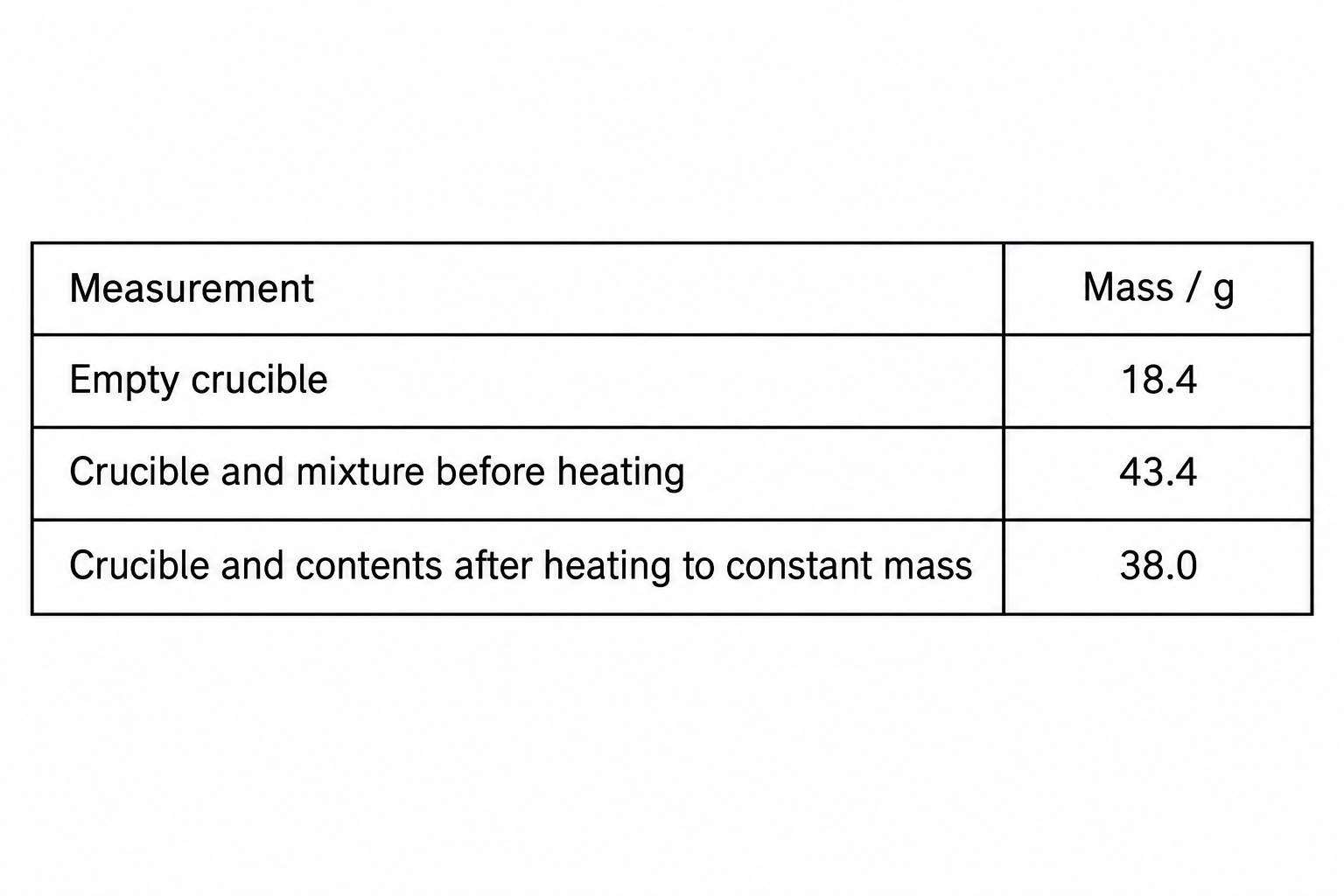
The table shows results for heating a mixture of CuSO₄·5H₂O and dry sand in a crucible. Heating removes all the water of crystallisation, leaving anhydrous CuSO₄ and unchanged sand. No other substance is lost. What was the percentage by mass of copper in the original mixture? Use relative atomic masses: H = 1, O = 16, S = 32 and Cu = 64.
Q10.
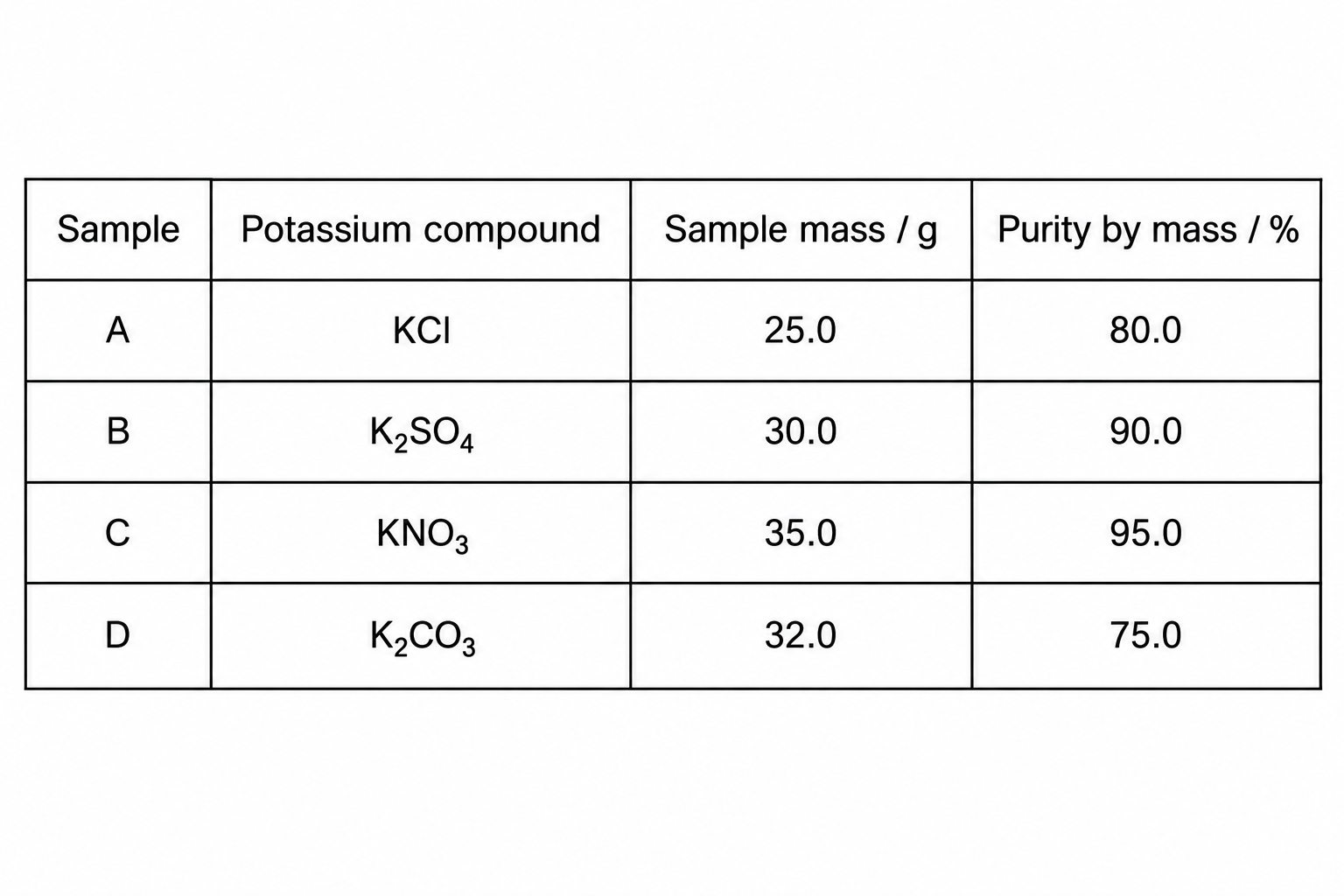
Four samples of potassium-containing products are described in the table. In each sample, the impurities contain no potassium. Which sample contains the greatest mass of potassium? Use relative atomic masses: C = 12, N = 14, O = 16, S = 32, Cl = 35.5 and K = 39.
What this assessment covers
Concepts Tested
- Empirical and Molecular Formulae
Question Mix
- Hard questions included
Skills you build
- Apply
Related assessments
More practice
Other assessments in this subject
