

CHEMISTRY - CHEMICAL EQUILIBRIUM

Le Chatelier Principle Worksheet

  • 10 questions
  • Difficulty: Easy
  • Board: CAIE
  • Attempt online on the examination portal
Start the 10-question quiz Free, no sign-up needed. Your score shows instantly.

Here are the first 3 questions. Click “View all questions” to see the complete assessment.

Q1.

Which statement expresses Le Chatelier’s principle?

  1. A) An equilibrium shifts to oppose an imposed change.
  2. B) An equilibrium always shifts towards the reactants.
  3. C) An equilibrium shifts to increase an imposed change.
  4. D) An equilibrium always shifts towards the products.

Q2.

What is the usual effect of increasing the concentration of a reactant in a mixture at equilibrium?

  1. A) Both the forward and reverse reactions stop.
  2. B) The equilibrium shifts to use up some of the added reactant.
  3. C) The reversible reaction becomes irreversible.
  4. D) The equilibrium shifts to produce more of the added reactant.

Q3.

Some product is removed from a mixture at equilibrium. How does the equilibrium respond?

  1. A) It converts all the remaining reactants into product.
  2. B) It shifts to replace some of the removed product.
  3. C) It shifts to remove the remaining product.
  4. D) It stops responding to changes in concentration.

Q4.

A gaseous equilibrium has the same total number of moles of gas on each side of its equation. What happens to its equilibrium position when pressure is increased at constant temperature?

  1. A) It alternates between favouring reactants and products.
  2. B) It shifts towards the products.
  3. C) It remains unchanged.
  4. D) It shifts towards the reactants.

Q5.

Which statement describes the effect of adding a catalyst to a reversible reaction?

  1. A) It allows equilibrium to be reached faster without changing its position.
  2. B) It prevents the reverse reaction from taking place.
  3. C) It shifts the equilibrium towards the reactants.
  4. D) It increases the equilibrium yield of products.

Q6.

Which type of reaction is favoured when the temperature of an equilibrium mixture is increased?

  1. A) The reaction that produces more gas molecules.
  2. B) The endothermic reaction.
  3. C) The reaction that produces fewer gas molecules.
  4. D) The exothermic reaction.

Q7.

Which information from a balanced equation is needed to predict the effect of a pressure change on a gaseous equilibrium?

  1. A) The relative formula masses of the gases.
  2. B) The numbers of atoms in individual gas molecules.
  3. C) The boiling points of the gases.
  4. D) The total numbers of moles of gas on the two sides.

Q8.

Reactants are written on the left of an equilibrium equation and products on the right. What is meant by saying that the equilibrium position shifts to the right?

  1. A) The equilibrium mixture contains a greater proportion of products.
  2. B) The products physically move to the right side of the container.
  3. C) The reverse reaction stops permanently.
  4. D) The equilibrium mixture contains a greater proportion of reactants.

Q9.

The diagram shows a gaseous equilibrium mixture being compressed at constant temperature. Which general rule describes the effect of this pressure increase?
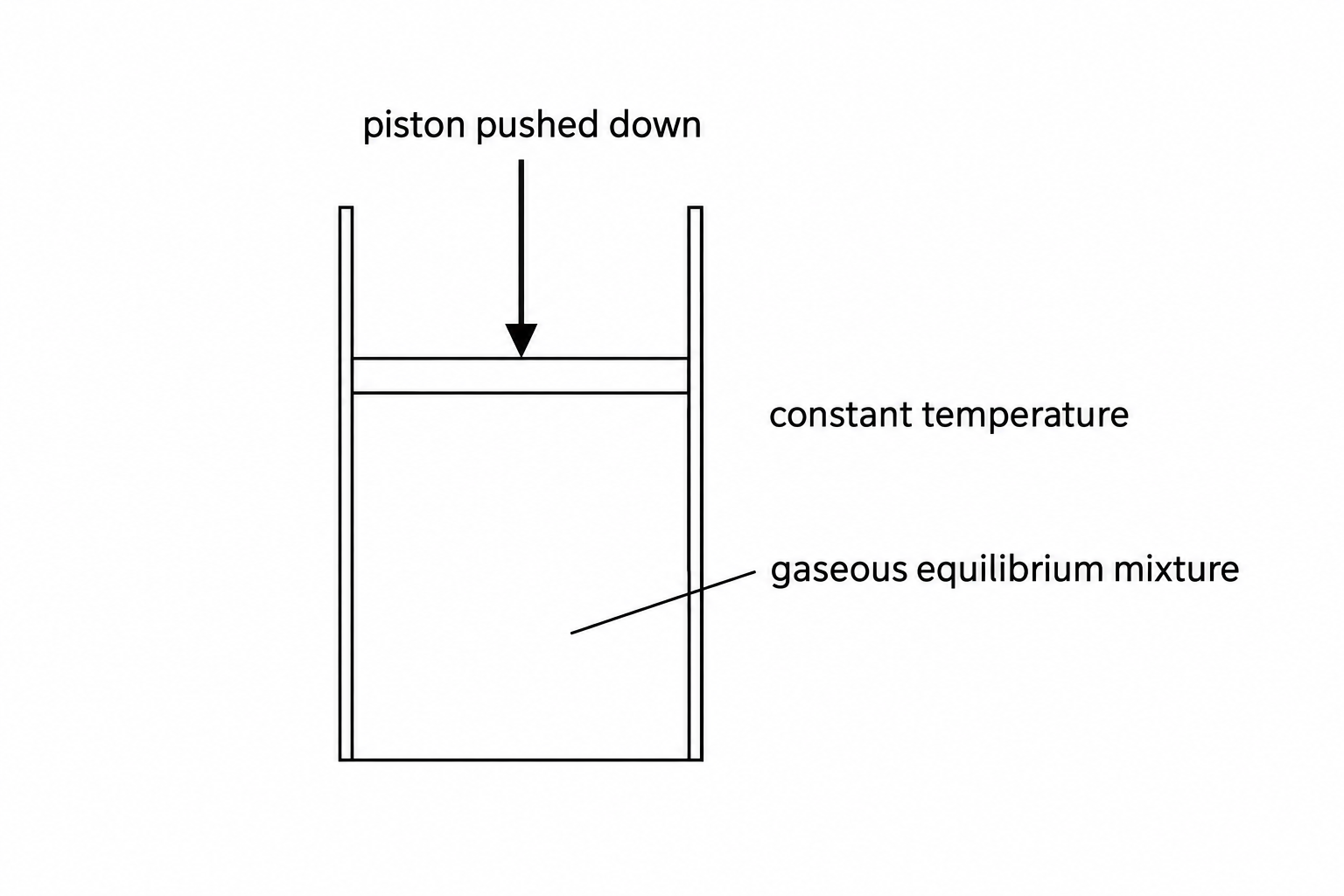
Diagram for question 9: The diagram shows a gaseous equilibrium mixture being compressed at constant temperature. Which general rule…
  1. A) The endothermic direction is always favoured.
  2. B) The product side is always favoured.
  3. C) The side with more moles of gas is favoured.
  4. D) The side with fewer moles of gas is favoured.

Q10.

The diagram identifies the energy changes of a reversible reaction. Which labelled direction is favoured when the equilibrium mixture is cooled?
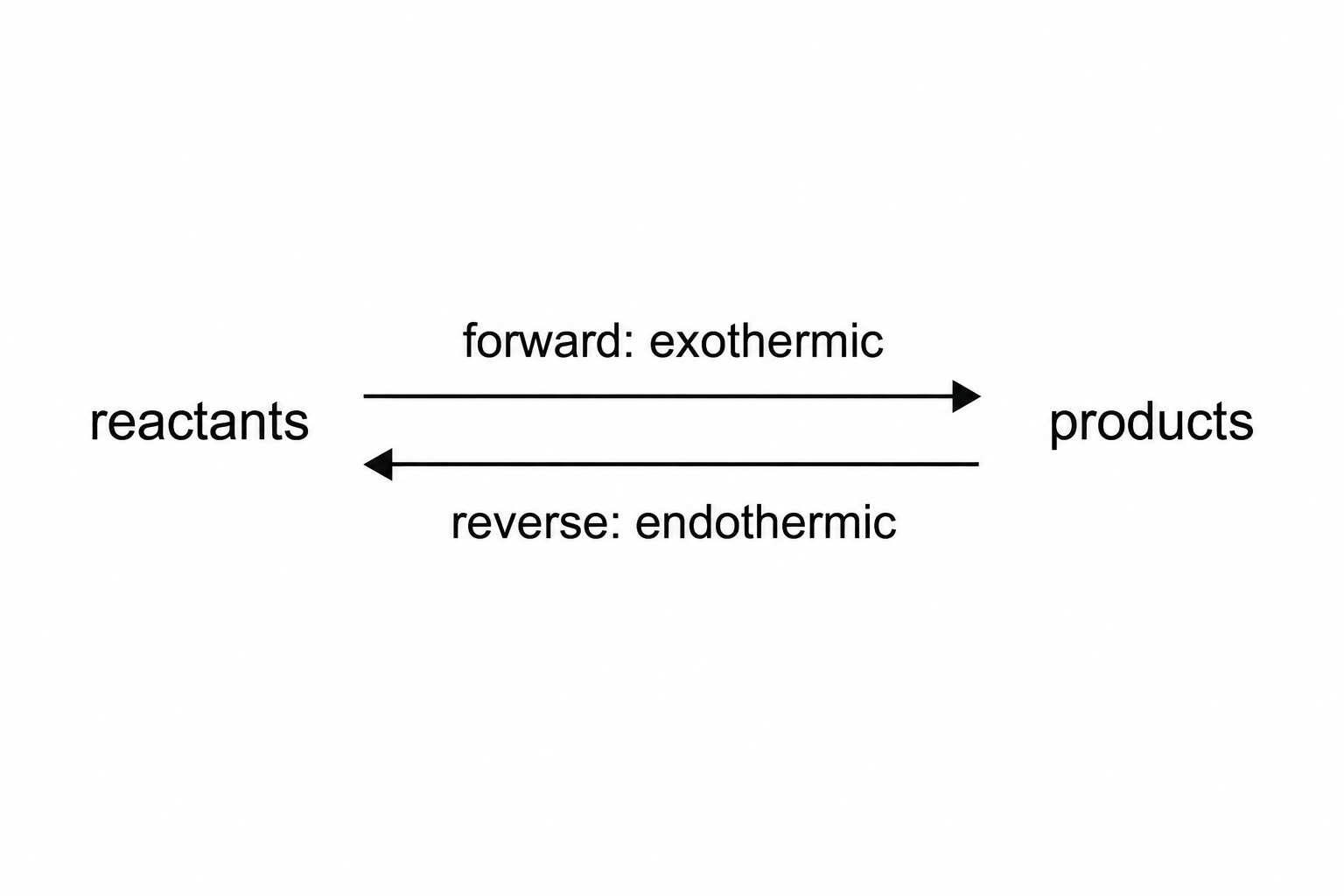
Diagram for question 10: The diagram identifies the energy changes of a reversible reaction. Which labelled direction is favoured…
  1. A) Both directions equally, so temperature cannot change the equilibrium position.
  2. B) Neither direction, because cooling stops reversible reactions.
  3. C) The reverse direction, because it absorbs energy.
  4. D) The forward direction, because it releases energy.

What this assessment covers

Concepts Tested

  • Chemical Equilibrium

Question Mix

  • Easy questions included

Skills you build

  • Remember