

BIOLOGY - PEDIGREES

Pedigrees Worksheet

  • 10 questions
  • Interpret pedigree diagrams for the inheritance of a given characteristic
  • Difficulty: Medium
  • Board: CAIE
  • Attempt online on the examination portal
Start the 10-question quiz Free, no sign-up needed. Your score shows instantly.

Here are the first 3 questions. Click “View all questions” to see the complete assessment.

Q1.

A pedigree records two parents who do not show a characteristic. They have a daughter who shows the characteristic and a son who does not. The characteristic is controlled by one autosomal gene. Assuming no new mutation has occurred, what does this pedigree show about the allele responsible for the characteristic?

  1. A) It is dominant, and both parents are heterozygous.
  2. B) It is recessive, and only the mother is a carrier.
  3. C) It is dominant, and only the father carries it.
  4. D) It is recessive, and both parents are carriers.

Q2.

In a pedigree, a father shows an autosomal dominant characteristic and the mother does not. Their children include one affected child and one unaffected child. Which description of the father's genotype is supported by this pedigree?

  1. A) He is homozygous dominant because he shows the characteristic.
  2. B) He is homozygous recessive because he has an unaffected child.
  3. C) He could be either homozygous dominant or heterozygous.
  4. D) He is heterozygous because he has passed on a recessive allele.

Q3.

A pedigree shows a father with an X-linked recessive condition and a mother who neither has the condition nor carries its allele. They have an unaffected daughter. Which statement correctly interprets the daughter's place in this pedigree?

  1. A) She must have inherited the condition allele from her mother.
  2. B) She cannot carry the allele because she is unaffected.
  3. C) She is a carrier because she inherited her father's X chromosome.
  4. D) She inherited the condition allele on her father's Y chromosome.

Q4.

A pedigree shows two unaffected parents with a son who has an autosomal recessive condition and a daughter who does not. What can be concluded about the daughter's genotype from this information alone?

  1. A) She must be heterozygous.
  2. B) She may be homozygous for the normal allele or heterozygous.
  3. C) She must be homozygous for the condition allele.
  4. D) She must be homozygous for the normal allele.

Q5.

In a pedigree for an X-linked recessive condition, an affected mother and an unaffected father have two affected sons. Why is the occurrence of the condition in both sons consistent with this inheritance pattern?

  1. A) Each son must inherit the condition allele from both parents to be affected.
  2. B) Each son inherits a Y chromosome carrying the condition allele from his mother.
  3. C) Each son inherits his father's X chromosome carrying the condition allele.
  4. D) Each son inherits an X chromosome carrying the condition allele from his mother.

Q6.

A pedigree shows an affected father, an unaffected mother and their affected son. Assume that there are no new mutations and that an individual with a dominant condition allele always shows the condition. Which inheritance pattern is inconsistent with this family?

  1. A) Autosomal dominant inheritance
  2. B) Autosomal recessive inheritance
  3. C) X-linked dominant inheritance
  4. D) X-linked recessive inheritance

Q7.

A three-generation pedigree follows an autosomal recessive condition. An affected man has an unaffected daughter. This daughter later has an unaffected son with another affected man. Which conclusion about the daughter and her son is certain?

  1. A) Only the son is a carrier; his mother has two normal alleles.
  2. B) Only the daughter is a carrier; her son has two normal alleles.
  3. C) Neither the daughter nor her son carries the condition allele.
  4. D) Both the daughter and her son are carriers.

Q8.

The pedigree shows the occurrence of an inherited characteristic in a family. Which affected individual is the maternal aunt of individual III-1?
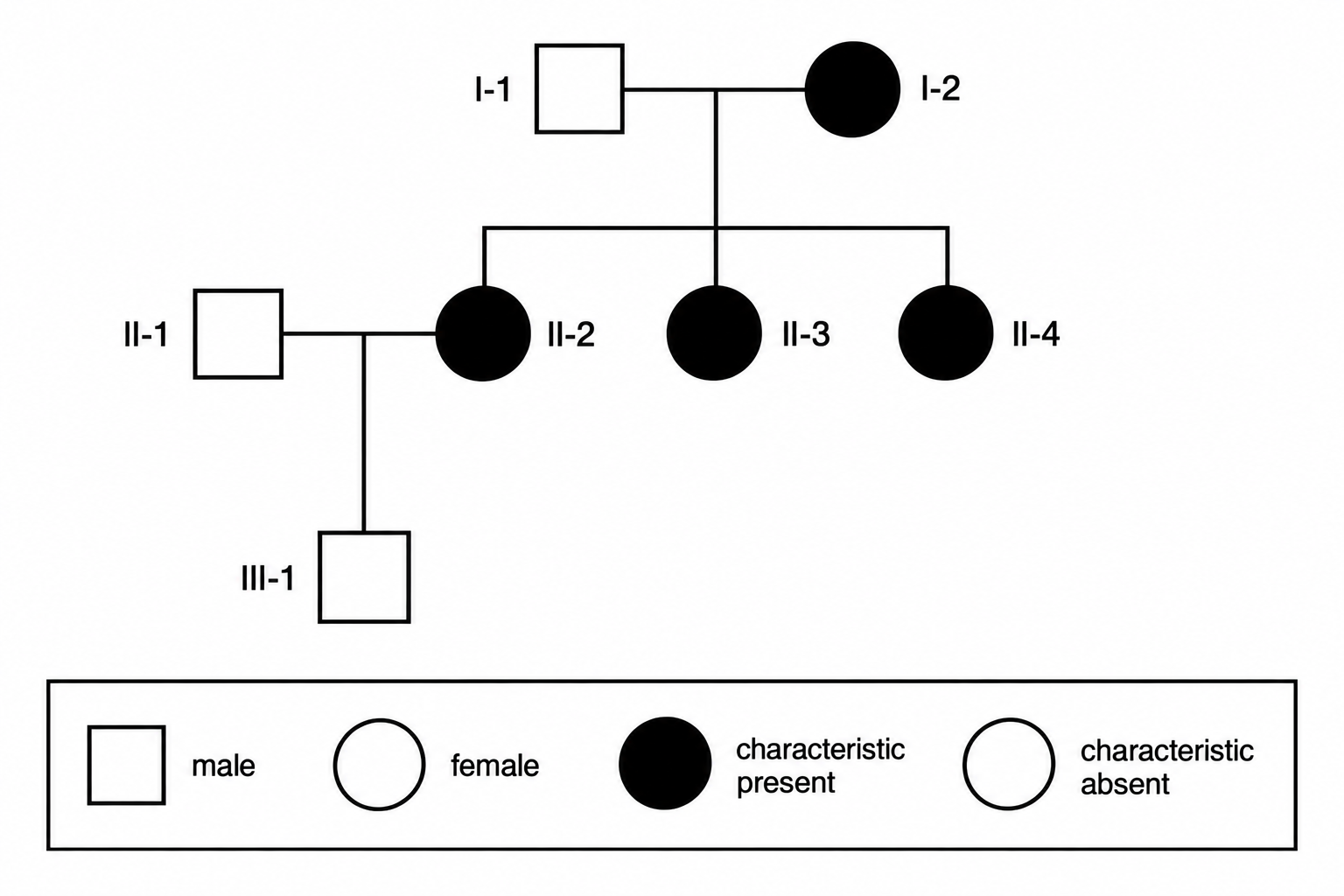
Diagram for question 8: The pedigree shows the occurrence of an inherited characteristic in a family. Which affected individual is…
  1. A) Individual I-2
  2. B) Individual II-2
  3. C) Individual II-4
  4. D) Individual II-3

Q9.

The characteristic in this pedigree is controlled by one autosomal gene. Assume that there are no new mutations. Which interpretation is supported by the pedigree?
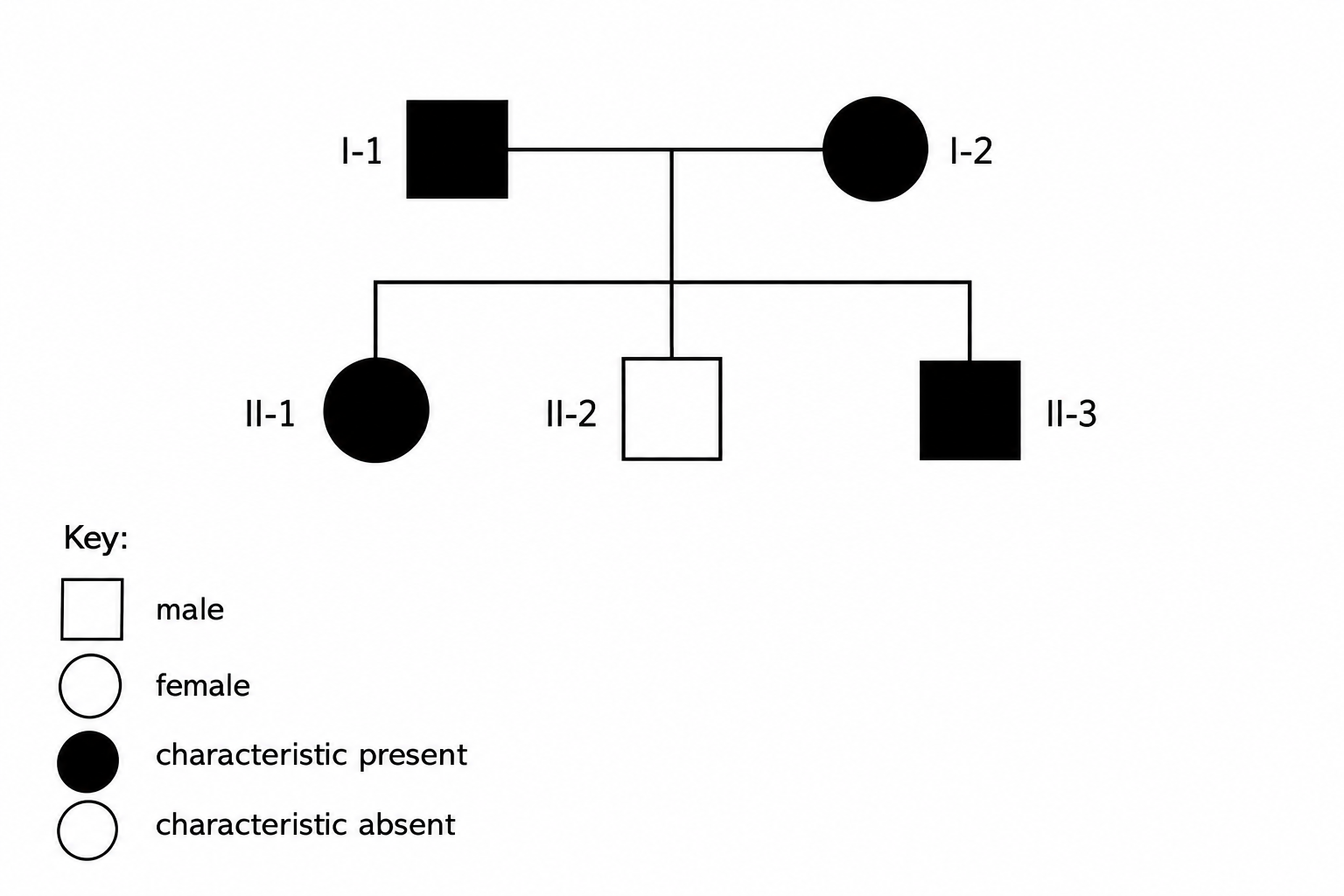
Diagram for question 9: The characteristic in this pedigree is controlled by one autosomal gene. Assume that there are no new…
  1. A) The characteristic is recessive because the unaffected child must be a carrier.
  2. B) The characteristic is dominant because only males can show it.
  3. C) The characteristic is recessive because both parents show it.
  4. D) The characteristic is dominant because two affected parents have an unaffected child.

Q10.

The pedigree shows an X-linked recessive condition. Through which route was the condition allele passed from individual I-1 to individual III-1?
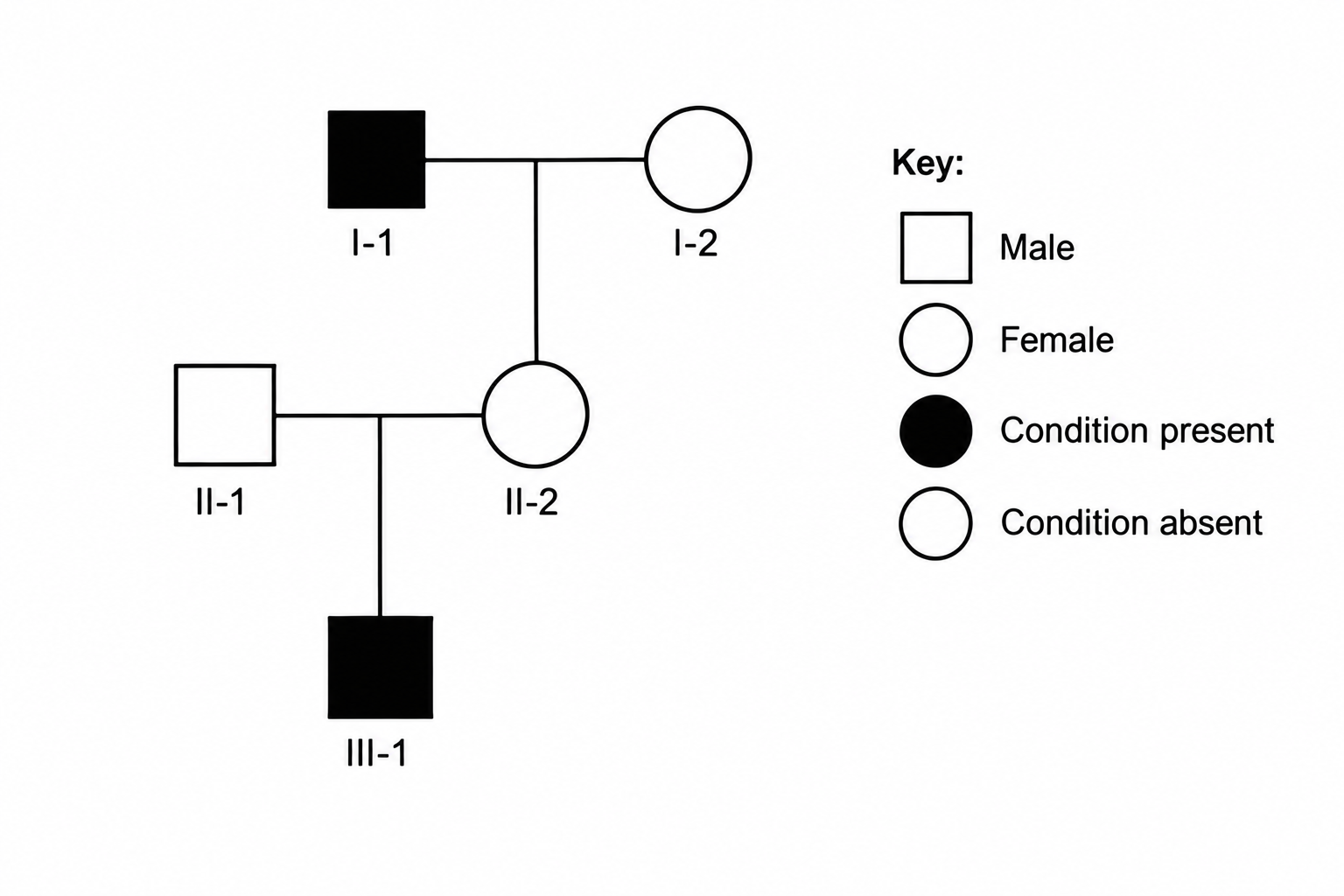
Diagram for question 10: The pedigree shows an X-linked recessive condition. Through which route was the condition allele passed from…
  1. A) From I-1 directly to III-1, without passing through generation II
  2. B) From I-1 to II-1 on an X chromosome, then to III-1 on a Y chromosome
  3. C) From I-1 to II-2 on an X chromosome, then to III-1 on an X chromosome
  4. D) From I-1 to II-2 on a Y chromosome, then to III-1 on an X chromosome

What this assessment covers

Concepts Tested

  • Pedigrees
  • Interpret pedigree diagrams for the inheritance of a given characteristic

Question Mix

  • Medium questions included

Skills you build

  • Understand