

MATHEMATICS - PARALLEL LINES AND TRANSVERSALS
Corresponding Angles Worksheet
- Focuses on identifying corresponding angles in parallel line scenarios
- Includes problems on calculating unknown angles using given relationships
- Covers geometric terms related to angles and lines
- Medium difficulty
Start the 10-question quiz
Free, no sign-up needed. Your score shows instantly.
Here are the first 3 questions. Click “View all questions” to see the complete assessment.
Q1.
Q2.
Parallel lines a and b are crossed by a transversal. An angle at line a is 64^(\)circ. What is the size of the corresponding angle at line b?
Q3.
Two parallel lines are crossed by a transversal. Angle A is 117^(\)circ. Angle B is vertically opposite to angle A. At the other intersection, angle C corresponds to angle B. What is the size of angle C?
Q4.
Two parallel lines are cut by a transversal. Which statement is not always true?
Q5.
At the intersection of two straight lines, angle K and angle L are directly opposite each other and do not share a side. Which geometric term describes this pair?
Q6.
Two corresponding angles formed by a transversal crossing parallel lines are (3x + 14 )^(\)circ and (5x − 22 )^(\)circ. What is the value of x?
Q7.
A transversal crosses two parallel lines. One interior angle is 38^(\)circ. What is the size of the interior angle on the same side of the transversal?
Q8.
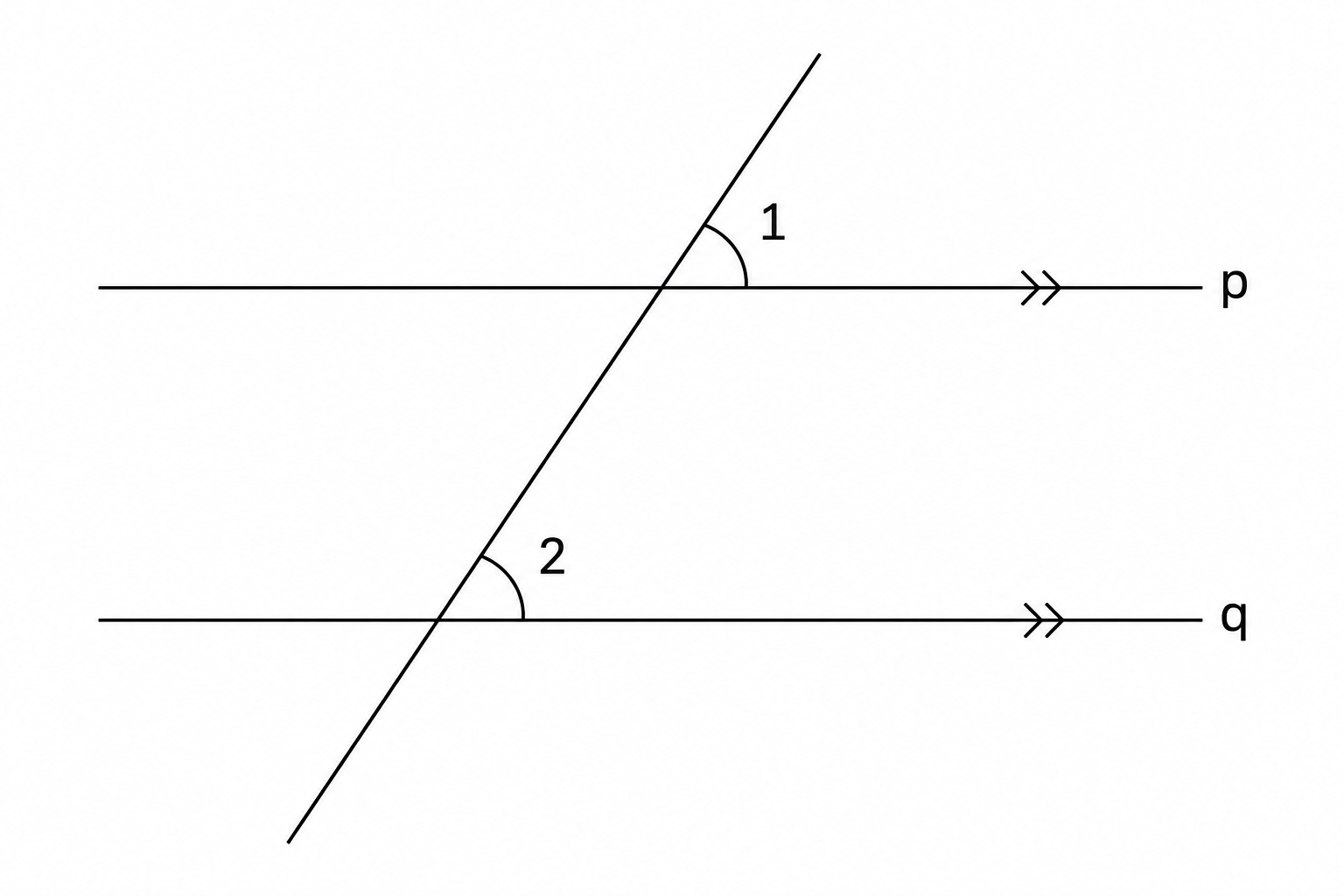
Which geometric term describes the relationship between angle 1 and angle 2 in the diagram?
Q9.
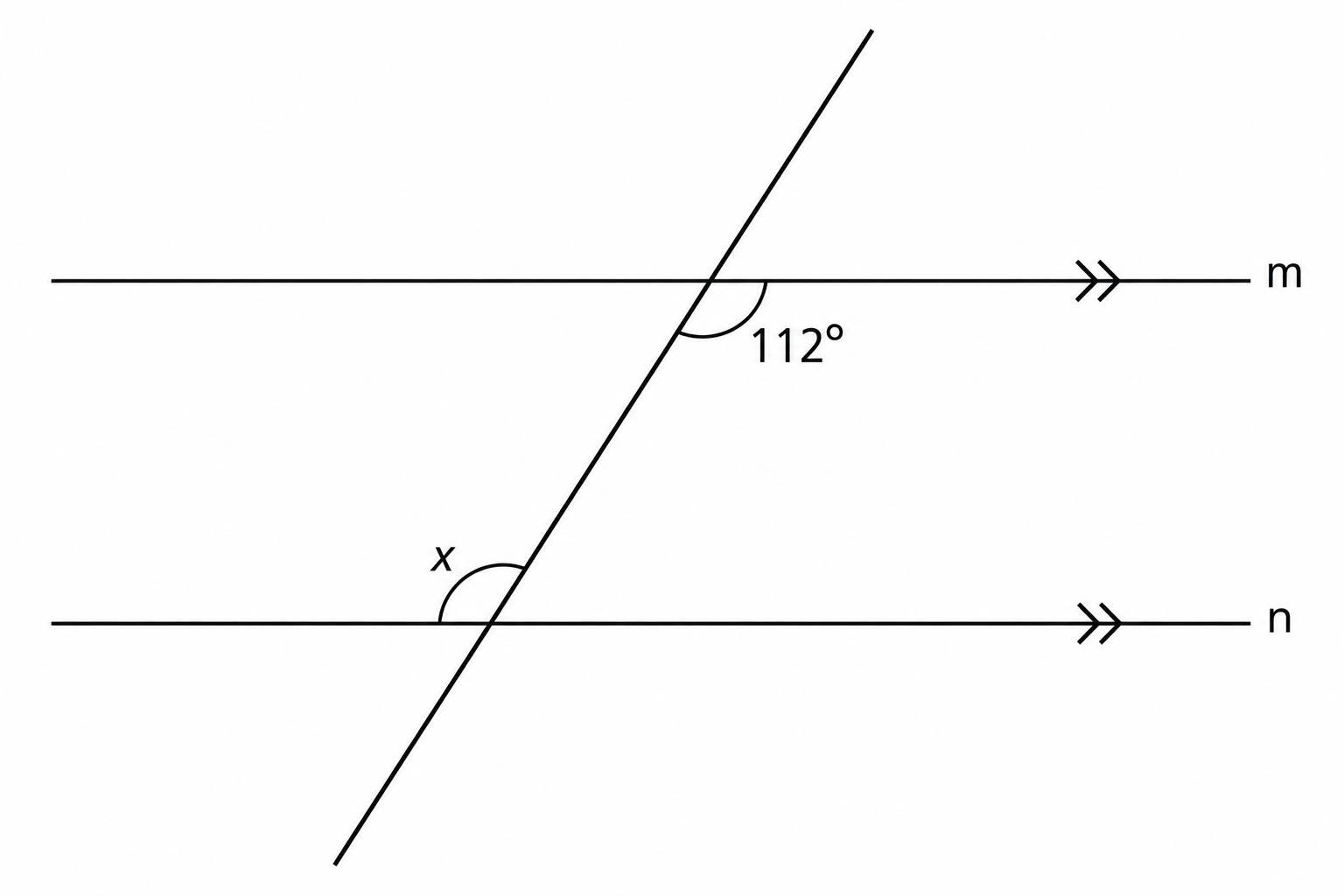
The lines m and n are parallel. Use the angle relationship shown to find x.
Q10.
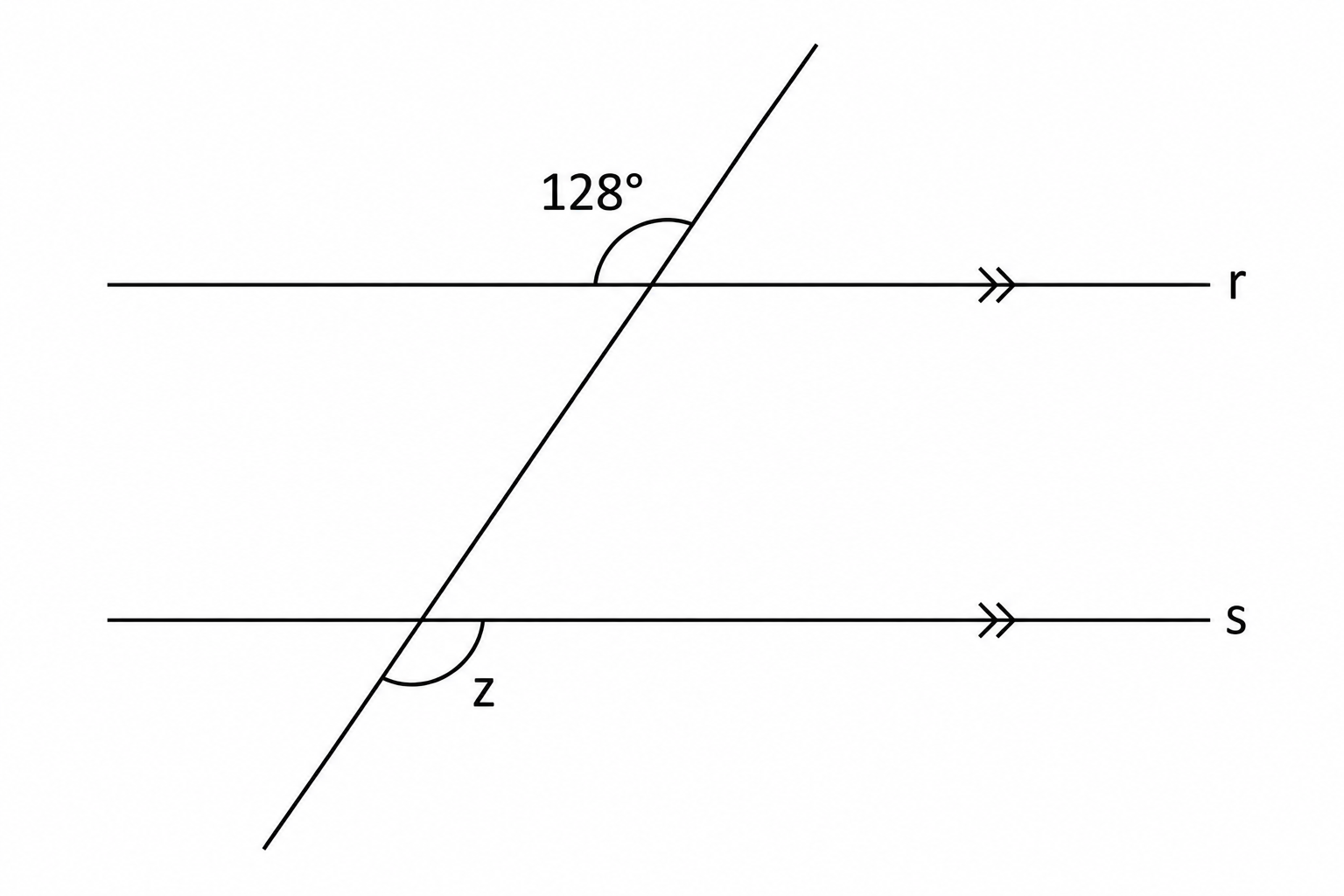
Lines r and s are parallel. Which option gives a valid sequence of angle properties and the correct value of z?
What this assessment covers
Concepts tested
- Corresponding angles in parallel lines
- Vertical angles and their properties
- Angle relationships in transversal intersections
- Geometric terms for angle pairs
- Calculating angles using algebraic expressions
Question Mix
- Medium questions included
Skills you build
- Identify corresponding angles in diagrams
- Calculate unknown angles using given angle measures
- Apply properties of vertical angles
- Use algebra to solve for unknown variables in angle expressions
- Recognize and describe geometric relationships between angles
Related assessments
More practice
Other assessments in this subject
