

MATHEMATICS - PARALLEL LINES AND TRANSVERSALS

Alternate Interior Angles Worksheet

  • Focuses on identifying and describing relationships between angles formed by parallel lines and a transversal
  • Includes questions on alternate interior angles and their properties
  • Covers the concept of same-side interior angles and their measurements
  • Tests understanding of angle relationships in intersecting lines
Start the 10-question quiz Free, no sign-up needed. Your score shows instantly.

Here are the first 3 questions. Click “View all questions” to see the complete assessment.

Q1.

Parallel lines p and q are cut by a transversal. Angle A lies between the parallel lines on the left of the transversal. Angle B lies between the parallel lines on the right of the transversal and is at the other intersection. Which term describes angles A and B?

  1. A) Vertically opposite angles
  2. B) Corresponding angles
  3. C) Alternate interior angles
  4. D) Same-side interior angles

Q2.

Two parallel lines are crossed by a transversal. Angle C is above its parallel line and to the right of the transversal. At the other intersection, angle D is also above its parallel line and to the right of the transversal. Which statement must be true?

  1. A) ∠ C = ∠ D because they are corresponding angles.
  2. B) ∠ C = ∠ D because they are vertically opposite angles.
  3. C) ∠ C + ∠ D = 90^(\)circ because they are corresponding angles.
  4. D) ∠ C + ∠ D = 180^(\)circ because they are alternate interior angles.

Q3.

Lines r and s intersect. Angle E is directly opposite angle F at the intersection. Angle E is 73^(\)circ. Which description of angle F is correct?

  1. A) It is alternate to angle E, so it is 107^(\)circ.
  2. B) It is adjacent to angle E, so it is 107^(\)circ.
  3. C) It is vertically opposite to angle E, so it is 73^(\)circ.
  4. D) It is corresponding to angle E, so it is 73^(\)circ.

Q4.

Two parallel lines are cut by a transversal. A pair of alternate interior angles have measures (2y + 15)^(\)circ and (5y − 30)^(\)circ. What is the measure of each angle?

  1. A) 30^(\)circ
  2. B) 15^(\)circ
  3. C) 45^(\)circ
  4. D) 60^(\)circ

Q5.

A student says, “Same-side interior angles between two parallel lines are equal.” Which correction is accurate?

  1. A) Same-side interior angles have a sum of 90^(\)circ.
  2. B) Same-side interior angles have a sum of 180^(\)circ.
  3. C) Same-side interior angles are equal only when the transversal is not straight.
  4. D) Same-side interior angles are always vertically opposite.

Q6.

Parallel lines u and v are cut by a transversal. Angle G and angle H are interior angles on the same side of the transversal. If ∠ G = 118^(\)circ, what is ∠ H, and why?

  1. A) 118^(\)circ, because alternate interior angles are equal.
  2. B) 118^(\)circ, because corresponding angles are equal.
  3. C) 62^(\)circ, because same-side interior angles are supplementary.
  4. D) 62^(\)circ, because vertically opposite angles are equal.

Q7.

A transversal t is perpendicular to one of two parallel lines. Which statement correctly describes the angles formed where t crosses the other parallel line?

  1. A) All four angles are 90^(\)circ because corresponding angles are equal.
  2. B) All four angles are 180^(\)circ because the lines are parallel.
  3. C) Only the alternate interior angles are 90^(\)circ; the other angles are different.
  4. D) Two angles are 45^(\)circ and two are 135^(\)circ.

Q8.

The diagram shows two parallel lines cut by a transversal. What is the value of x?
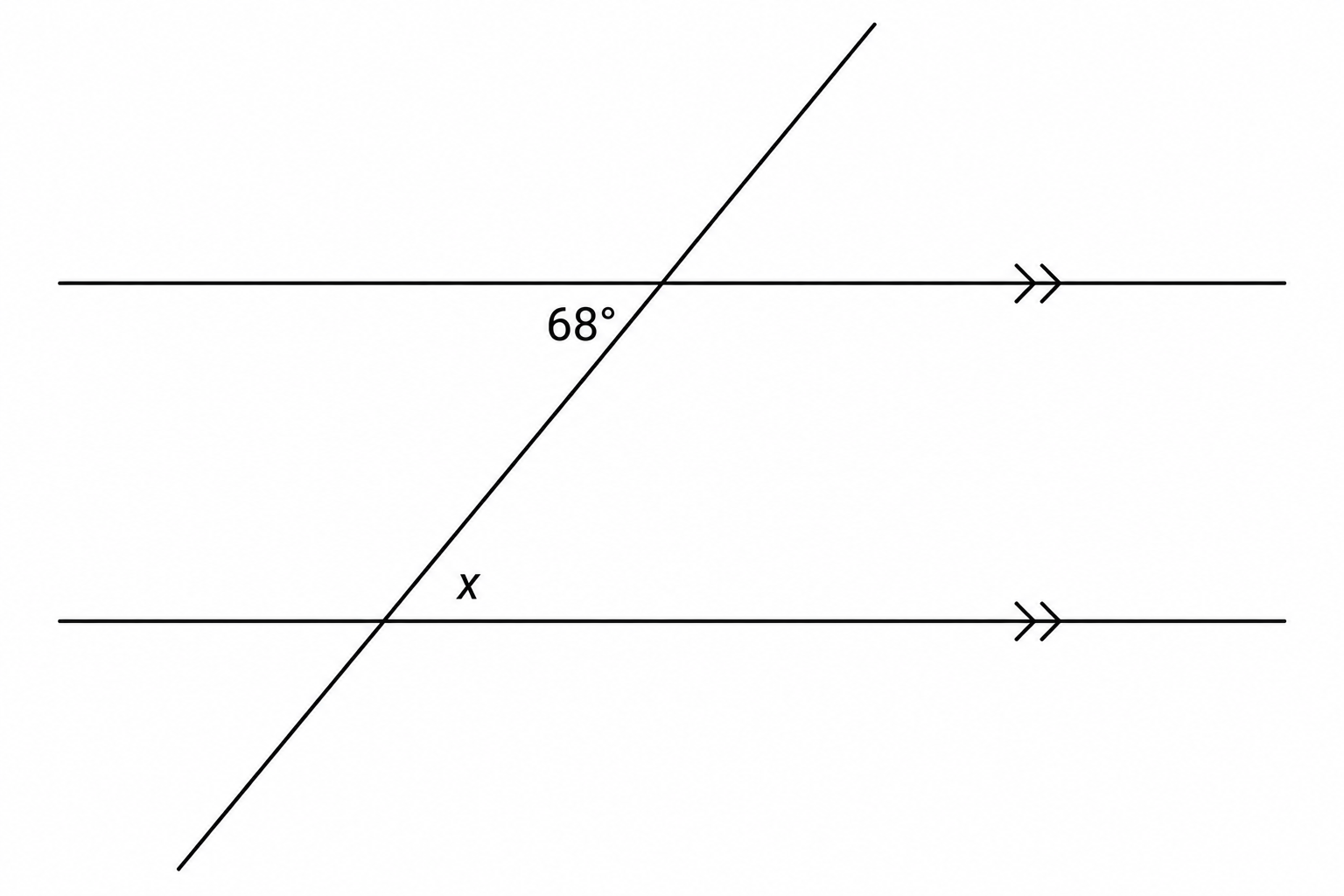
Diagram for question 8: The diagram shows two parallel lines cut by a transversal. What is the value of x?
  1. A) 112^(\)circ
  2. B) 122^(\)circ
  3. C) 68^(\)circ
  4. D) 136^(\)circ

Q9.

Which pair of labelled angles in the diagram are alternate interior angles?
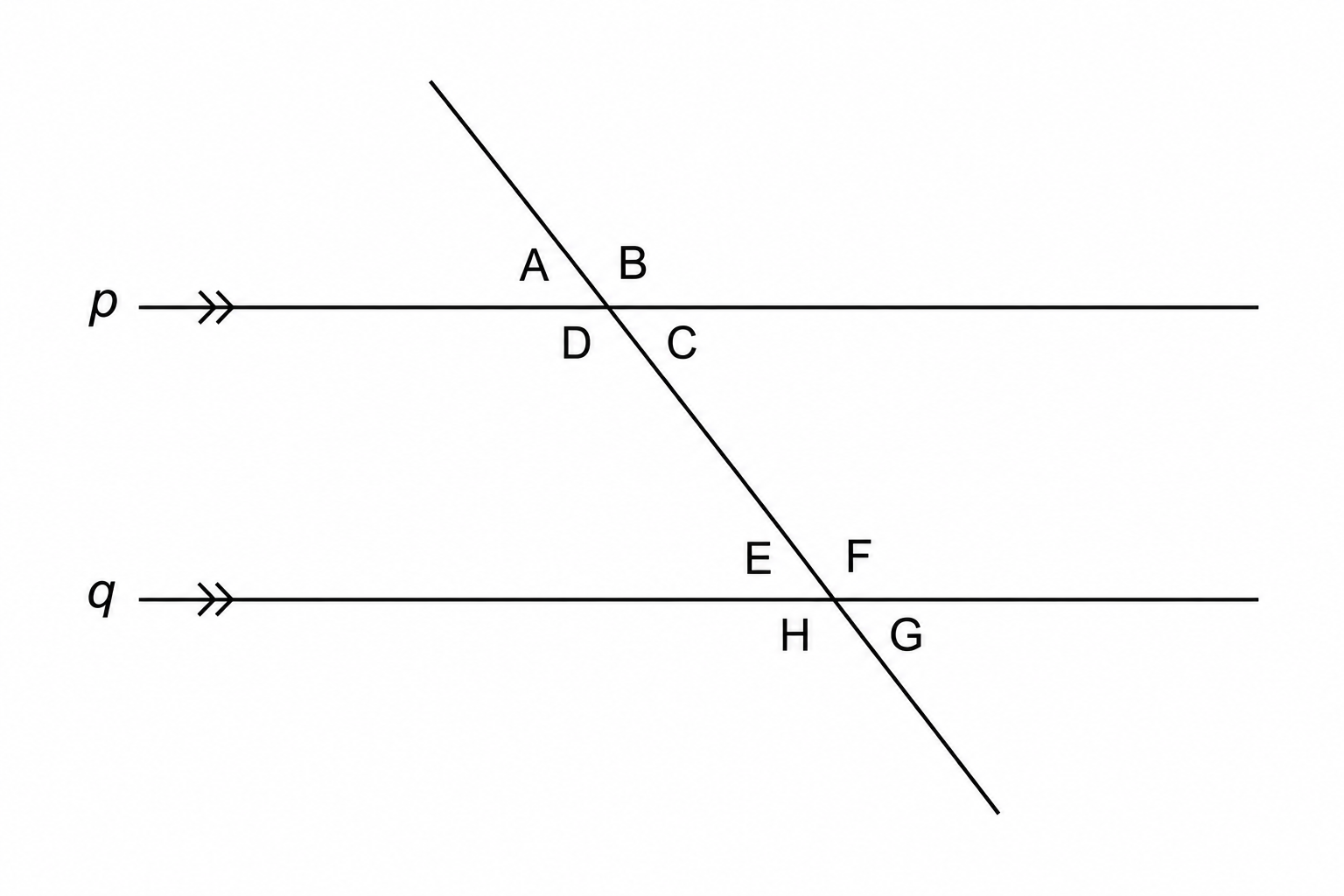
Diagram for question 9: Which pair of labelled angles in the diagram are alternate interior angles?
  1. A) ∠ C and ∠ F
  2. B) ∠ D and ∠ F
  3. C) ∠ B and ∠ F
  4. D) ∠ A and ∠ G

Q10.

Use the intersecting lines in the diagram. Which statement about x is correct?
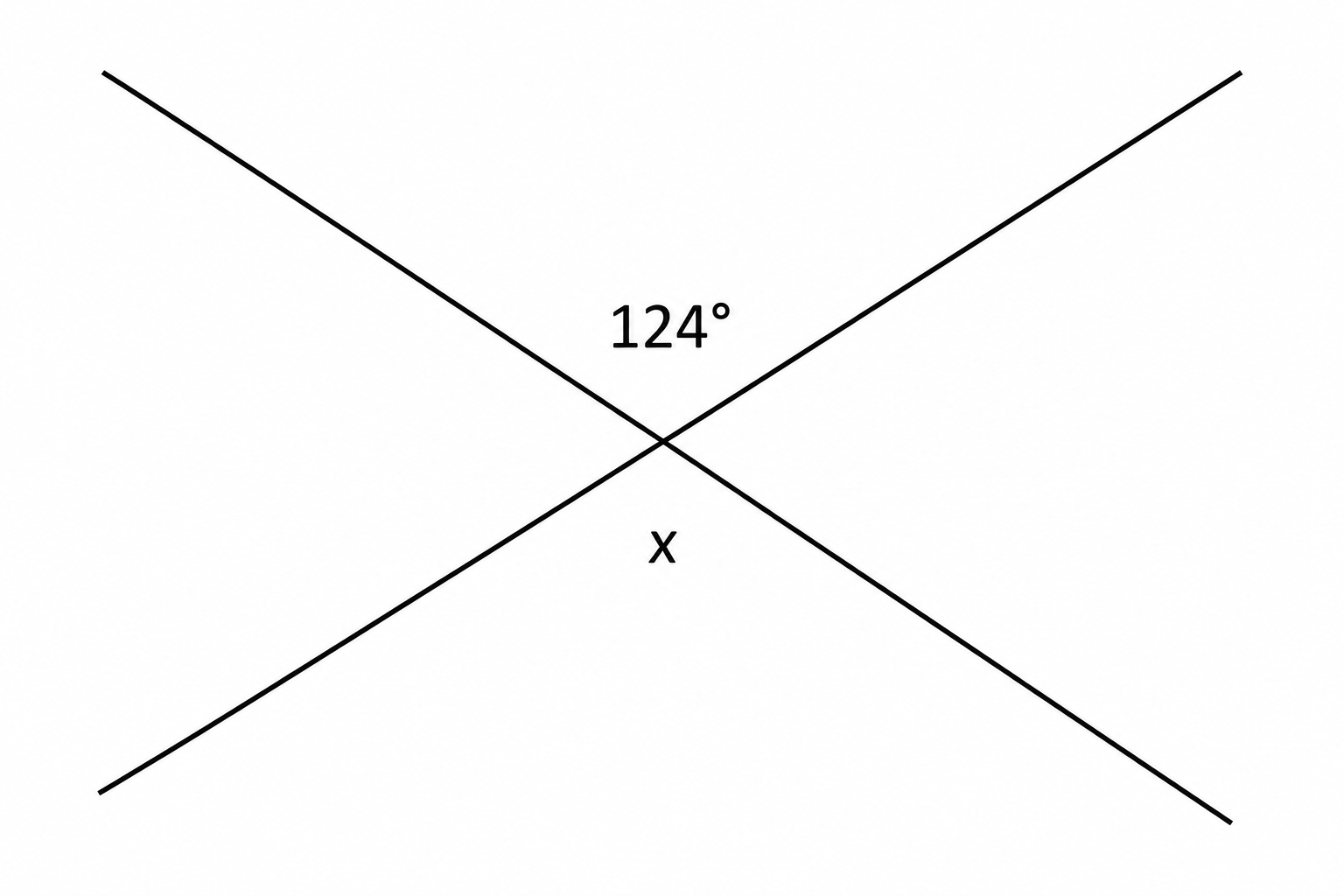
Diagram for question 10: Use the intersecting lines in the diagram. Which statement about x is correct?
  1. A) x = 56^(\)circ because corresponding angles are equal.
  2. B) x = 124^(\)circ because vertically opposite angles are equal.
  3. C) x = 56^(\)circ because vertically opposite angles have a sum of 180^(\)circ.
  4. D) x = 124^(\)circ because adjacent angles are equal.

What this assessment covers

Concepts tested

  • Alternate interior angles
  • Same-side interior angles
  • Angle relationships in parallel lines
  • Properties of intersecting lines
  • Transversal and angle formation

Question Mix

  • Medium questions included

Skills you build

  • Identify types of angles formed by transversals
  • Apply properties of parallel lines to solve problems
  • Calculate angle measures using algebraic expressions
  • Recognize angle relationships in diagrams
  • Interpret geometric diagrams to make conclusions