

MATHEMATICS - FUNCTIONS
Evaluating Functions Worksheet
- Focuses on evaluating composite functions and their domains
- Includes problems on determining function ranges and domains
- Challenges with finding specific function values given conditions
- Involves understanding piecewise and linear functions
Start the 10-question quiz
Free, no sign-up needed. Your score shows instantly.
Here are the first 3 questions. Click “View all questions” to see the complete assessment.
Q1.
Q2.
The function f(x) = x² − 4x + 1 has domain −1,0,2,4,5. What is the range of f?
Q3.
A linear function is defined by f(x) = ax + b. Given that f(2) = 7 and f(f(2)) = 22, find f( − 1).
Q4.
For real inputs, let f(x) = √(2x + 3) and g(x) = x² − 6. What is the domain of h(x) = f(g(x))?
Q5.
The function f is defined by f(x) = begincases − x + 1,&x<0\x² − 2,&x ≥ 0endcases. Find f(f( − 3)) + f(f(2)).
Q6.
Let f(x) = x² − 6x + 5. Which set could be used as a three-element domain so that f is one-to-one on that domain?
Q7.
A function f satisfies f(2x − 1) = 4x² − 4x + 7 for every real value of x. Find f(5).
Q8.
For real values of x, the function is f(x) = (3)/(x − 2) + 1. Which statement gives both the domain and the range of f?
Q9.
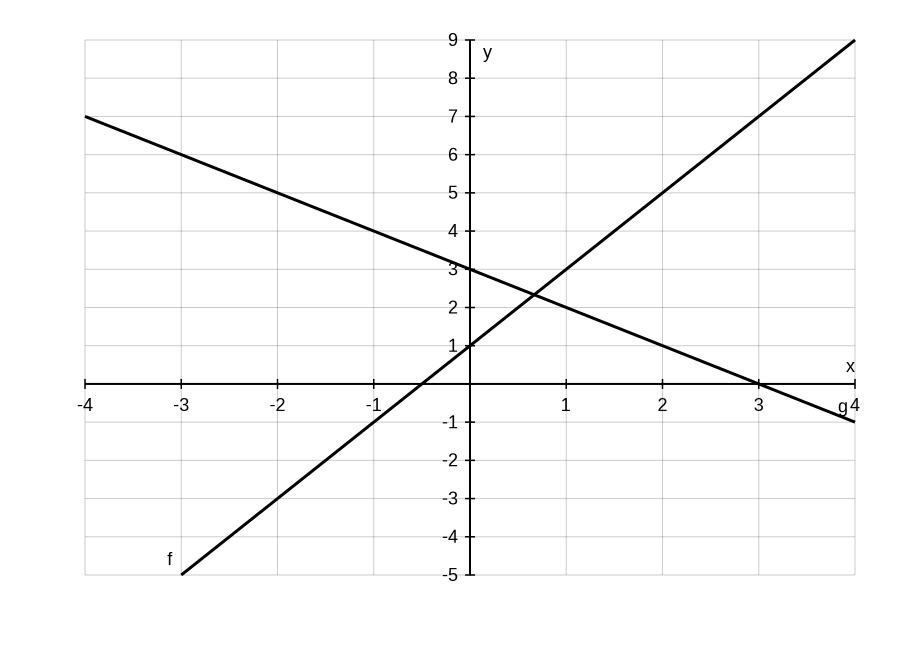
The graph shows the functions f and g. Find f(g(2)) + g(f( − 1)).
Q10.
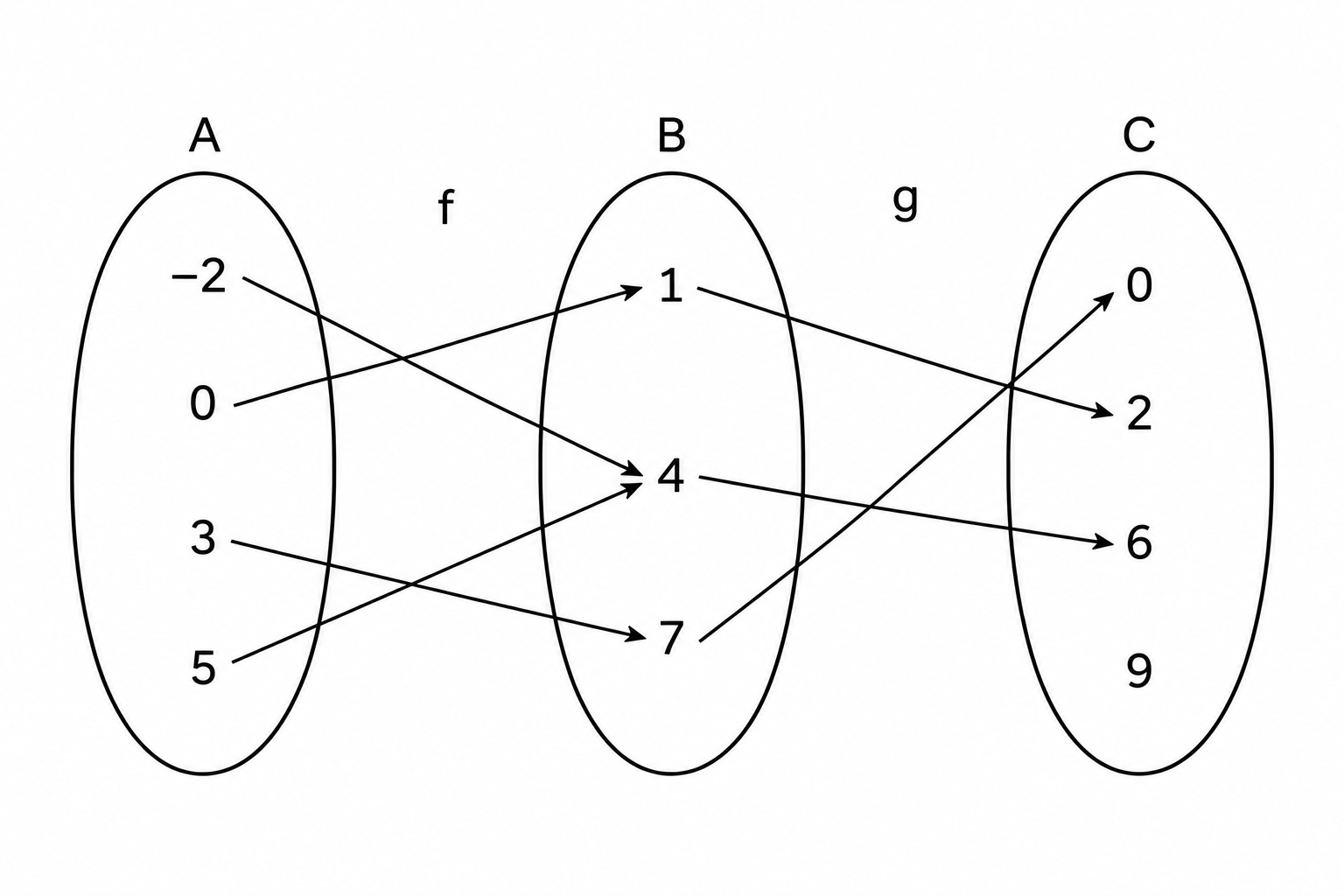
The mapping diagram shows functions f:A → B and g:B → C. What is the range of the composite function g° f when its domain is A?
What this assessment covers
Concepts tested
- Composite functions and their evaluations
- Domain and range of functions
- Piecewise functions and their properties
- Linear functions and solving for unknowns
- Quadratic functions and their characteristics
Question Mix
- Hard questions included
Skills you build
- Evaluate composite functions
- Determine domains and ranges of functions
- Solve equations involving functions
- Analyze piecewise function behavior
- Apply function properties to solve problems
Related assessments
More practice
Other assessments in this subject
