Q1 Question
Points: 1
Choose the correct answer:
Let f(x) = (2x − 1)/(x + 3) and g(x) = x² − 4. What is f(g( − 1))?
Showing question 1 of 10
Choose the correct answer:
The function f(x) = x² − 4x + 1 has domain −1,0,2,4,5. What is the range of f?
Choose the correct answer:
A linear function is defined by f(x) = ax + b. Given that f(2) = 7 and f(f(2)) = 22, find f( − 1).
Choose the correct answer:
For real inputs, let f(x) = √(2x + 3) and g(x) = x² − 6. What is the domain of h(x) = f(g(x))?
Choose the correct answer:
The function f is defined by f(x) = begincases − x + 1,&x<0\x² − 2,&x ≥ 0endcases. Find f(f( − 3)) + f(f(2)).
Choose the correct answer:
Let f(x) = x² − 6x + 5. Which set could be used as a three-element domain so that f is one-to-one on that domain?
Choose the correct answer:
A function f satisfies f(2x − 1) = 4x² − 4x + 7 for every real value of x. Find f(5).
Choose the correct answer:
For real values of x, the function is f(x) = (3)/(x − 2) + 1. Which statement gives both the domain and the range of f?
Choose the correct answer:
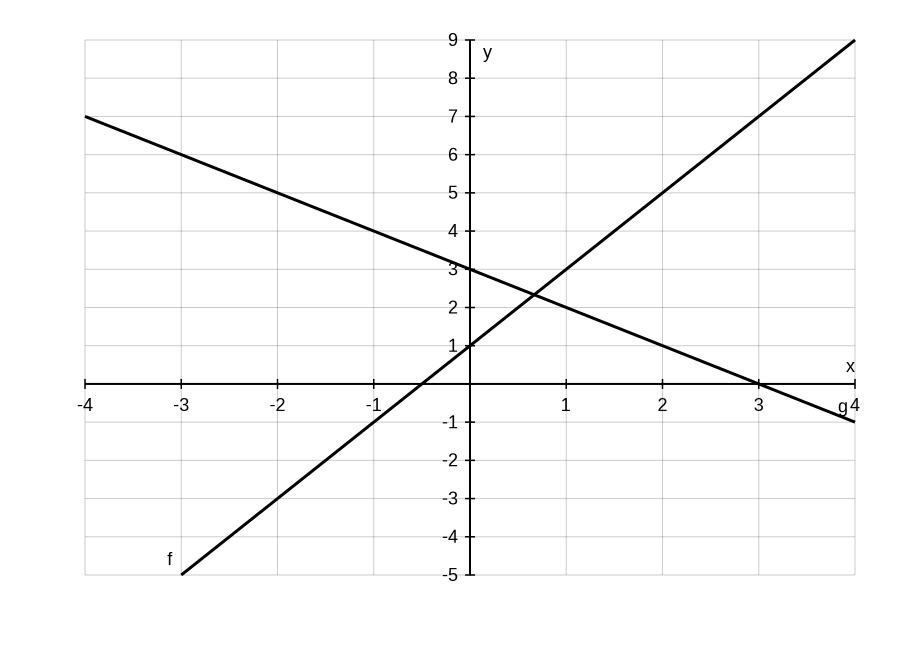
The graph shows the functions f and g. Find f(g(2)) + g(f( − 1)).
Choose the correct answer:
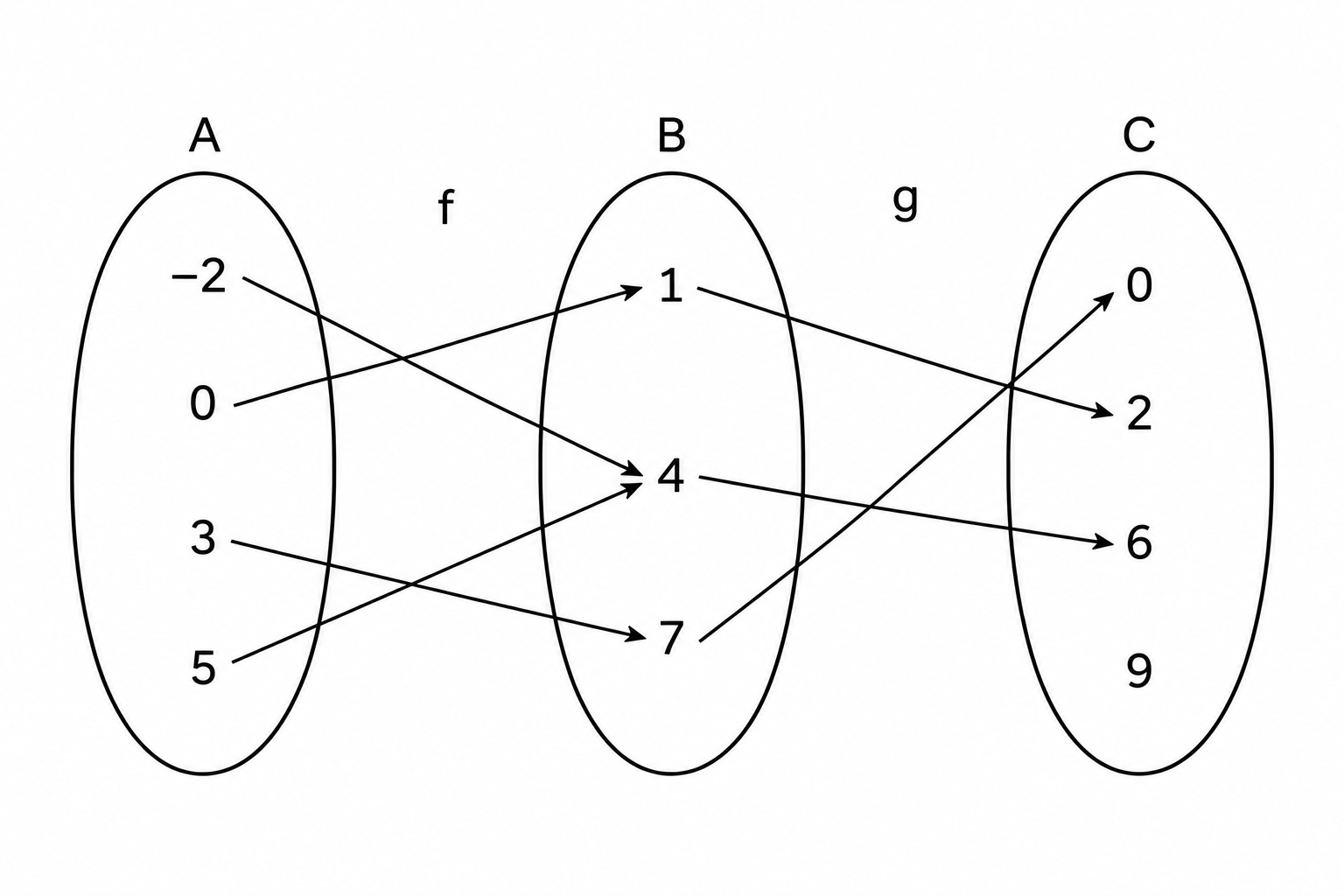
The mapping diagram shows functions f:A → B and g:B → C. What is the range of the composite function g° f when its domain is A?