MATHEMATICS - ADDING AND SUBTRACTING FRACTIONS

Adding Fractions Problems with Answers

  • 10 questions
  • Estimate, add and subtract proper and improper fractions, and mixed numbers, using the order of operations.
  • Difficulty: Medium
  • Board: CAIE
  • Attempt online on the examination portal
Start the 10-question quiz Free, no sign-up needed. Your score shows instantly.

Here are the first 3 questions. Click “View all questions” to see the complete assessment.

Q1.

A student estimates 7/8 + 5/6 by rounding each fraction to the nearest whole number. Which statement describes this estimate correctly?

  1. A) The estimate is 2, and it is less than the exact sum.
  2. B) The estimate is 1, and it is less than the exact sum.
  3. C) The estimate is 2, and it is greater than the exact sum.
  4. D) The estimate is 0, and it is equal to the exact sum.

Q2.

Which expression correctly rewrites 5/6 + 3/4 using a common denominator?

  1. A) 10/12 + 9/12
  2. B) 10/12 + 3/12
  3. C) 15/24 + 18/24
  4. D) 5/12 + 3/12

Q3.

For 11/12 − (1/3 + 1/4 ), which line correctly shows the expression after the calculation inside the brackets has been completed?

  1. A) 11/12 + 7/12
  2. B) 11/12 − 1/12
  3. C) 11/12 − 7/12
  4. D) 11/12 − 2/7

Q4.

A student wants to calculate 31/5 − 13/5 by subtracting the whole-number parts and the fractional parts separately. Which rewriting correctly exchanges a whole for fifths?

  1. A) 22/5 − 13/5
  2. B) 25/5 − 13/5
  3. C) 36/5 − 13/5
  4. D) 26/5 − 13/5

Q5.

Without finding the exact difference, which statement correctly describes 7/6 − 5/4?

  1. A) It is zero because both fractions have a whole-number part of 1.
  2. B) It is positive because 7>5.
  3. C) It is positive because 1/6>1/4.
  4. D) It is negative because 11/6<11/4.

Q6.

A container holds 21/4 L of water. Another 5/6 L is poured in, then 3/4 L is removed. Which expression gives the amount remaining, in litres?

  1. A) 21/4 + (5/6 + 3/4 )
  2. B) 21/4 − (5/6 + 3/4 )
  3. C) 21/4 − (5/6 − 3/4 )
  4. D) 21/4 + (5/6 − 3/4 )

Q7.

Which statement correctly compares 5/8 + 2/3 and 5/8 + 3/5 without calculating both sums?

  1. A) The first sum is smaller because 2<3.
  2. B) The first sum is greater because 2/3>3/5.
  3. C) The sums are equal because both include 5/8.
  4. D) The second sum is greater because 5>3.

Q8.

Which statement correctly explains how to combine the whole-number and fractional parts when adding 15/6 + 23/8?

  1. A) The fractional parts total 8/14, so the complete sum is 34/7.
  2. B) The fractional parts total 15/24, so the complete sum is 45/24.
  3. C) The fractional parts total 15/24, so the complete sum is 35/24.
  4. D) The fractional parts total 15/24, so the complete sum is 41/24.

Q9.

The diagram shows a ribbon divided into three sections. Which expression represents the length, in metres, of the middle section?
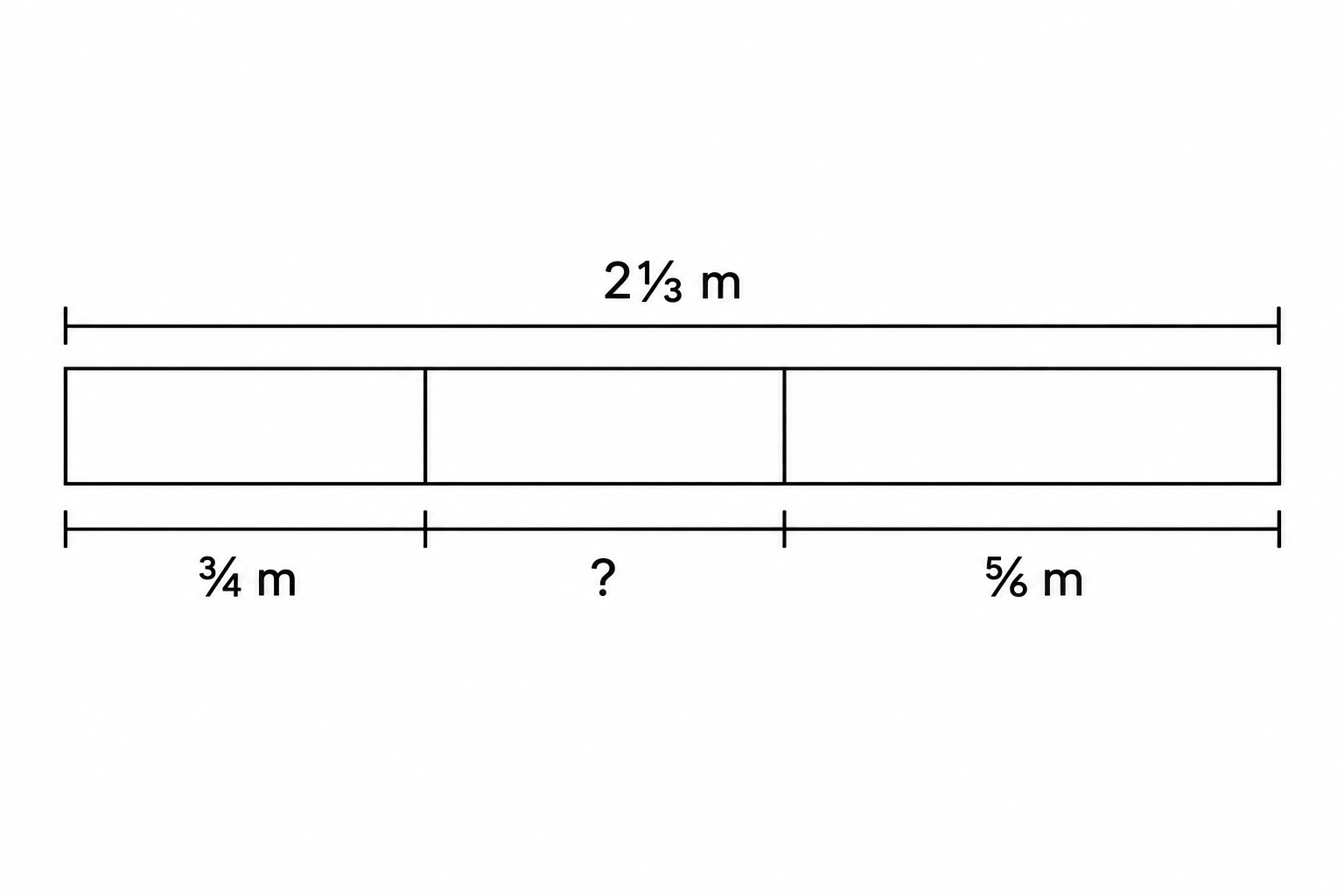
Diagram for question 9: The diagram shows a ribbon divided into three sections. Which expression represents the length, in metres…
  1. A) 21/3 − (5/6 − 3/4 )
  2. B) 3/4 + 5/6 − 21/3
  3. C) 21/3 − (3/4 + 5/6 )
  4. D) 21/3 + 3/4 + 5/6

Q10.

The table shows the amounts of juice in two jugs. Which statement correctly locates their combined amount?
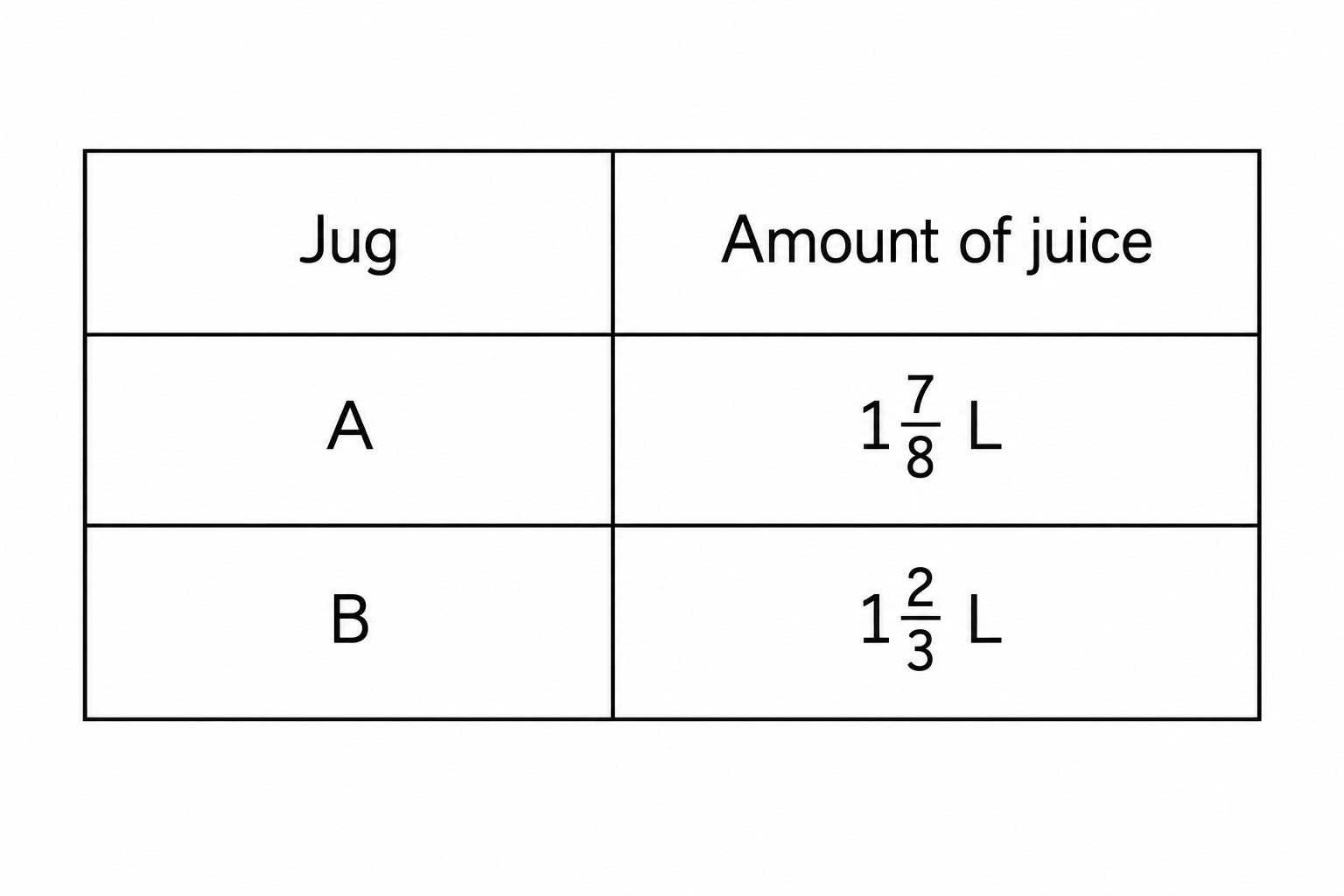
Diagram for question 10: The table shows the amounts of juice in two jugs. Which statement correctly locates their combined amount?
  1. A) It is between 21/2 L and 3 L.
  2. B) It is between 31/2 L and 4 L.
  3. C) It is between 3 L and 31/2 L.
  4. D) It is between 4 L and 41/2 L.

What this assessment covers

Concepts Tested

  • Adding and Subtracting Fractions
  • Estimate, add and subtract proper and improper fractions, and mixed numbers, using the order of operations.

Question Mix

  • Medium questions included

Skills you build

  • Understand