Q1 Question
Points: 1
Choose the correct answer:
A student estimates 7/8 + 5/6 by rounding each fraction to the nearest whole number. Which statement describes this estimate correctly?
Showing question 1 of 10
Choose the correct answer:
A student estimates 7/8 + 5/6 by rounding each fraction to the nearest whole number. Which statement describes this estimate correctly?
Choose the correct answer:
Which expression correctly rewrites 5/6 + 3/4 using a common denominator?
Choose the correct answer:
For 11/12 − (1/3 + 1/4 ), which line correctly shows the expression after the calculation inside the brackets has been completed?
Choose the correct answer:
A student wants to calculate 31/5 − 13/5 by subtracting the whole-number parts and the fractional parts separately. Which rewriting correctly exchanges a whole for fifths?
Choose the correct answer:
Without finding the exact difference, which statement correctly describes 7/6 − 5/4?
Choose the correct answer:
A container holds 21/4 L of water. Another 5/6 L is poured in, then 3/4 L is removed. Which expression gives the amount remaining, in litres?
Choose the correct answer:
Which statement correctly compares 5/8 + 2/3 and 5/8 + 3/5 without calculating both sums?
Choose the correct answer:
Which statement correctly explains how to combine the whole-number and fractional parts when adding 15/6 + 23/8?
Choose the correct answer:
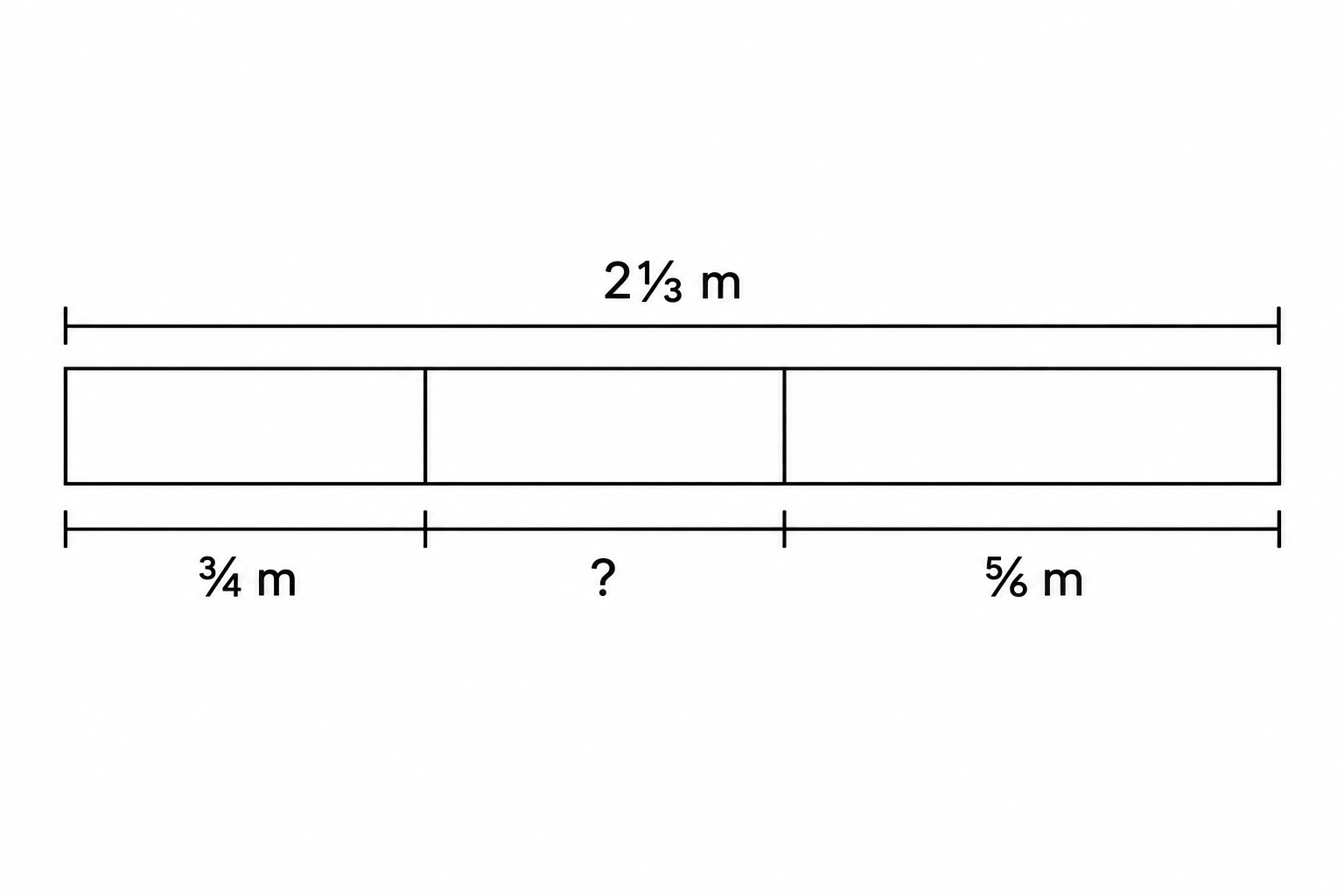
The diagram shows a ribbon divided into three sections. Which expression represents the length, in metres, of the middle section?
Choose the correct answer:
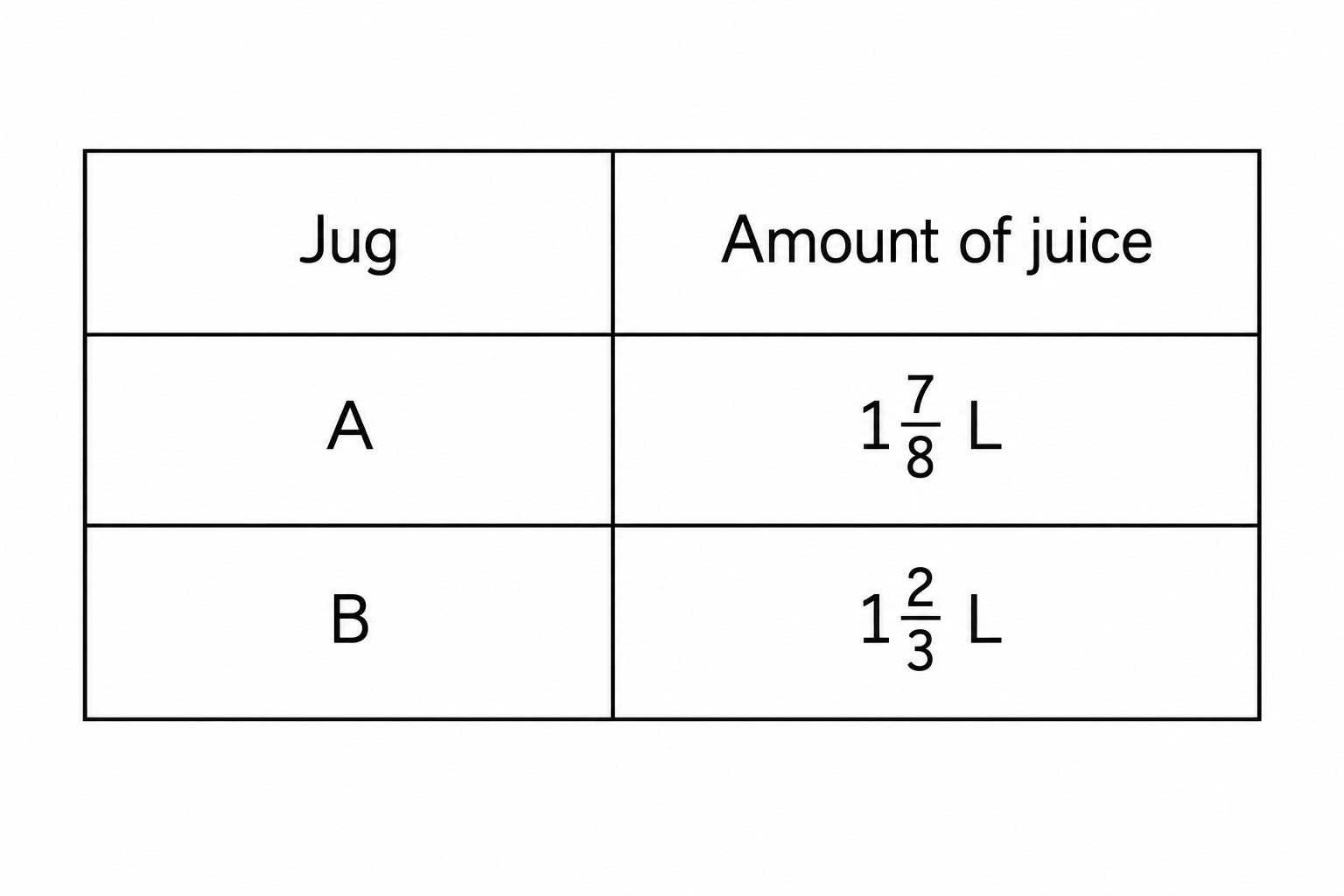
The table shows the amounts of juice in two jugs. Which statement correctly locates their combined amount?