

CHEMISTRY - STOICHIOMETRY
Stoichiometry Practice Problems
- 10 questions
- Difficulty: Hard
- Board: CAIE
- Attempt online on the examination portal
Here are the first 3 questions. Click “View all questions” to see the complete assessment.
Q1.
Q2.
A 15.9 g sample of an oxide of element X is completely reduced, producing 11.1 g of X. Using Ar values X = 74 and O = 16, what is the empirical formula of the oxide?
Q3.
A 10.40 g impure sample is 75.0% potassium by mass, with the remainder inert. The potassium reacts completely with chlorine and gains 7.10 g. Using Ar values K = 39 and Cl = 35.5, what is the empirical formula of the product?
Q4.
A 25.0 g sample containing a silver oxide and 1.8 g of inert material is heated until the oxide decomposes completely. The final solid has a mass of 23.4 g. Using Ar values Ag = 108 and O = 16, what is the empirical formula of the silver oxide?
Q5.
A 6.35 g sample of copper is heated with 15.875 g of iodine. After the reaction, 3.175 g of unreacted iodine is removed. Using Ar values Cu = 63.5 and I = 127, what is the empirical formula of the copper iodide formed?
Q6.
An impure phosphorus sample has a mass of 15.5 g, but only 40.0% of it is phosphorus. All the phosphorus reacts with oxygen, increasing the mass by 8.0 g. Using Ar values P = 31 and O = 16, what is the empirical formula of the oxide?
Q7.
A mixture of 8.4 g of iron and 4.8 g of sulfur is heated. All the sulfur reacts, but 2.8 g of iron remains unreacted and is removed. Using Ar values Fe = 56 and S = 32, what is the empirical formula of the iron sulfide produced?
Q8.
A 5.00 g alloy contains 80.0% of element Q by mass. All of Q is converted into 14.65 g of a pure chloride, which is separated from the other material. Using Ar values Q = 40 and Cl = 35.5, what is the empirical formula of the chloride?
Q9.
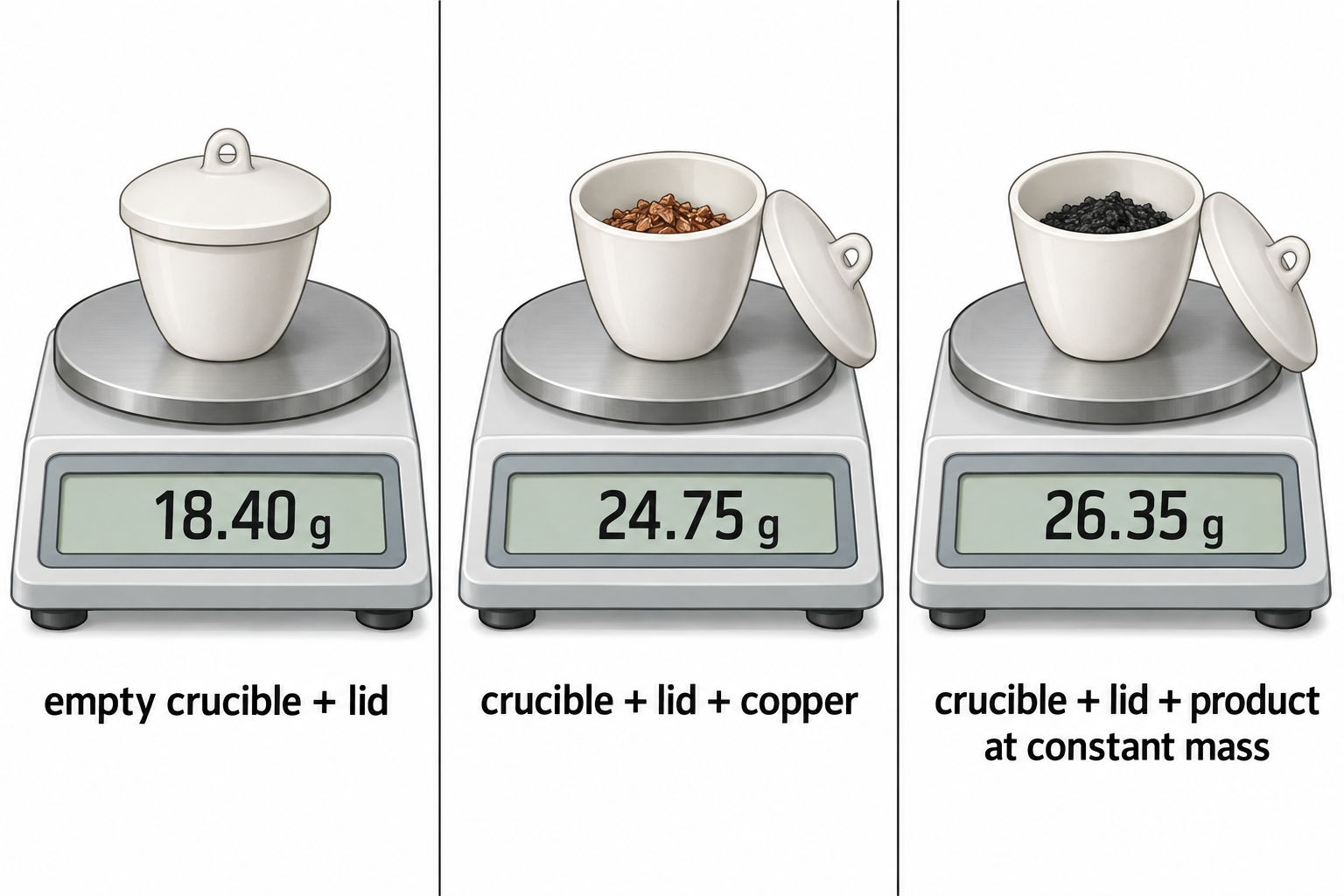
The figure shows balance readings from an experiment in which copper is heated in air until its mass becomes constant. Using Ar values Cu = 63.5 and O = 16, what is the empirical formula of the copper oxide?
Q10.
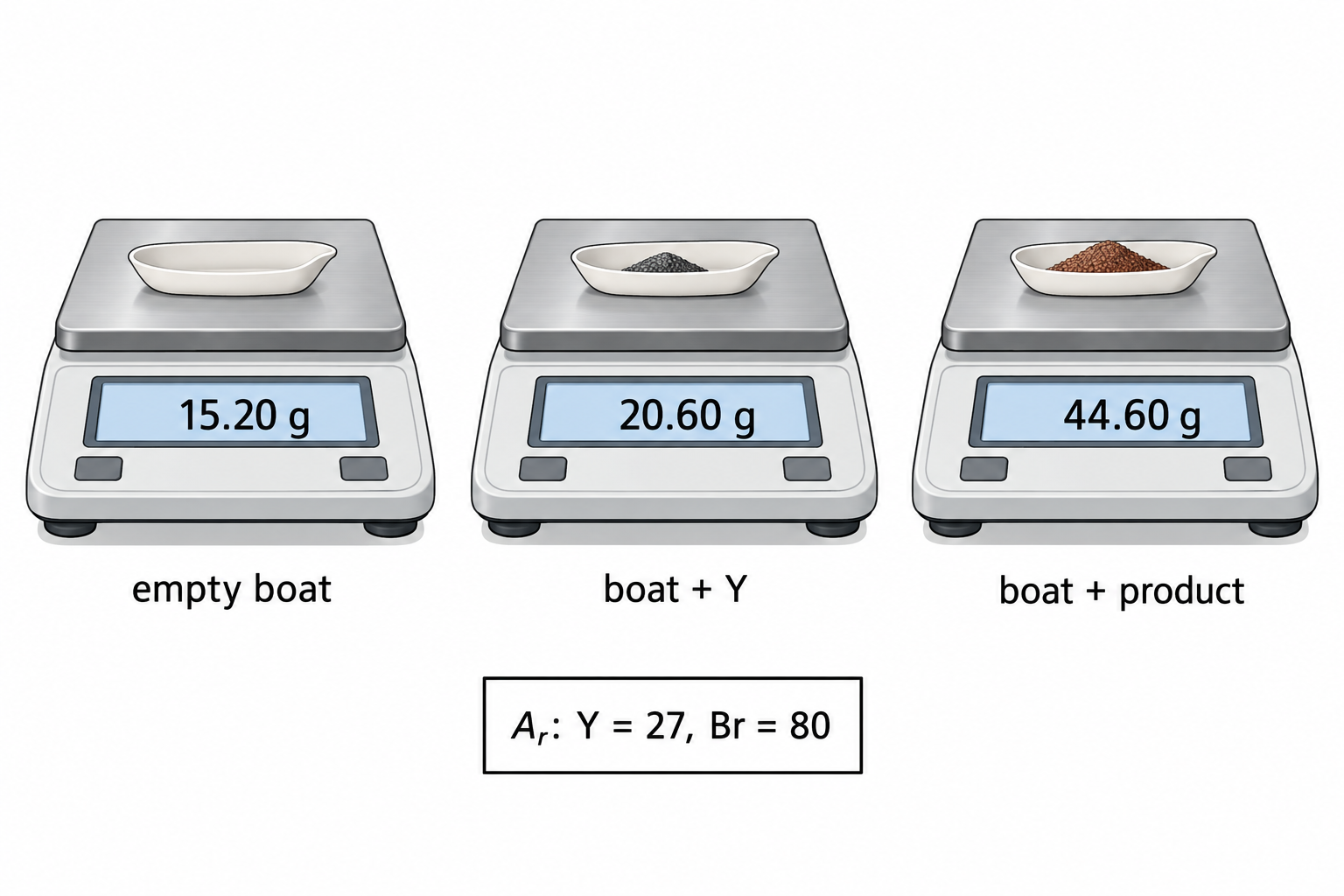
The figure records the masses obtained when element Y is heated with excess bromine. Using the relative atomic masses stated in the figure, what is the empirical formula of the bromide formed?
What this assessment covers
Concepts Tested
- stoichiometry
Question Mix
- Hard questions included
Skills you build
- Apply
Related assessments
More practice
Other assessments in this subject
