

CHEMISTRY - BALANCING EQUATIONS
Balancing Equations Practice Problems
- 10 questions
- Difficulty: Hard
- Board: CAIE
- Attempt online on the examination portal
Here are the first 3 questions. Click “View all questions” to see the complete assessment.
Q1.
Q2.
When FeS2 is roasted in oxygen, the products are Fe2O3 and SO2. Which equation is correctly balanced using the smallest whole-number coefficients?
Q3.
Balance KMnO4 + HCl → KCl + MnCl2 + H2O + Cl2. Which list gives the smallest whole-number coefficients in the order shown?
Q4.
Aluminium reacts with sulfuric acid according to Al + H2SO4 → Al2(SO4)3 + H2. Which balanced equation has the smallest whole-number coefficients?
Q5.
For the reaction Na2CO3 + H3PO4 → Na3PO4 + CO2 + H2O, what is the sum of the smallest whole-number coefficients?
Q6.
Ammonia is oxidised according to NH3 + O2 → NO + H2O. If the coefficient of NH3 is fixed at 12, what coefficient must be placed before O2?
Q7.
Lead(II) nitrate decomposes according to Pb(NO3)2 → PbO + NO2 + O2. Which list gives the smallest whole-number coefficients in the order shown?
Q8.
Balance P4 + KOH + H2O → PH3 + KH2PO2. Which list gives the smallest whole-number coefficients in the order shown?
Q9.
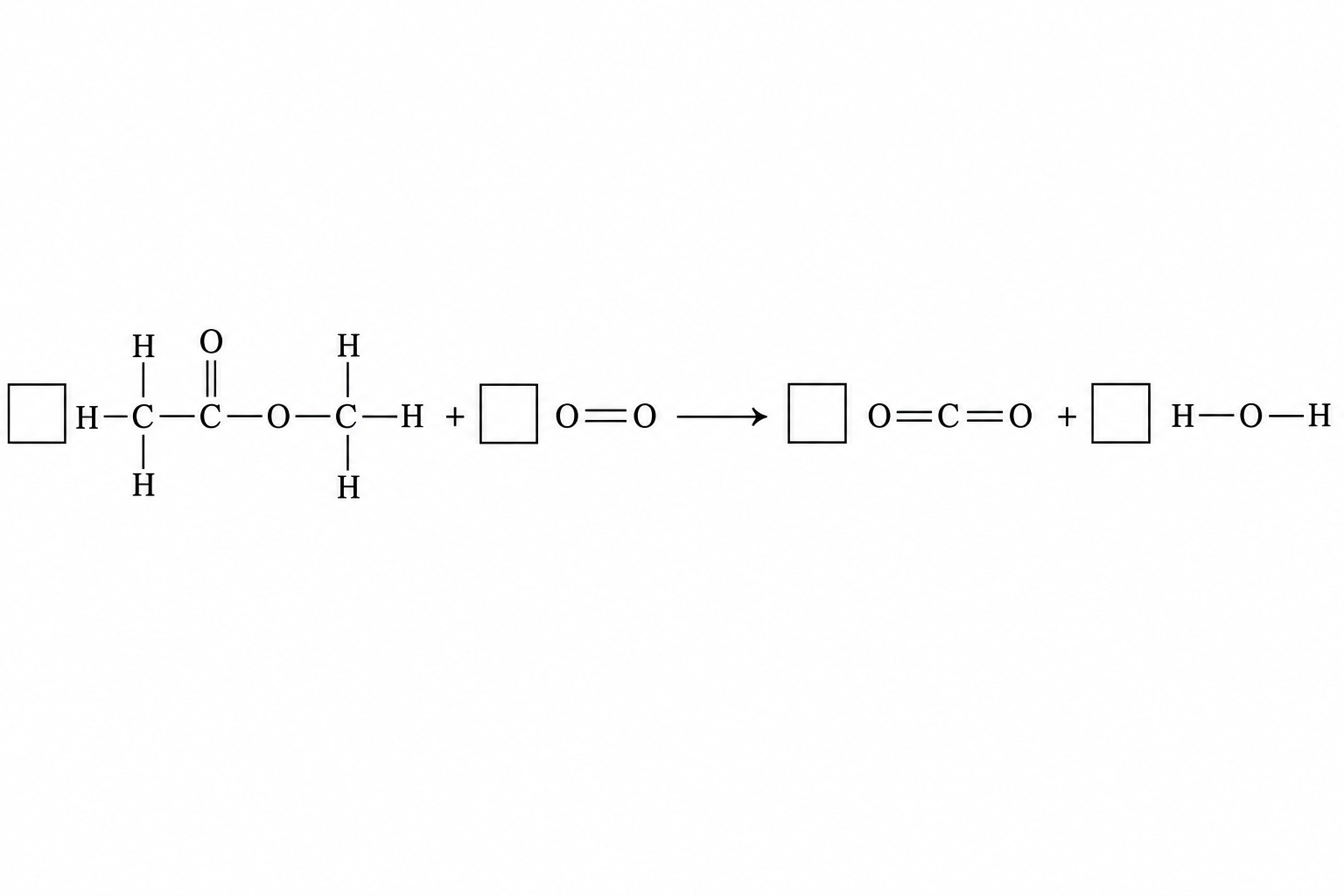
The figure shows the structural formulae of the substances in a combustion reaction. What are the smallest whole-number coefficients for the four substances, in their left-to-right order?
Q10.
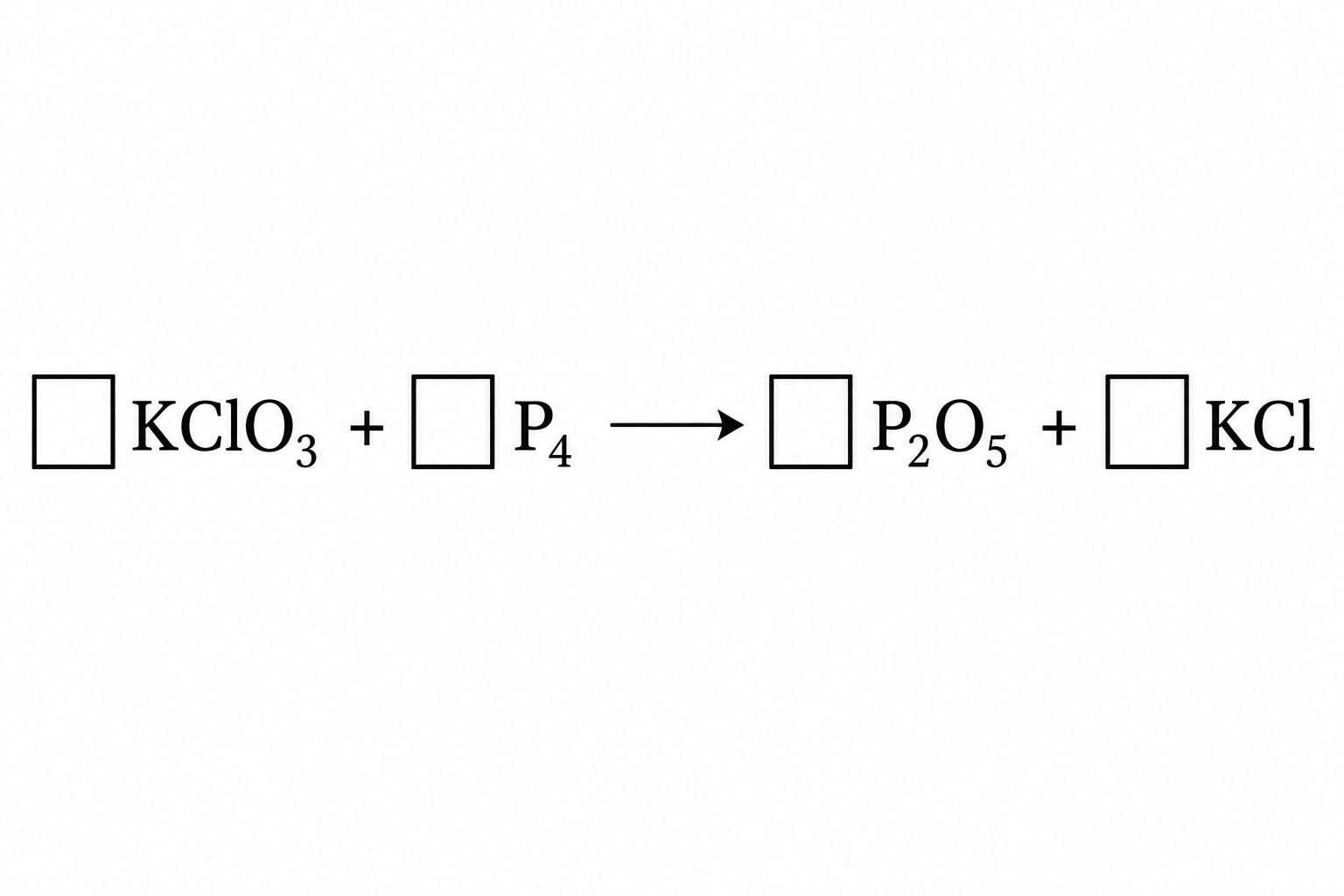
The figure shows an unbalanced reaction with empty coefficient boxes. Which list gives the smallest whole-number coefficients for the substances in their left-to-right order?
What this assessment covers
Concepts Tested
- balancing equations
Question Mix
- Hard questions included
Skills you build
- Apply
Related assessments
More practice
Other assessments in this subject
