

CHEMISTRY - CHEMICAL EQUATIONS
Balancing Equations Worksheet
- 10 questions
- Difficulty: Hard
- Board: CAIE
- Attempt online on the examination portal
Here are the first 3 questions. Click “View all questions” to see the complete assessment.
Q1.
Q2.
Which sequence gives the smallest whole-number coefficients for Fe(NO₃)₃ → Fe₂O₃ + NO₂ + O₂, in the order shown?
Q3.
Aluminium reacts with sulfuric acid according to Al + H₂SO₄ → Al₂(SO₄)₃ + H₂. After balancing with the smallest whole-number coefficients, what is the coefficient of H₂?
Q4.
Ammonia is oxidised according to NH₃ + O₂ → NO + H₂O. What is the coefficient ratio O₂ : H₂O when the equation is balanced using the smallest whole numbers?
Q5.
Balance P₄ + KOH + H₂O → PH₃ + KH₂PO₂ using the smallest whole-number coefficients. What is the sum of all five coefficients?
Q6.
Chlorine reacts with hot concentrated sodium hydroxide according to Cl₂ + NaOH → NaCl + NaClO₃ + H₂O. When balanced with the smallest whole-number coefficients, what is the coefficient of NaCl?
Q7.
Which equation correctly represents the complete combustion of butane, C₄H₁₀, using the smallest whole-number coefficients?
Q8.
In the equation Ca₃(PO₄)₂ + SiO₂ + C → P₄ + CaSiO₃ + CO, what are the smallest whole-number coefficients of Ca₃(PO₄)₂, SiO₂ and C, respectively?
Q9.
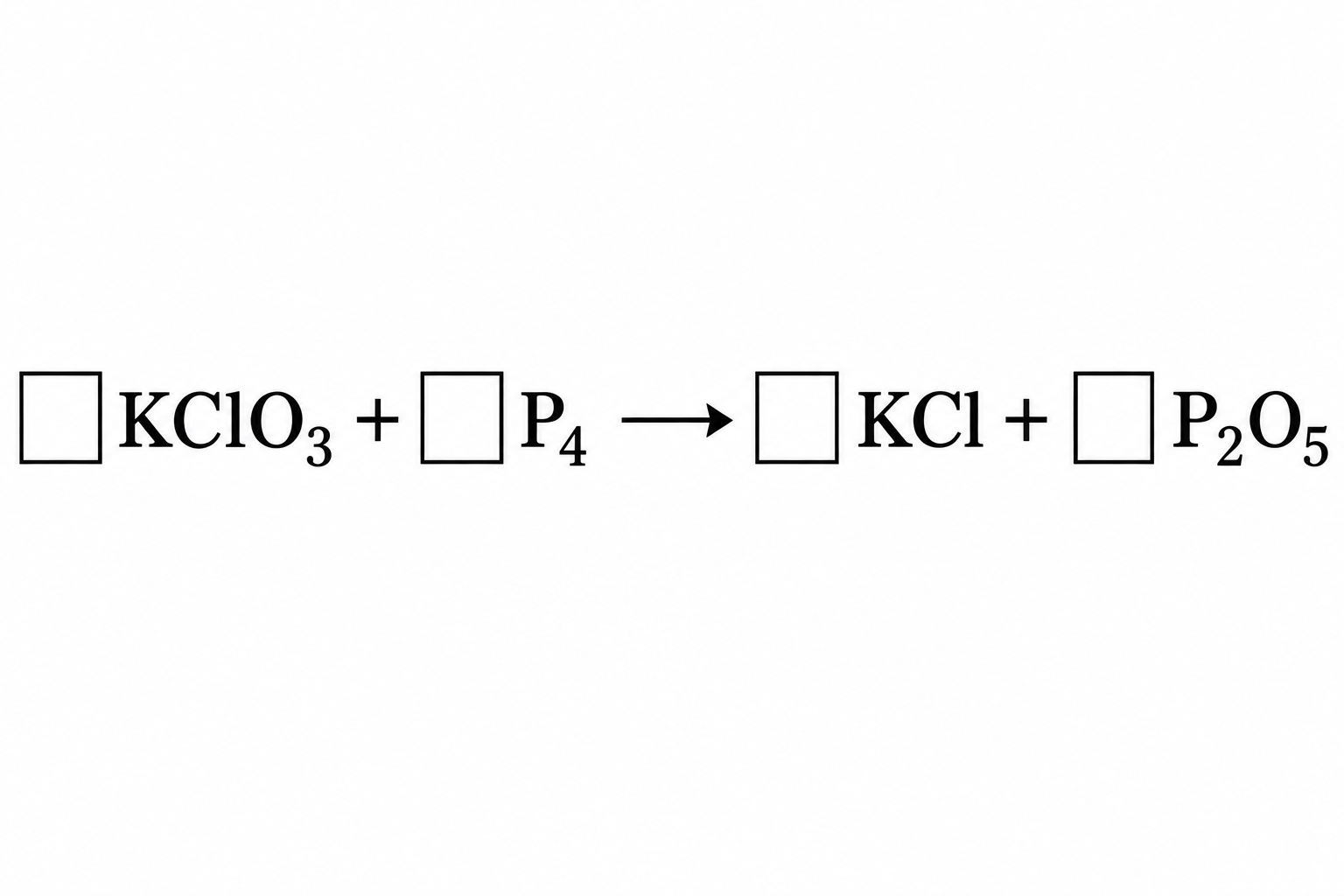
The figure shows an unbalanced chemical equation. Which sequence gives the smallest whole-number coefficients for the substances from left to right?
Q10.
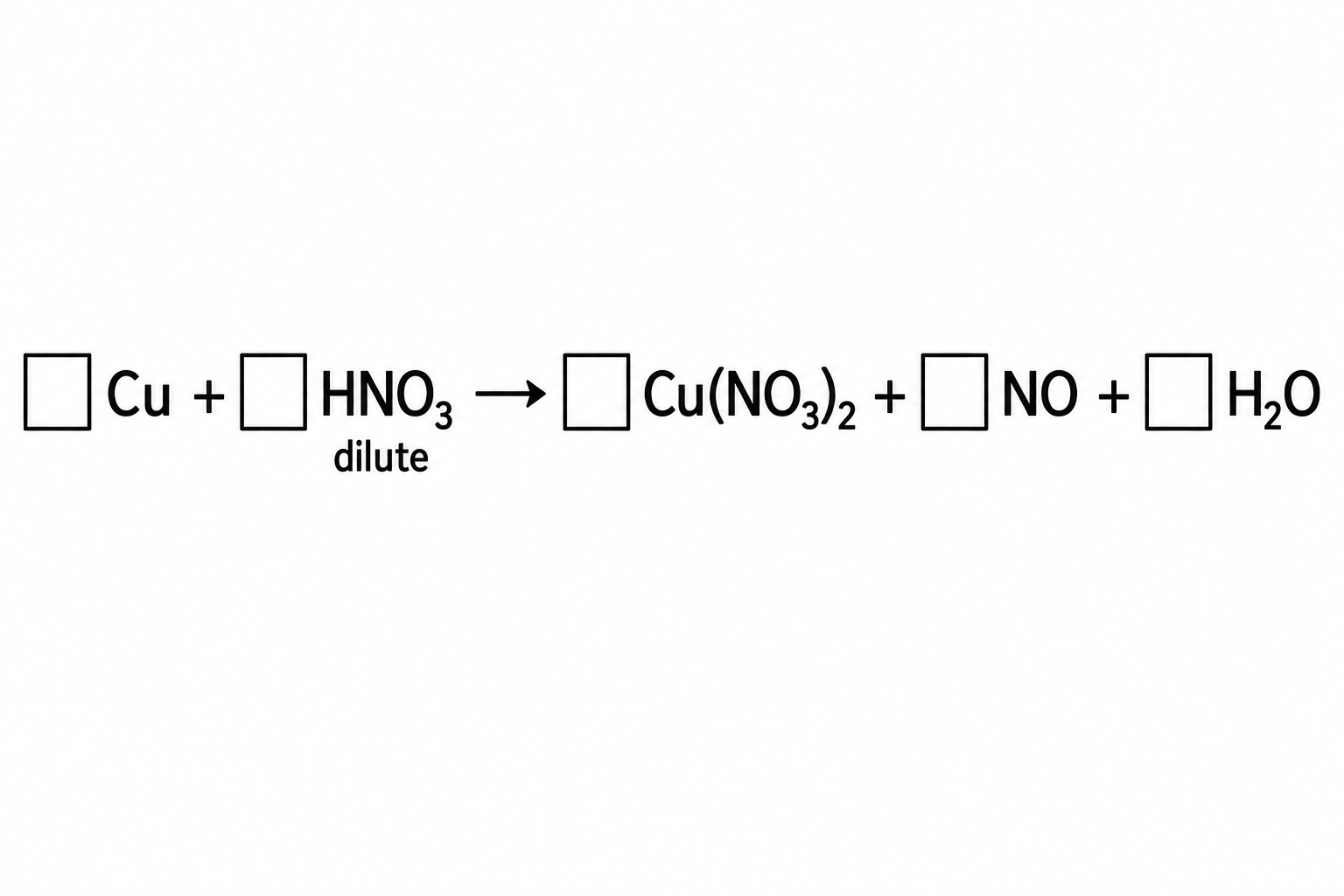
The figure shows copper reacting with dilute nitric acid. Which sequence gives the smallest whole-number coefficients for the five substances from left to right?
What this assessment covers
Concepts Tested
- Chemical Equations
Question Mix
- Hard questions included
Skills you build
- Apply
Related assessments
More practice
Other assessments in this subject
