

MATHEMATICS - VARIABLES ON BOTH SIDES
Variables On Both Sides Worksheet
- 10 questions
- Understand that a situation can be represented either in words or as an equation. Move between the two representations and solve the equation (integer or fractional coefficients, unknown on either or both sides).
- Difficulty: Hard
- Board: CAIE
- Attempt online on the examination portal
Here are the first 3 questions. Click “View all questions” to see the complete assessment.
Q1.
Q2.
Three quarters of the result obtained when 8 is subtracted from a number, followed by an increase of 5, equals half the number increased by 12. Which equation and solution represent this statement?
Q3.
Mira uses one third of a ribbon's original length and an additional 14 cm. Sami uses half of its original length and an additional 2 cm. They use equal lengths. Which equation represents the situation, and what was the original ribbon length?
Q4.
A tank initially contains an unknown volume of water. After two fifths of the original volume and another 9 L are removed, the amount remaining is 3 L less than half the original volume. Which equation and solution represent this situation?
Q5.
Five less than twice a number equals three more than three quarters of the same number. Which equation represents this statement, and what is the number?
Q6.
For a batch containing an unknown number of items, Machine A packages three quarters of the batch plus 18 extra items. Machine B packages five sixths of the batch plus 8 extra items. If they package equal numbers of items, which equation and batch size are correct?
Q7.
Hana is an unknown number of years old. Omar is 11 years older than Hana. In 4 years, Hana's age will be two thirds of Omar's age then. Which equation represents the situation, and how old is Hana now?
Q8.
Five times the difference between a number and 4 equals twice the sum of the number and 9. Which equation and solution correctly represent the statement?
Q9.
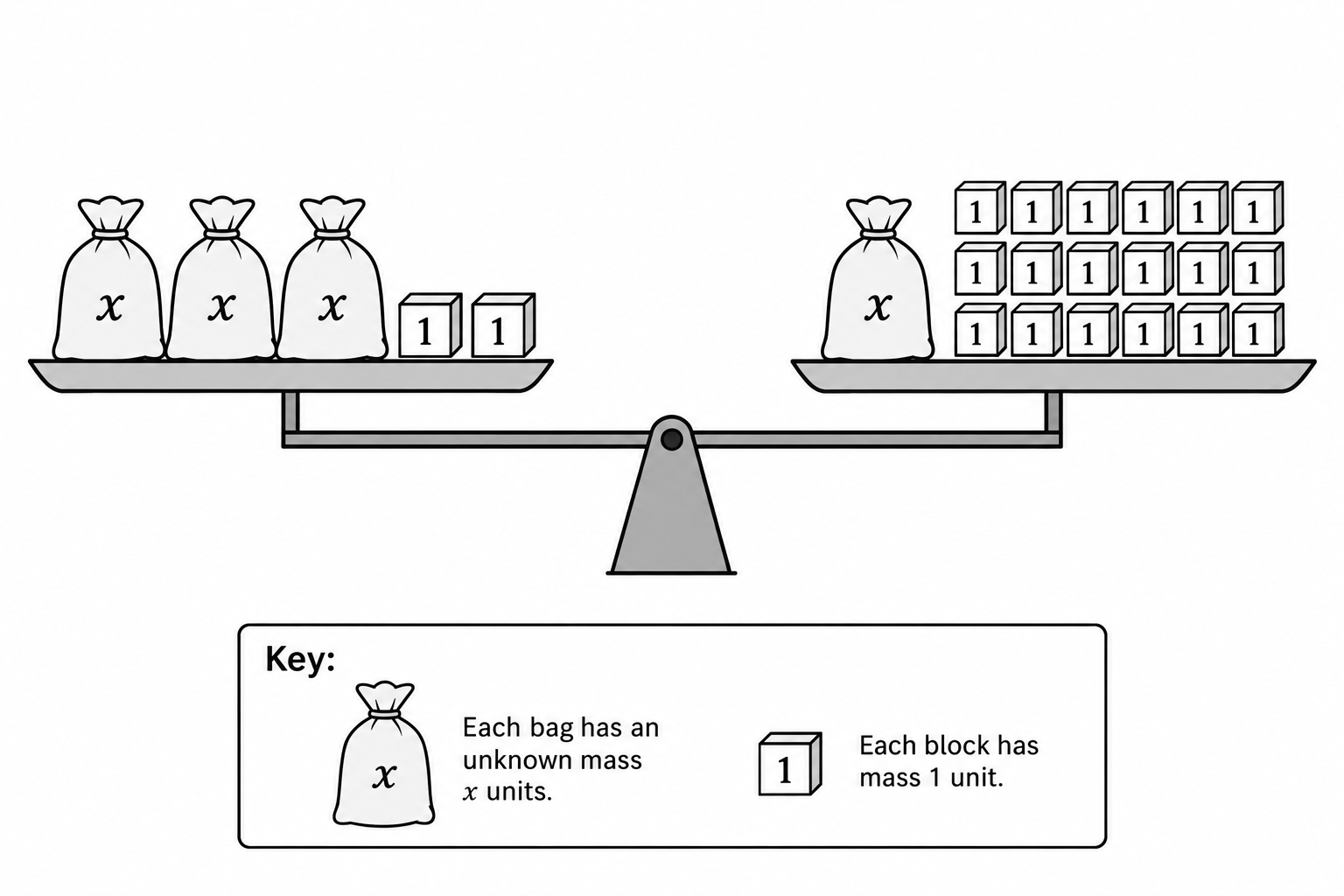
The level balance in the diagram uses identical bags, each with mass x units, and blocks that each have mass 1 unit. Which equation represents the diagram, and what is the mass of one bag?
Q10.
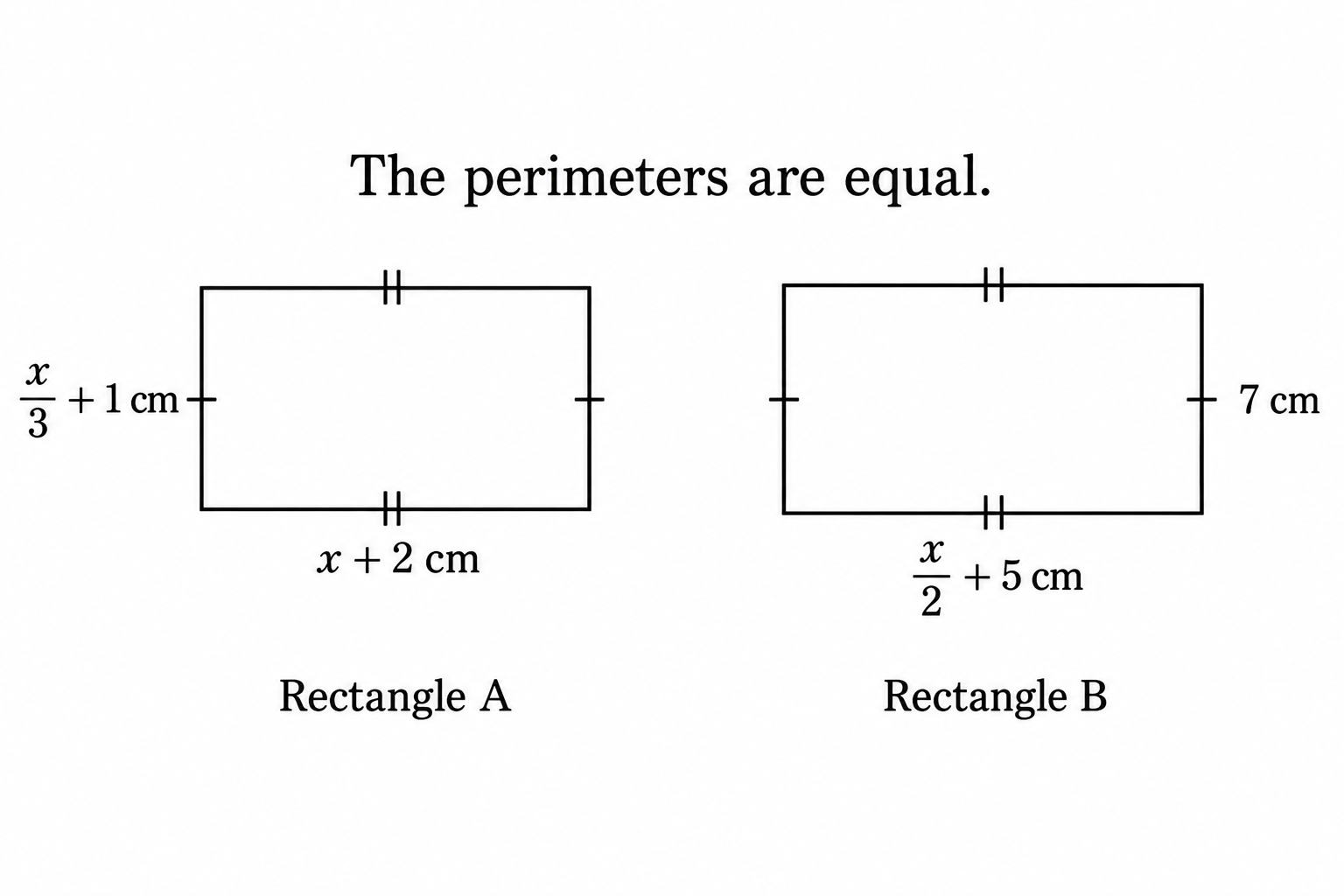
The two rectangles in the diagram have equal perimeters. Using the labelled dimensions, which equation represents this fact, and what is the value of x?
What this assessment covers
Concepts Tested
- variables on both sides
- Understand that a situation can be represented either in words or as an equation. Move between the two representations and solve the equation (integer or fractional coefficients, unknown on either or both sides).
Question Mix
- Hard questions included
Skills you build
- Apply
Related assessments
More practice
Other assessments in this subject
