

MATHEMATICS - TRANSFORMATIONS
Translations Worksheet
- 10 questions
- Use knowledge of translation of 2D shapes to identify the corresponding points between the original and the translated image, without the use of a grid.
- Difficulty: Easy
- Board: CAIE
- Attempt online on the examination portal
Start the 10-question quiz
Free, no sign-up needed. Your score shows instantly.
Here are the first 3 questions. Click “View all questions” to see the complete assessment.
Q1.
Q2.
A rectangle has corners labelled top-left J, top-right K, bottom-right L and bottom-left M. After a translation, its corners are top-left W, top-right X, bottom-right Y and bottom-left Z. Which point corresponds to M?
Q3.
A polygon has just one inward-pointing corner, labelled N. The polygon is translated. Its image has an inward-pointing corner labelled H and outward-pointing corners labelled F, G and J. Which point corresponds to N?
Q4.
A quadrilateral is translated. Each image vertex is labelled with the same letter as its original vertex, followed by a prime mark. Which original vertex corresponds to K^(prime)?
Q5.
A triangle has sides of different lengths. Its shortest side joins A to B, and its third vertex is C. In its translated image, the shortest side joins U to V, and the third vertex is W. Which point corresponds to C?
Q6.
An arrow-shaped outline points to the right. Its tip is labelled T. The outline is translated upwards without turning. In the translated outline, P labels the tip, while Q, R and S label other corners. Which point corresponds to T?
Q7.
A triangle and a dot marking one of its vertices are translated together. The marked original vertex is R. The image vertices are G, H and I, with the dot at G. Which point corresponds to R?
Q8.
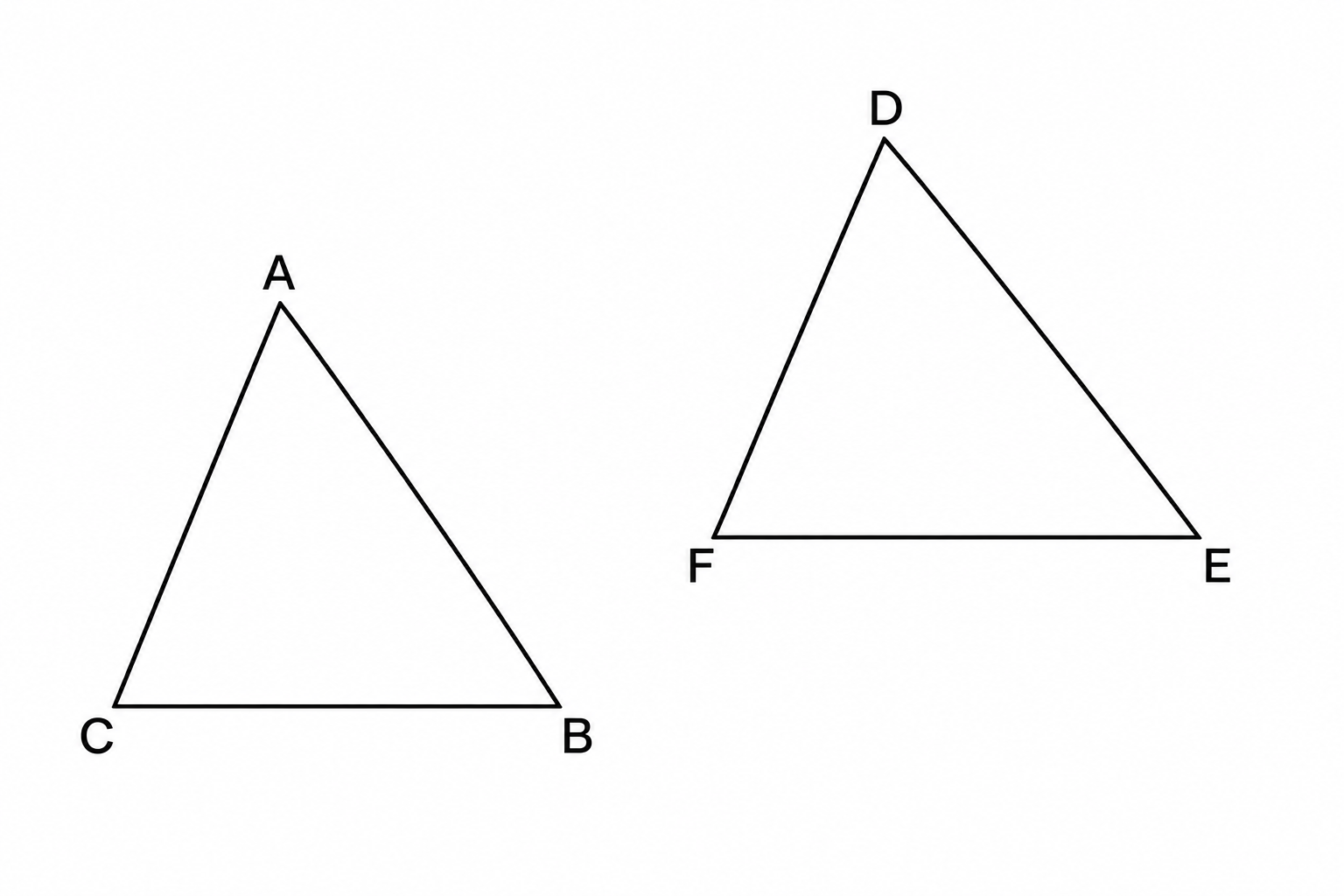
The diagram shows a triangle and its translated image. Which point corresponds to C?
Q9.
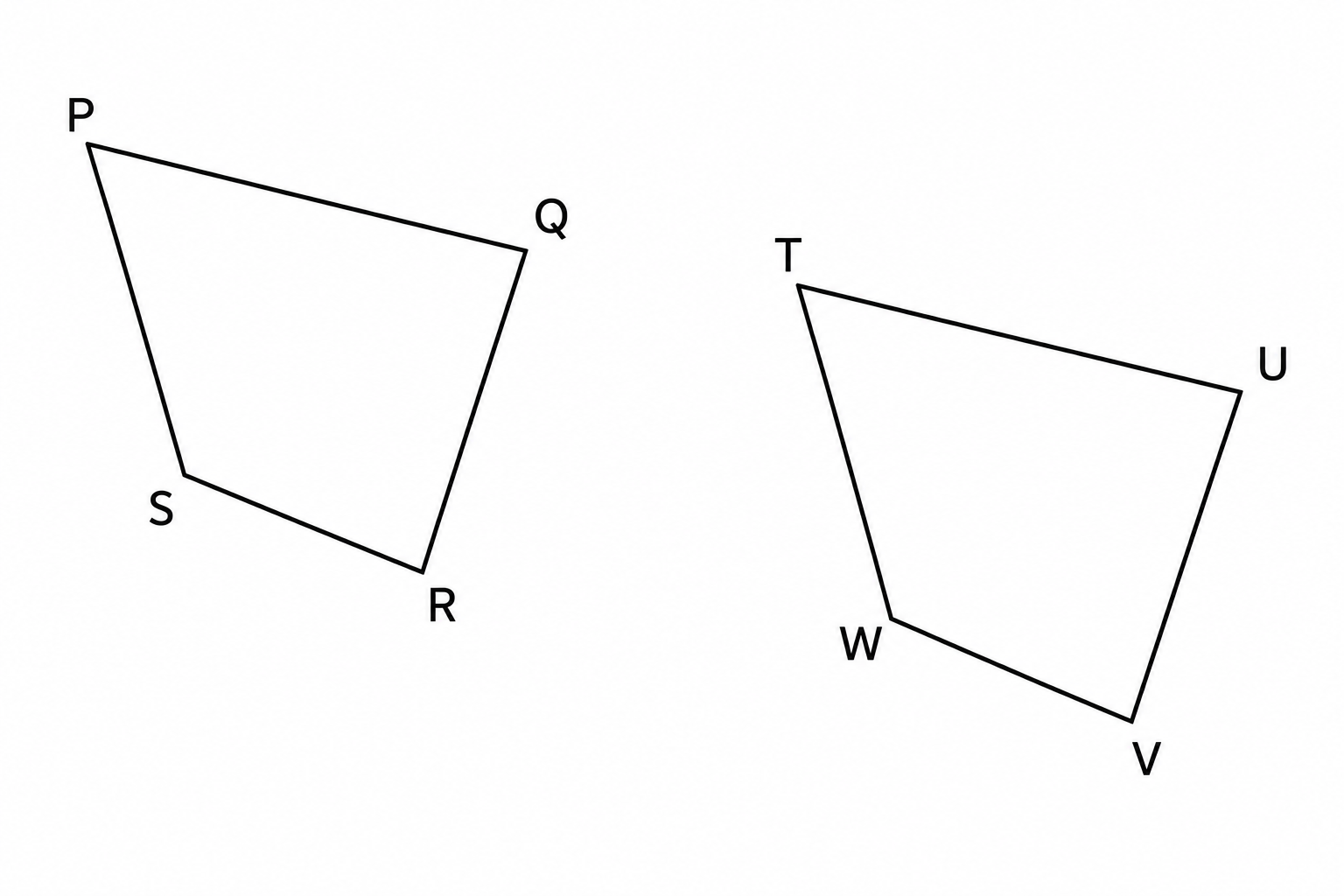
The quadrilateral on the right is a translation of the quadrilateral on the left. Which point corresponds to Q?
Q10.
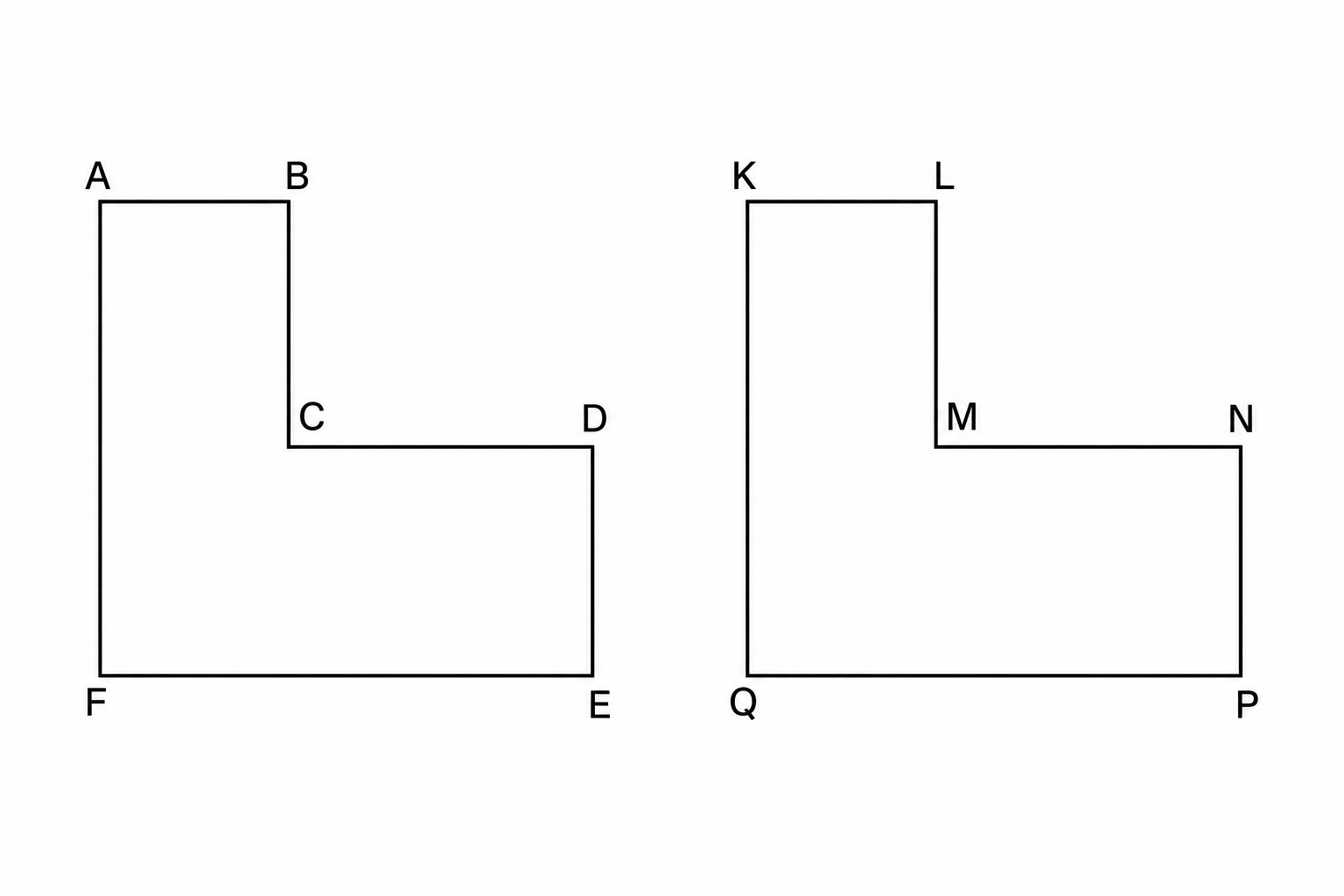
The diagram shows an L-shaped polygon and its translated image. Which point on the original polygon corresponds to M on the image?
What this assessment covers
Concepts Tested
- Transformations
- Use knowledge of translation of 2D shapes to identify the corresponding points between the original and the translated image, without the use of a grid.
Question Mix
- Easy questions included
Skills you build
- Remember
Related assessments
More practice
Other assessments in this topic
