

MATHEMATICS - TRANSFORMATIONS

Reflections Worksheet

  • 10 questions
  • Reflect 2D shapes on coordinate grids, in a given mirror line (x- or y-axis), recognising that the image is congruent to the object after a reflection.
  • Difficulty: Medium
  • Board: CAIE
  • Attempt online on the examination portal
Start the 10-question quiz Free, no sign-up needed. Your score shows instantly.

Here are the first 3 questions. Click “View all questions” to see the complete assessment.

Q1.

Triangle ABC has vertices A(2,1), B(5,2) and C(3,4). It is reflected in the y-axis. Which list gives the corresponding vertices of its image?

  1. A) A'( − 2,1),\ B'( − 5,2),\ C'( − 3,4)
  2. B) A'(1,2),\ B'(2,5),\ C'(4,3)
  3. C) A'(2, − 1),\ B'(5, − 2),\ C'(3, − 4)
  4. D) A'( − 2, − 1),\ B'( − 5, − 2),\ C'( − 3, − 4)

Q2.

A quadrilateral lies entirely above the x-axis. It is reflected in the x-axis. Which statement correctly explains how to draw its congruent image?

  1. A) Place every vertex below the axis at twice its original distance from the axis.
  2. B) Keep each vertical position unchanged and move each vertex to the opposite side of the vertical axis.
  3. C) Keep each horizontal position unchanged and place each vertex the same distance below the axis as it was above.
  4. D) Keep every vertex in its original position because congruent shapes must occupy the same place.

Q3.

Triangle ABC has vertices A( − 3,2), B(1,5) and C(4,2). Its reflection in the x-axis is triangle A'B'C'. Which statement about the corresponding side A'C' is correct?

  1. A) Its length is 4 units because the image is below the axis.
  2. B) Its length is 7 units because reflection preserves lengths.
  3. C) Its length is 14 units because reflection doubles distances.
  4. D) Its length is 1 unit because the negative coordinate cancels part of the positive coordinate.

Q4.

Triangle ABC has vertices A( − 3,0), B(4,0) and C(1,5). When the triangle is reflected in the x-axis, which vertices remain in their original positions?

  1. A) All the vertices
  2. B) C only
  3. C) A and B only
  4. D) A only

Q5.

A triangle has vertices ( − 5,2), ( − 2,6) and ( − 1,1). The corresponding vertices of its image are ( − 5, − 2), ( − 2, − 6) and ( − 1, − 1). Which statement describes the reflection?

  1. A) The mirror line is the y-axis.
  2. B) Neither coordinate axis gives this image by reflection.
  3. C) The mirror line could be either coordinate axis.
  4. D) The mirror line is the x-axis.

Q6.

A triangle has vertices ( − 6,2), (3,4) and (2,1). It is reflected in the y-axis. Which description of the image is correct?

  1. A) Two vertices are to the right of the vertical axis and one is to the left; all are above the horizontal axis.
  2. B) All vertices are to the left of the vertical axis and above the horizontal axis.
  3. C) One vertex is to the right of the vertical axis and two are to the left; all are below the horizontal axis.
  4. D) One vertex is to the right of the vertical axis and two are to the left; all are above the horizontal axis.

Q7.

A scalene triangle lies entirely above the x-axis. It is reflected in the x-axis, and then its image is reflected in the same axis again. How does the final triangle compare with the original triangle?

  1. A) It is congruent to the original and every vertex returns to its original position.
  2. B) It occupies the original position but has side lengths twice as long.
  3. C) It is congruent to the original but lies on the opposite side of the vertical axis.
  4. D) It is congruent to the original but remains entirely below the axis.

Q8.

The pentagon shown is reflected in the y-axis. Which coordinates are the endpoints of the image of side CD?
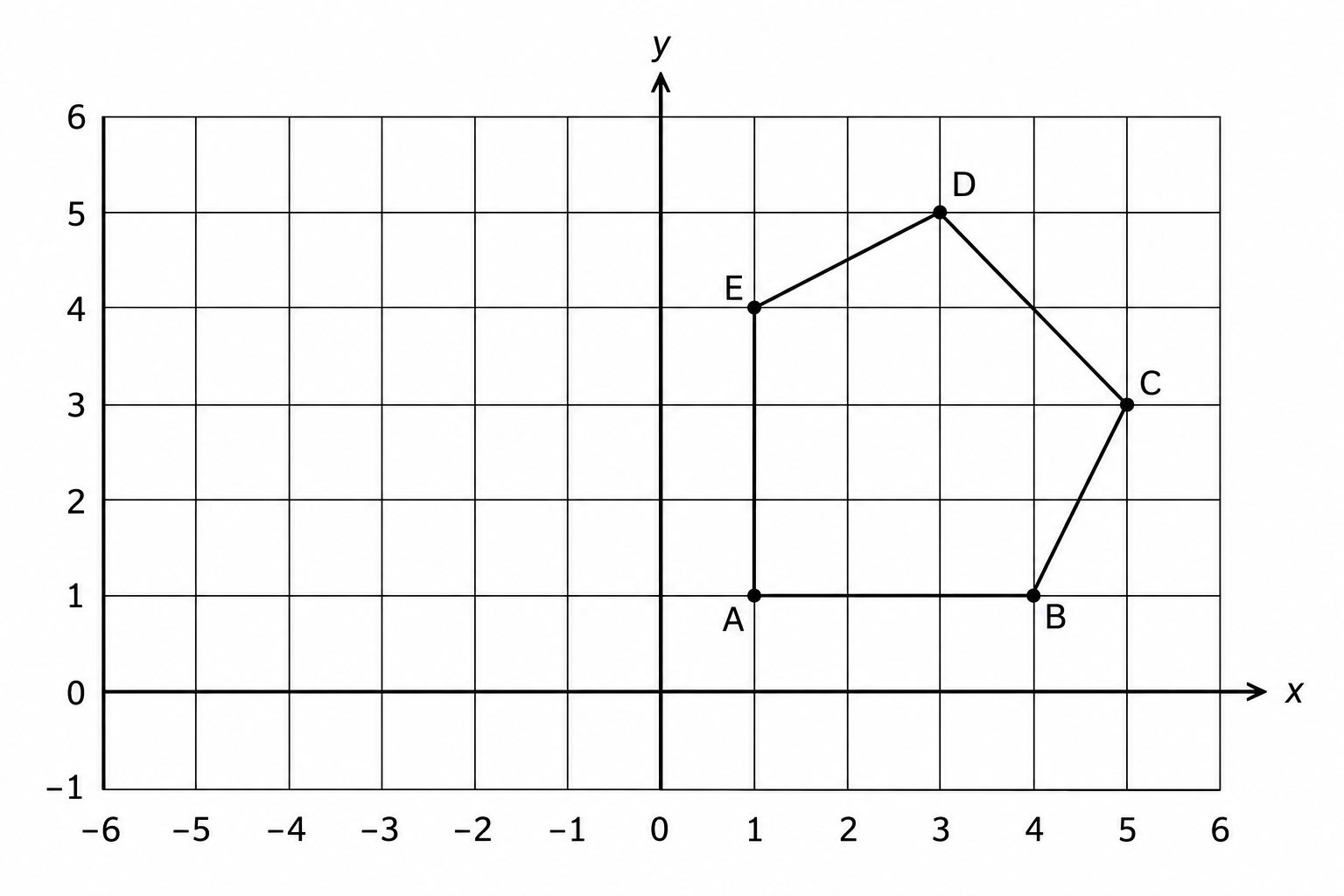
Diagram for question 8: The pentagon shown is reflected in the y-axis. Which coordinates are the endpoints of the image of side CD?
  1. A) C'(3,5),\ D'(5,3)
  2. B) C'( − 5,3),\ D'( − 3,5)
  3. C) C'( − 5, − 3),\ D'( − 3, − 5)
  4. D) C'(5, − 3),\ D'(3, − 5)

Q9.

The rectangle shown is reflected in the x-axis. Which statement correctly describes its image?
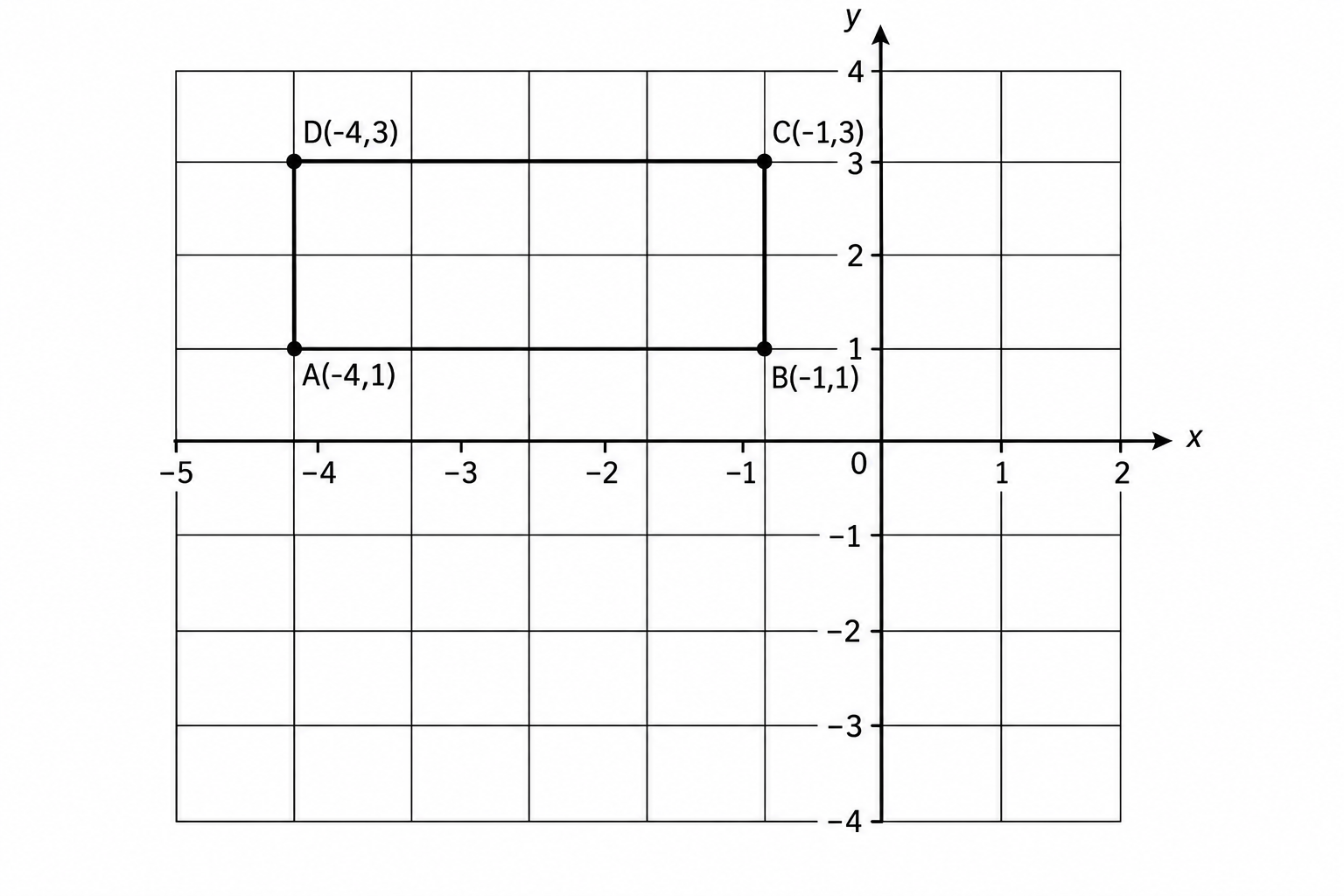
Diagram for question 9: The rectangle shown is reflected in the x-axis. Which statement correctly describes its image?
  1. A) It lies entirely to the left of the vertical axis and below the horizontal axis, with unchanged side lengths.
  2. B) It lies entirely to the left of the vertical axis and below the horizontal axis, with its vertical sides twice as long.
  3. C) It lies entirely to the right of the vertical axis and below the horizontal axis, with unchanged side lengths.
  4. D) It lies entirely to the left of the vertical axis and above the horizontal axis, with unchanged side lengths.

Q10.

A student tries to reflect triangle ABC in the y-axis, using P, Q and R as the images of A, B and C, respectively. Exactly one image vertex is misplaced. Which change completes the reflection correctly?
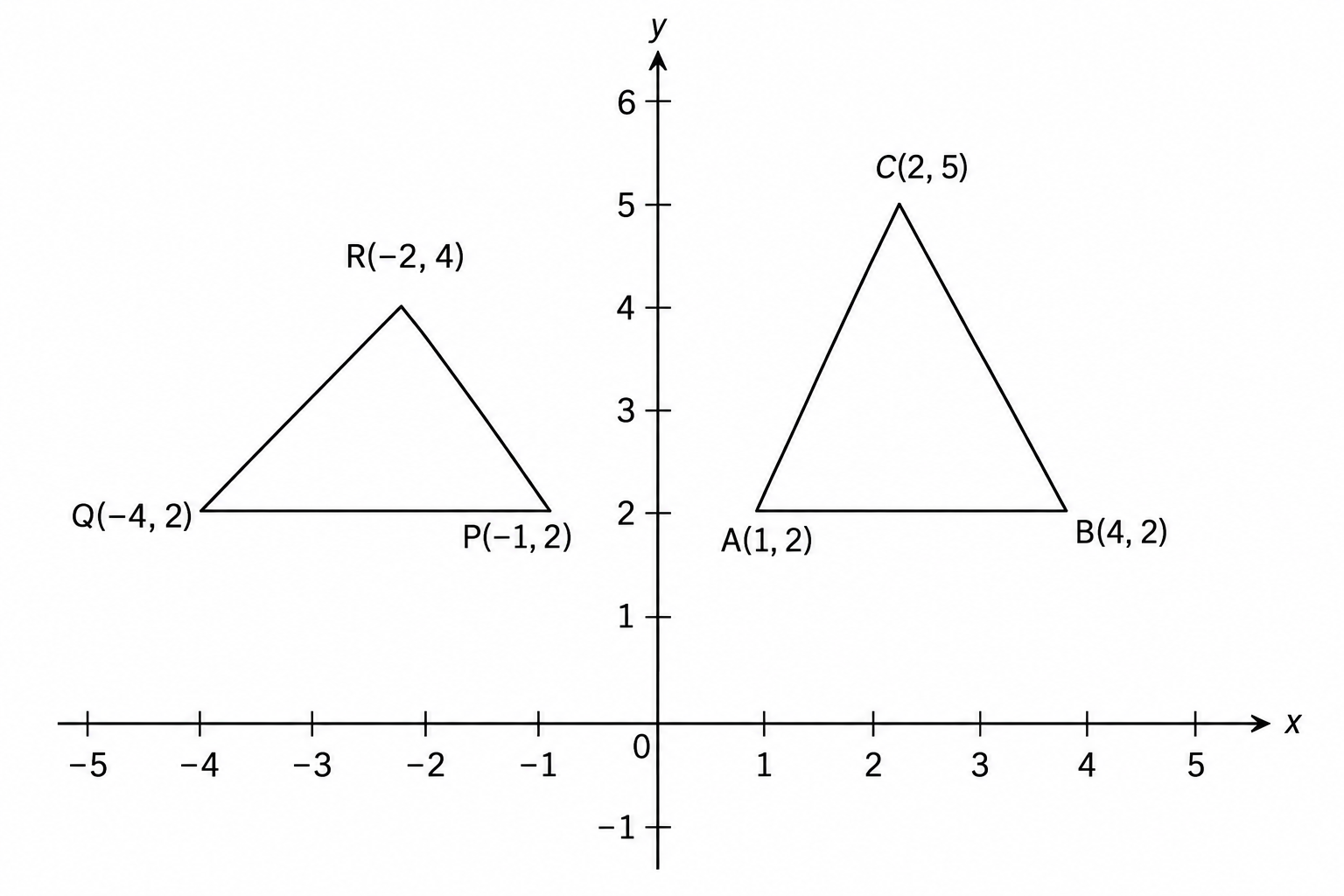
Diagram for question 10: A student tries to reflect triangle ABC in the y-axis, using P, Q and R as the images of A, B and C…
  1. A) Move P to ( − 1, − 2).
  2. B) Move Q to (4, − 2).
  3. C) Move R to ( − 2,5).
  4. D) Move R to ( − 5,2).

What this assessment covers

Concepts Tested

  • Transformations
  • Reflect 2D shapes on coordinate grids, in a given mirror line (x- or y-axis), recognising that the image is congruent to the object after a reflection.

Question Mix

  • Medium questions included

Skills you build

  • Understand