

MATHEMATICS - SYSTEMS OF EQUATIONS
Solving Systems by Elimination Worksheet
- Focuses on solving systems of equations using the elimination method
- Includes real-world application problems involving cost and items
- Challenges students with both integer and fractional coefficients
- Encourages understanding of graphical solutions to systems of equations
Start the 10-question quiz
Free, no sign-up needed. Your score shows instantly.
Here are the first 3 questions. Click “View all questions” to see the complete assessment.
Q1.
Q2.
The equations 2x + 3y = 5 and 5x − 2y = 22 have one common solution. What is the value of 2x − y at this solution?
Q3.
Use elimination to solve 4a − 3b = 18 and 2a + 5b = − 4. What is the value of 2a − b?
Q4.
A school buys notebooks costing 10 dollars each and folders costing 5 dollars each. It buys 38 items for a total of 290 dollars. Which pair gives the numbers of notebooks and folders?
Q5.
Find the pair that satisfies both 0.4x + 0.3y = 2.5 and 0.2x − 0.5y = − 0.7.
Q6.
For the simultaneous equations 6p + 5q = 7 and 4p − 3q = 11, find p − q.
Q7.
Solve the simultaneous equations x/2 + y/3 = 2 and x/4 − y/2 = − 1.
Q8.
The pair (x,y) satisfies both 3x − 2y = 7 and 5x + 3y = − 1. What is x + y?
Q9.
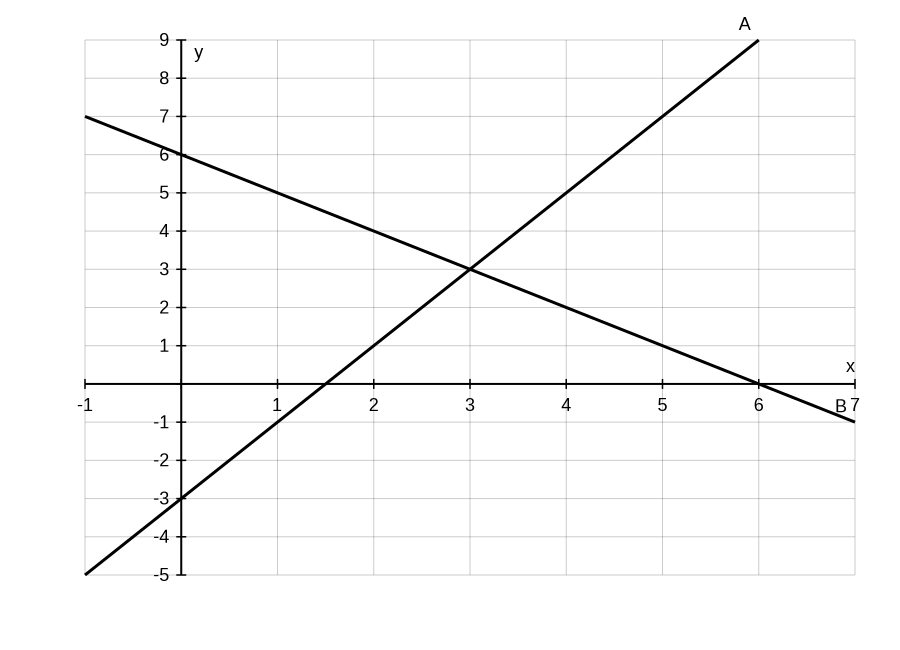
The graph shows the lines representing y = 2x − 3 and y = − x + 6. Which ordered pair is the solution of these simultaneous equations?
Q10.
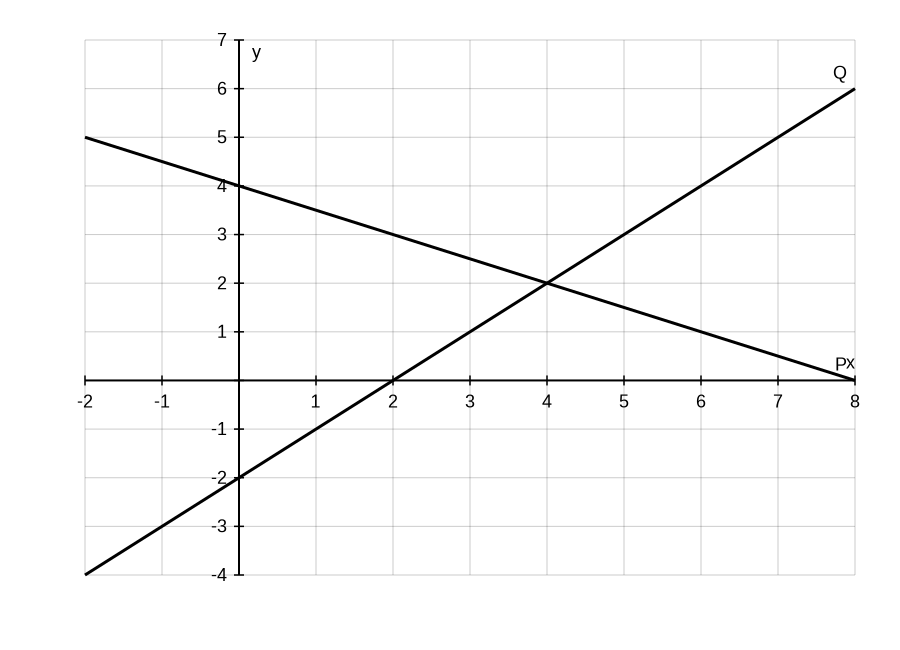
The two lines on the graph represent a pair of simultaneous linear equations. Use their point of intersection to find the value of x + 2y.
What this assessment covers
Concepts tested
- Solving systems of linear equations by elimination
- Understanding and applying the concept of simultaneous equations
- Interpreting solutions of equations graphically
- Working with equations involving fractions
- Application of algebra in real-world contexts
Question Mix
- Hard questions included
Skills you build
- Applying the elimination method to solve equations
- Interpreting and solving word problems involving systems of equations
- Analyzing and solving equations with fractional coefficients
- Identifying solutions graphically from intersection points
- Calculating specific values from solutions of equations
Related assessments
More practice
Other assessments in this subject
