

MATHEMATICS - SLOPE

Slope from Two Points Worksheet

  • Focuses on finding the equation of a line from two points
  • Emphasizes understanding of gradient and y-intercept
  • Includes practice with interpreting graphs of straight lines
  • Medium difficulty
Start the 10-question quiz Free, no sign-up needed. Your score shows instantly.

Here are the first 3 questions. Click “View all questions” to see the complete assessment.

Q1.

A straight line passes through the points (1,5) and (3,9). Which equation represents the line?

  1. A) y = 2x + 5
  2. B) y = 2x + 3
  3. C) y = 4x + 1
  4. D) y = x + 4

Q2.

A straight line goes through ( − 2,7) and (1, − 2). Which pair gives its gradient and vertical-axis intercept?

  1. A) Gradient 3 and intercept −5
  2. B) Gradient −1/3 and intercept −1
  3. C) Gradient −3 and intercept −2
  4. D) Gradient −3 and intercept 1

Q3.

The points (2,1) and (5,10) lie on the same straight line. Which equation has the correct gradient and vertical-axis intercept?

  1. A) y = 9x − 17
  2. B) y = 3x + 5
  3. C) y = 3x − 5
  4. D) y = x − 1

Q4.

A straight line passes through ( − 1, − 4) and (2,2). Which statement correctly describes its equation in the form y = mx + c?

  1. A) m = 3 and c = − 1
  2. B) m = 2 and c = − 2
  3. C) m = 2 and c = 2
  4. D) m = − 2 and c = − 2

Q5.

For a straight line, the values x = − 2,0,3 correspond respectively to y = 8,4, − 2. Which equation matches these values?

  1. A) y = − 2x + 8
  2. B) y = − x + 4
  3. C) y = 2x + 4
  4. D) y = − 2x + 4

Q6.

A straight line contains the points (0, − 3) and (4,5). Which statement explains the values of m and c in its equation?

  1. A) m = 8 because the vertical change is 8, and c = 4 because the second point has horizontal coordinate 4.
  2. B) m = 1/2 because the horizontal change is half the vertical change, and c = 5 because 5 is the greatest coordinate.
  3. C) m = − 2 because one vertical coordinate is negative, and c = 3 because an intercept must be positive.
  4. D) m = 2 because the vertical change is twice the horizontal change, and c = − 3 because the line crosses the vertical axis there.

Q7.

A straight line passes through ( − 3, − 8) and (2,7). Which equation corresponds to this line?

  1. A) y = 3x − 1
  2. B) y = − 3x + 1
  3. C) y = 5x + 7
  4. D) y = 3x + 1

Q8.

The points (2,7) and (6, − 1) lie on a straight line. Which reasoning correctly links these points to the equation of the line?

  1. A) The gradient is −8, and the second vertical coordinate gives c = − 1, so the equation is y = − 8x − 1.
  2. B) The gradient is ( − 1 − 7)/(6 − 2) = − 2, and substitution gives c = 11, so the equation is y = − 2x + 11.
  3. C) The gradient is (7 − ( − 1))/(6 − 2) = 2, and substitution gives c = 3, so the equation is y = 2x + 3.
  4. D) The gradient is (6 − 2)/( − 1 − 7) = − 1/2, and substitution gives c = 8, so the equation is y = − 1/2x + 8.

Q9.

The graph shows a straight line. Which equation corresponds to the graph?
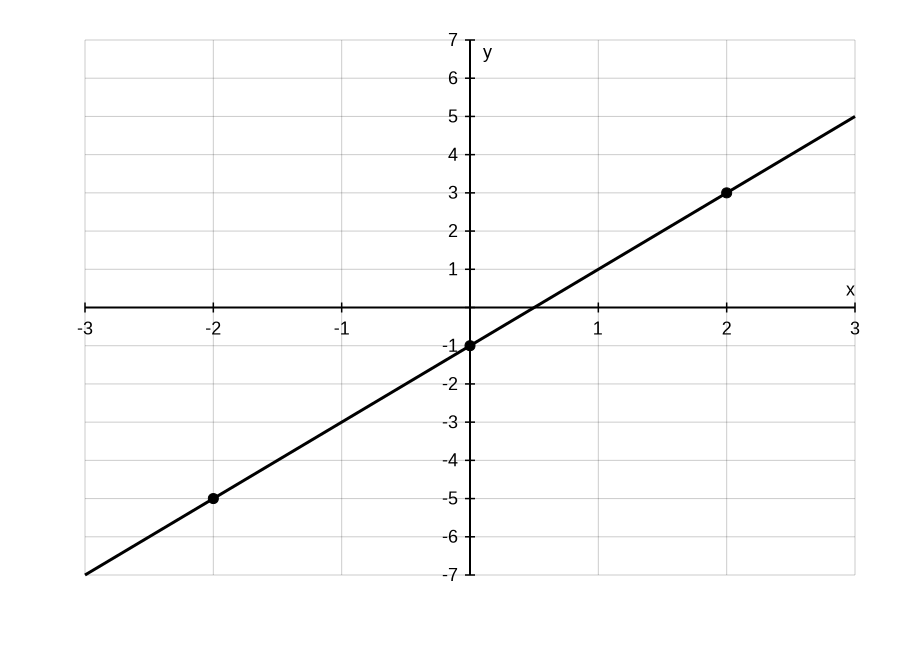
Diagram for question 9: The graph shows a straight line. Which equation corresponds to the graph?
  1. A) y = 2x + 1
  2. B) y = x − 2
  3. C) y = 2x − 1
  4. D) y = − 2x − 1

Q10.

The graph shows two straight lines labelled P and Q. Which statement about their equations is correct?
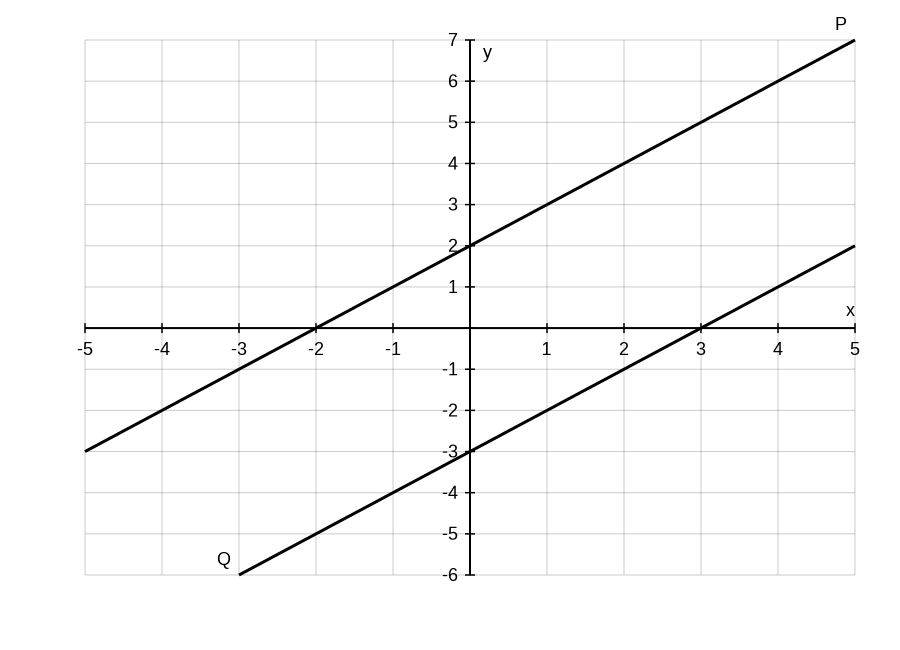
Diagram for question 10: The graph shows two straight lines labelled P and Q. Which statement about their equations is correct?
  1. A) Line P has gradient 2, while line Q has gradient −3.
  2. B) The lines have the same intercept 1 but different gradients.
  3. C) Both lines have gradient −1; the intercepts of P and Q are 2 and −3, respectively.
  4. D) Both lines have gradient 1; the intercepts of P and Q are 2 and −3, respectively.

What this assessment covers

Concepts tested

  • Equation of a line from two points
  • Understanding of gradient (slope)
  • Identifying y-intercept in equations
  • Graph interpretation of linear equations
  • Comparison of equations for different lines

Question Mix

  • Medium questions included

Skills you build

  • Calculate the gradient from two points
  • Determine the y-intercept from a line equation
  • Formulate the equation of a line
  • Interpret linear graphs
  • Compare and contrast different linear equations