Q1 Question
Points: 1
Choose the correct answer:
A straight line passes through the points (1,5) and (3,9). Which equation represents the line?
Showing question 1 of 10
Choose the correct answer:
A straight line goes through ( − 2,7) and (1, − 2). Which pair gives its gradient and vertical-axis intercept?
Choose the correct answer:
The points (2,1) and (5,10) lie on the same straight line. Which equation has the correct gradient and vertical-axis intercept?
Choose the correct answer:
A straight line passes through ( − 1, − 4) and (2,2). Which statement correctly describes its equation in the form y = mx + c?
Choose the correct answer:
For a straight line, the values x = − 2,0,3 correspond respectively to y = 8,4, − 2. Which equation matches these values?
Choose the correct answer:
A straight line contains the points (0, − 3) and (4,5). Which statement explains the values of m and c in its equation?
Choose the correct answer:
A straight line passes through ( − 3, − 8) and (2,7). Which equation corresponds to this line?
Choose the correct answer:
The points (2,7) and (6, − 1) lie on a straight line. Which reasoning correctly links these points to the equation of the line?
Choose the correct answer:
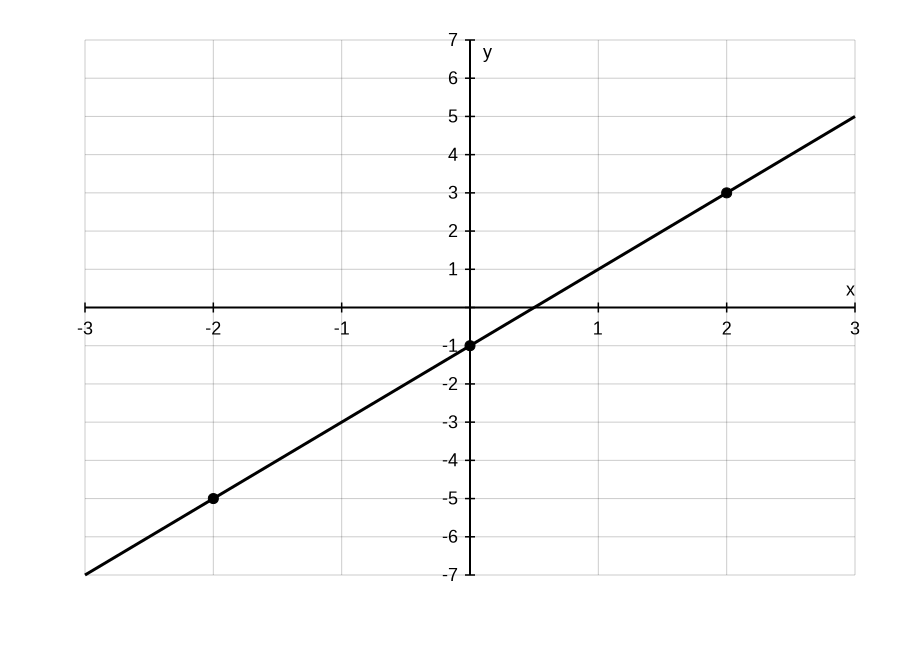
The graph shows a straight line. Which equation corresponds to the graph?
Choose the correct answer:
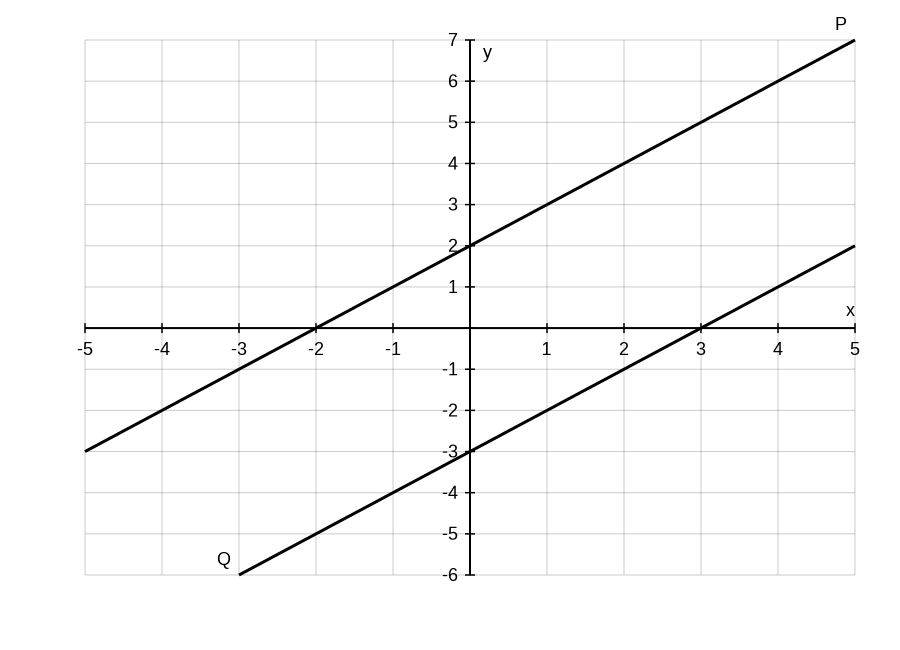
The graph shows two straight lines labelled P and Q. Which statement about their equations is correct?