

MATHEMATICS - RIGHT TRIANGLE TRIGONOMETRY
Right Triangle Trigonometry Worksheet
- Covers complex trigonometric calculations involving angles of elevation and depression
- Focuses on real-world applications of right triangle trigonometry
- Includes problems requiring precise measurement and estimation
Start the 10-question quiz
Free, no sign-up needed. Your score shows instantly.
Here are the first 3 questions. Click “View all questions” to see the complete assessment.
Q1.
Q2.
An observer stands 24 m horizontally from the foot of a vertical mast. The observer's eye is 1.6 m above level ground, and the angle of elevation of the top of the mast is 41^(°). A straight cable runs from the top of the mast to another point on the ground and makes an angle of 58^(°) with the ground. What is the length of the cable, to the nearest 0.1 m?
Q3.
An aircraft is flying at a constant height of 950 m. The near and far ends of a straight horizontal runway are in the same direction from the aircraft and have angles of depression 12^(°) and 7^(°), respectively. What is the length of the runway, to 3 significant figures?
Q4.
From the top of a vertical cliff, the angle of depression of a boat is 24^(°). After the boat travels 180 m directly towards the foot of the cliff, the angle of depression is 38^(°). What is the height of the cliff, to the nearest metre?
Q5.
The diagonal of a rectangular panel is 17.5 m and makes an angle of 33^(°) with a longer side of the panel. What is the perimeter of the panel, to the nearest 0.1 m?
Q6.
A straight ramp is 5.20 m long and rises vertically by 0.84 m. It is replaced by a ramp with the same vertical rise but an angle of 7^(°) to the horizontal. By how much must the horizontal run increase, to the nearest 0.01 m?
Q7.
An observer is horizontally 32 m from a vertical tree. From the observer's eye level, the angle of elevation of the top of the tree is 29^(°) and the angle of depression of its base is 4^(°). What is the height of the tree, to the nearest 0.1 m?
Q8.
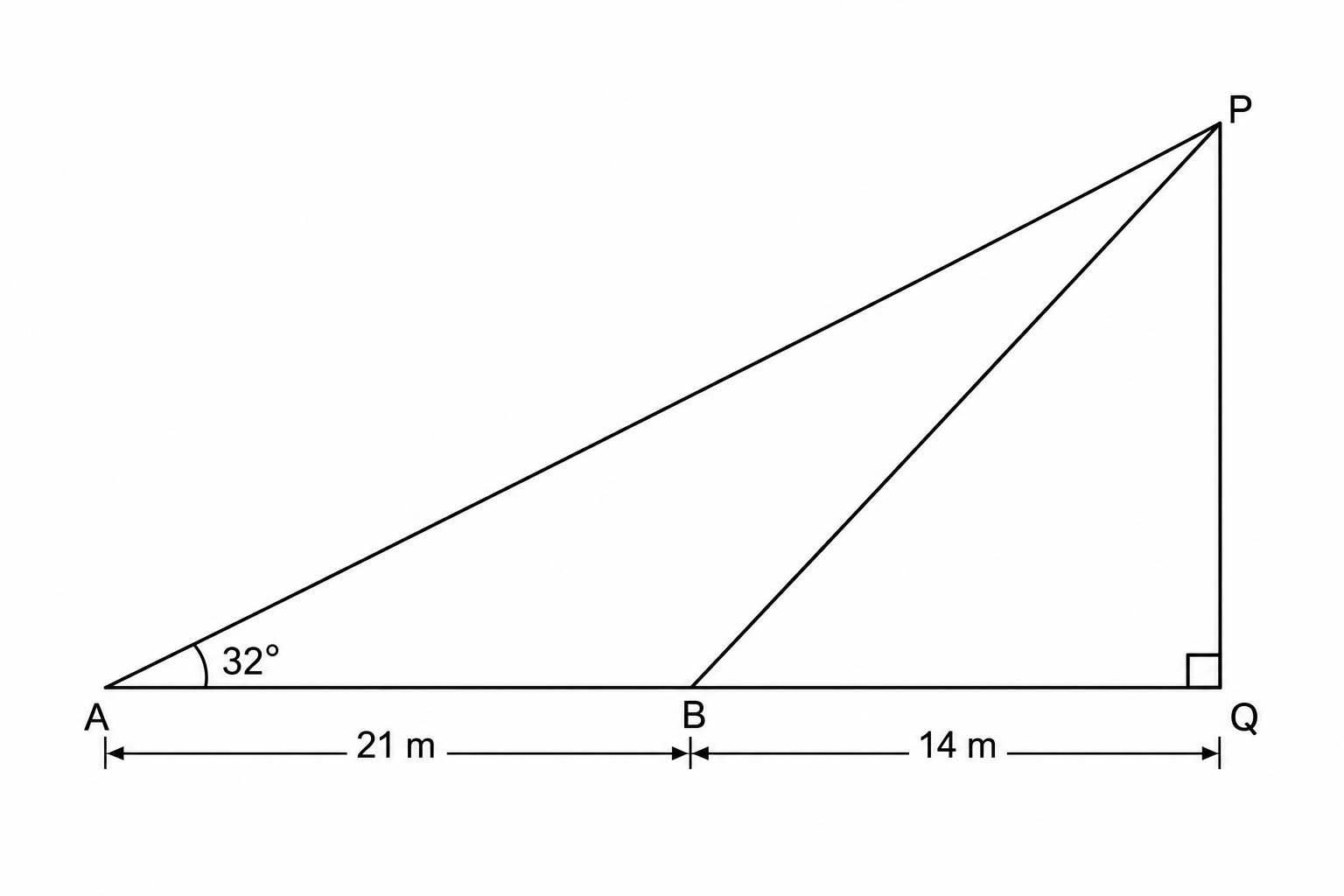
The diagram shows two observation points, A and B, on level ground with a vertical tower PQ. What is the angle of elevation of P from B, to the nearest 0.1^(°)?
Q9.
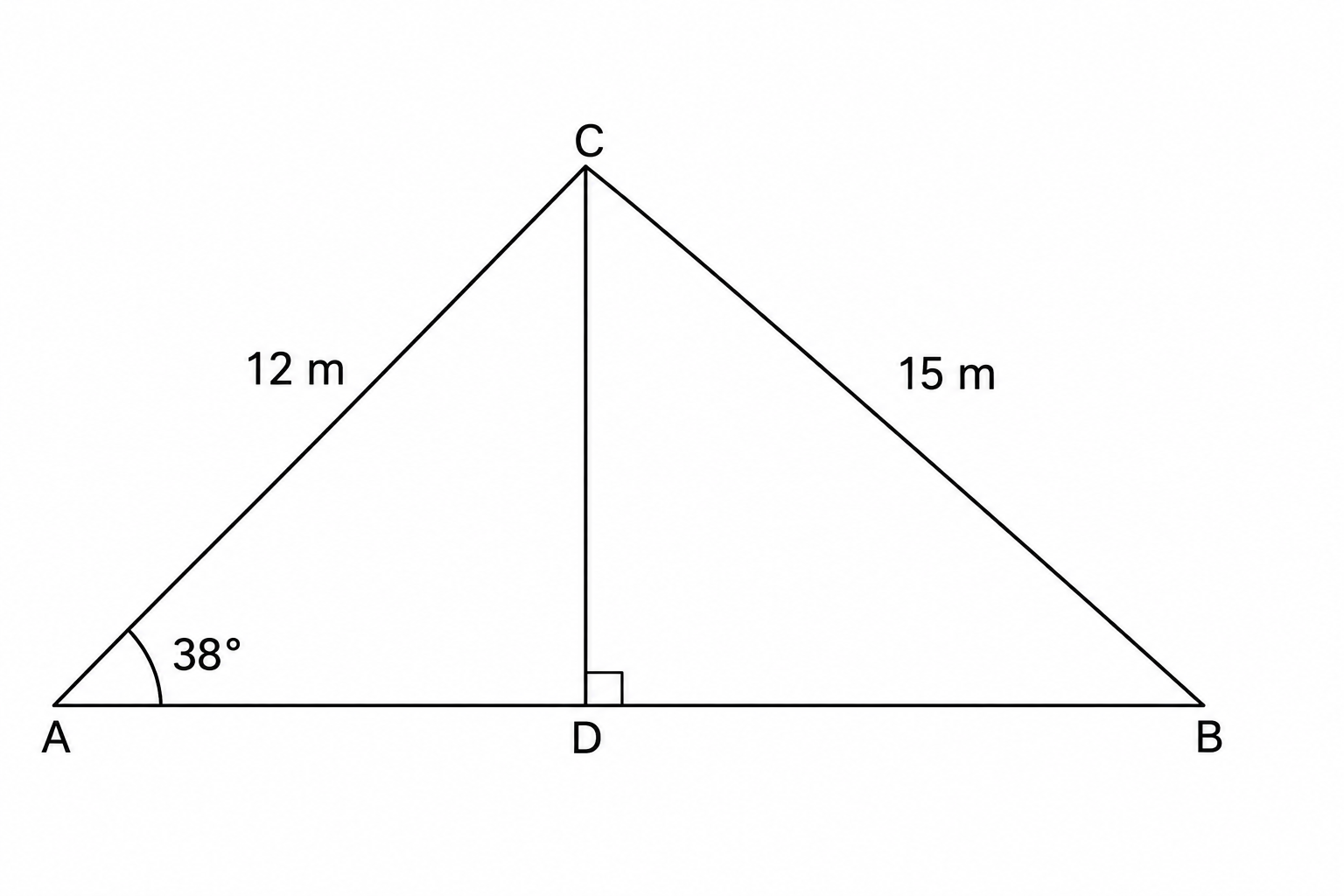
In the diagram, CD is perpendicular to AB. What is the length of AB, to the nearest 0.1 m?
Q10.
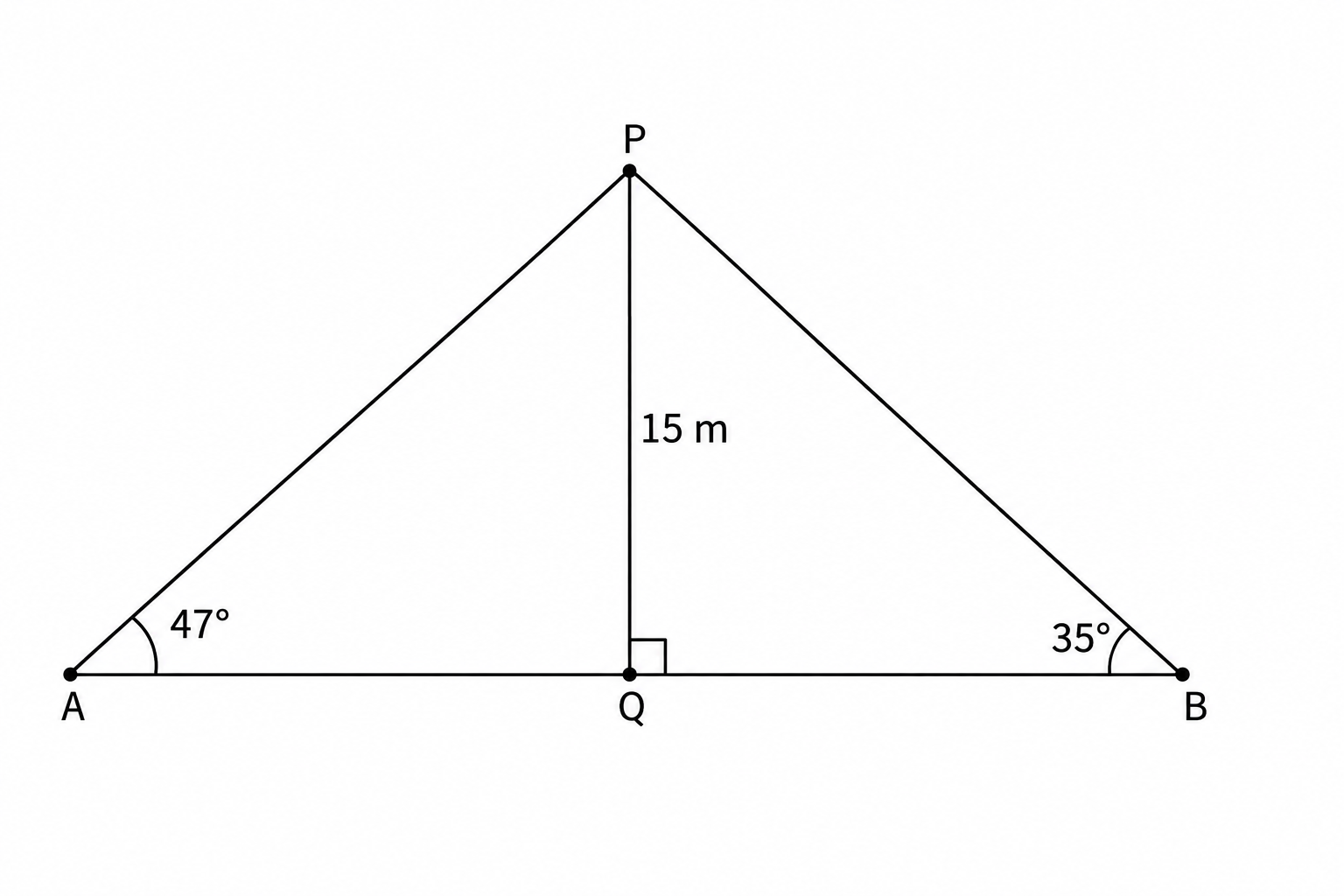
The diagram shows two cables attached to the same point P on a vertical mast. The ground anchors are A and B. What is the distance AB, to the nearest 0.1 m?
What this assessment covers
Concepts tested
- Angles of elevation and depression
- Trigonometric ratios in right triangles
- Solving for unknown lengths and heights
- Application of trigonometry in real-world contexts
- Understanding and using significant figures in calculations
Question Mix
- Hard questions included
Skills you build
- Calculate heights and distances using trigonometry
- Apply trigonometric ratios to solve real-world problems
- Interpret and solve problems involving angles of elevation and depression
- Estimate measurements to a specified degree of accuracy
- Analyze and solve complex geometric configurations
Related assessments
More practice
Other assessments in this subject
