

MATHEMATICS - POLYNOMIAL OPERATIONS
Multiplying Polynomials Worksheet
- Focuses on expanding and simplifying polynomial expressions
- Includes application of the distributive law in polynomial multiplication
- Covers simplification using laws of indices and division of polynomials
- Involves problem-solving with coefficients and unknowns in expressions
Start the 10-question quiz
Free, no sign-up needed. Your score shows instantly.
Here are the first 3 questions. Click “View all questions” to see the complete assessment.
Q1.
Q2.
Which expression is the simplified expansion of (3a − 2 ) (a + 5 )?
Q3.
Which line correctly applies the distributive law as the first step in expanding (2b − 3 ) (b + 4 )?
Q4.
A student expands (m + 6 ) (m − 2 ) and obtains m² + 4m − 12. Why is the coefficient of m equal to 4?
Q5.
Expand (x² + 3x ) (x³ − 2 ) and simplify using the laws of indices.
Q6.
Simplify ( (y + 4 ) (y − 1 ))/(y + 4), where y ≠ − 4.
Q7.
When (2p + 3 ) (p + k ) is expanded, the coefficient of p is 11. What is the value of k?
Q8.
The expansion of (3t − 2 ) (2t + 5 ) is written as 6t² + □ − 10. Which term should replace the box?
Q9.
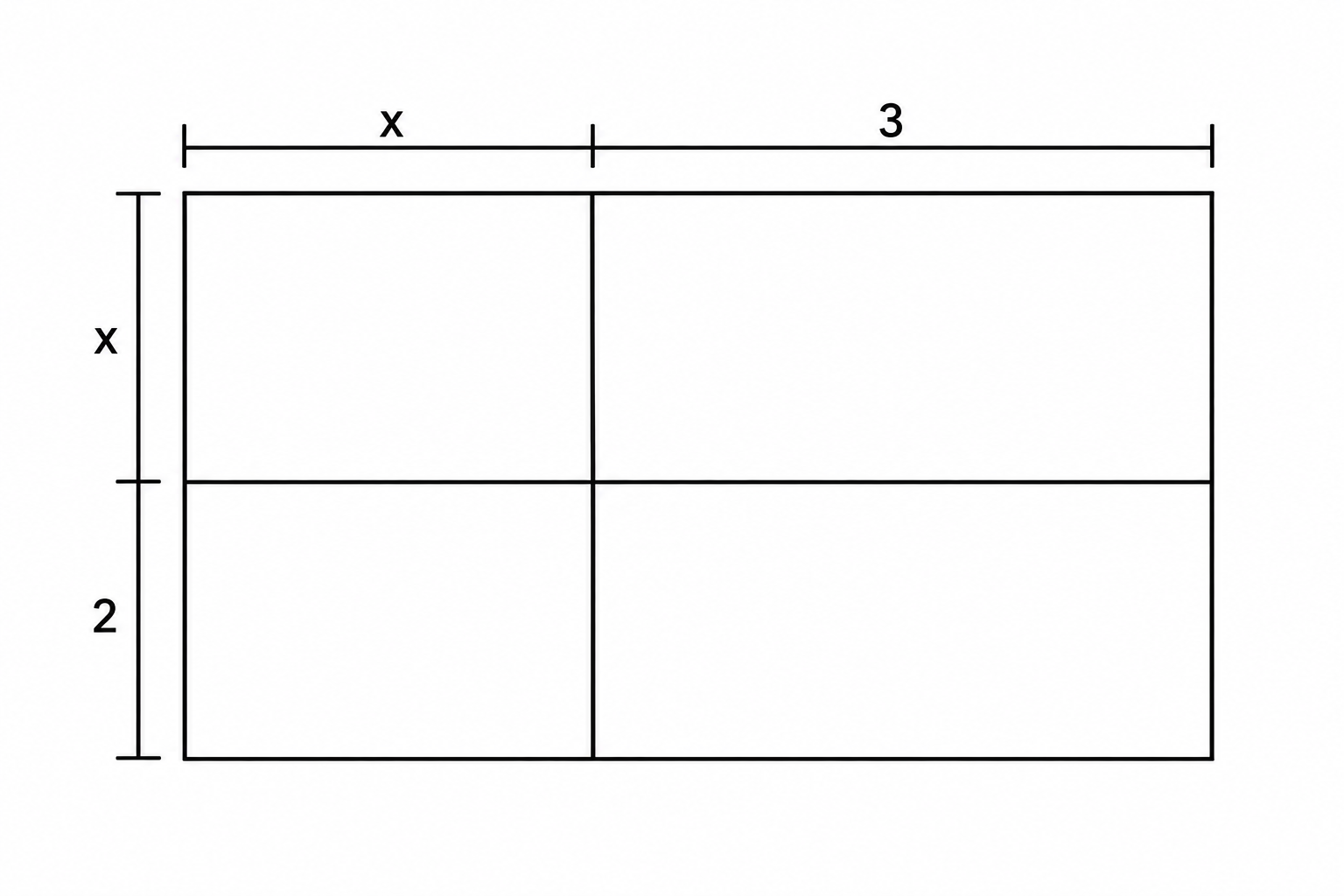
The diagram shows a rectangle divided into four smaller rectangles. Which expression gives its total area after collecting like terms?
Q10.
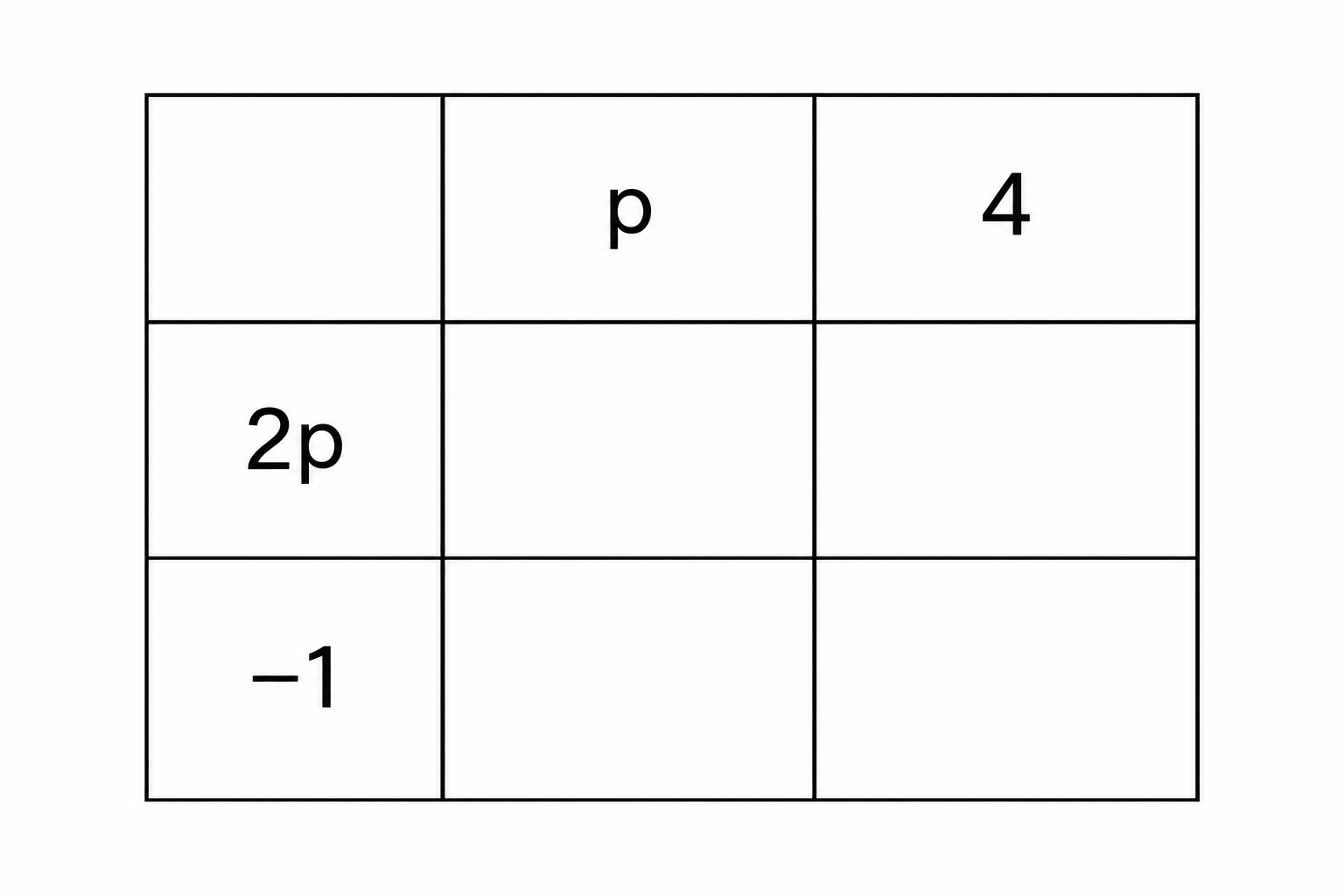
The diagram is a multiplication grid. Each inner cell is found by multiplying its row heading by its column heading. Which expression is the sum of the four inner-cell products after like terms are collected?
What this assessment covers
Concepts tested
- Expanding binomial expressions
- Simplifying polynomial expressions
- Using the distributive law in algebra
- Applying laws of indices in polynomial multiplication
- Understanding coefficients in polynomial expansions
Question Mix
- Medium questions included
Skills you build
- Expanding and simplifying expressions
- Applying the distributive property
- Using algebraic identities
- Solving for unknowns in expressions
- Interpreting polynomial expressions in geometric contexts
Related assessments
More practice
Other assessments in this subject
