

MATHEMATICS - ORDER OF OPERATIONS
Order of Operations Practice Problems
- Focuses on applying the order of operations in mathematical expressions
- Includes problems involving integers, powers, and roots
- Challenges students to identify and correct errors in calculations
- Medium difficulty
Start the 10-question quiz
Free, no sign-up needed. Your score shows instantly.
Here are the first 3 questions. Click “View all questions” to see the complete assessment.
Q1.
Q2.
Which line correctly shows the first step when evaluating 24 ÷ (8 − 2) + 3²?
Q3.
What is the value of (18 − 2 × 5)² ÷ 4?
Q4.
Which sequence gives the correct order of operations for 7 + 2³ × 5?
Q5.
A student writes 4 × 3² = 12². Which statement best explains the student's error?
Q6.
Which expression has a value of 14?
Q7.
A rule says: subtract 3 from 11, square the result, and then divide by 4. Which expression represents this rule?
Q8.
Which placement of brackets makes the value of the expression equal to 4?
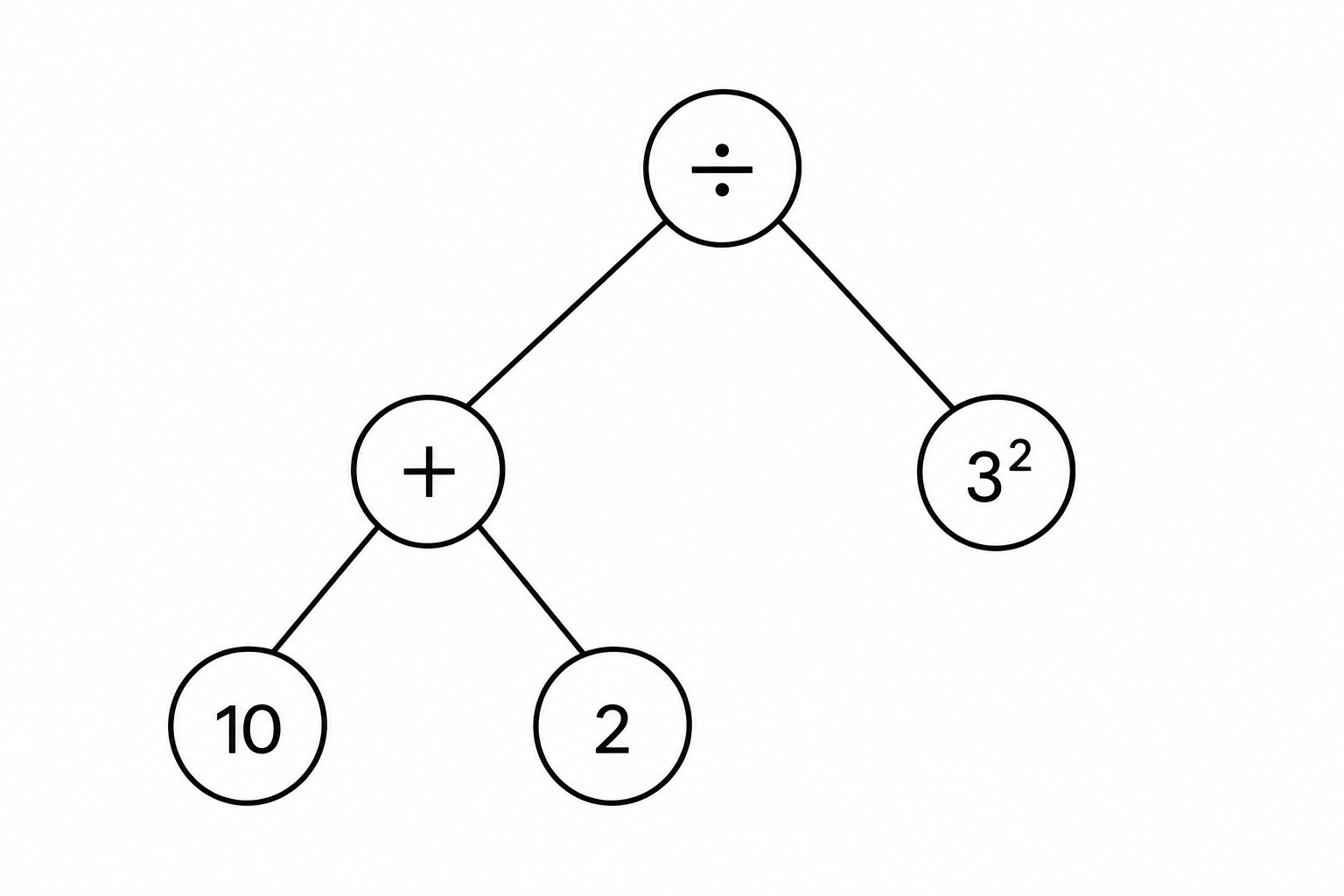
Q9.
The operation tree shows how an expression is formed. Which expression does the tree represent?
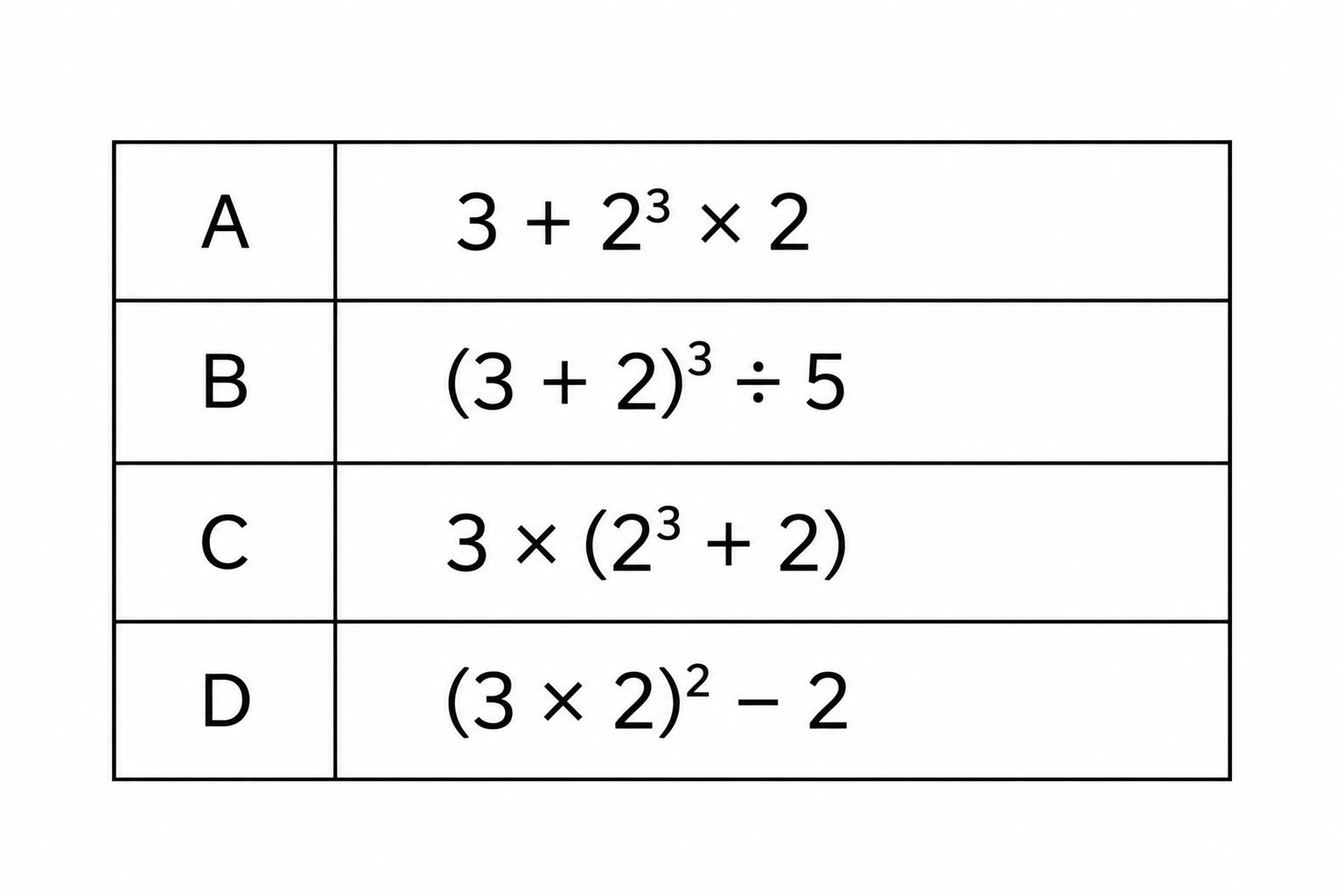
Q10.
The image shows four expression cards. Which card contains the expression with the greatest value?
What this assessment covers
Concepts tested
- Order of operations (PEMDAS/BODMAS)
- Evaluating expressions with powers and roots
- Identifying correct sequences in calculations
- Understanding and correcting mathematical errors
- Use of brackets to alter expression outcomes
Question Mix
- Medium questions included
Skills you build
- Applying the order of operations to solve expressions
- Evaluating complex expressions accurately
- Identifying errors in mathematical reasoning
- Interpreting and constructing mathematical expressions
- Using logical reasoning to determine expression values
Related assessments
More practice
Other assessments in this subject
