

MATHEMATICS - MULTIPLYING AND DIVIDING FRACTIONS
Dividing Fractions Problems with Answers
- Focuses on dividing fractions and interpreting results
- Includes practical applications like filling containers and dividing gardens
- Uses benchmark fractions for estimation
- Covers error analysis in fraction division
Start the 10-question quiz
Free, no sign-up needed. Your score shows instantly.
Here are the first 3 questions. Click “View all questions” to see the complete assessment.
Q1.
Q2.
A container holds 5/6 L of juice. Each glass holds 1/6 L. How many full glasses can be filled?
Q3.
Which multiplication expression has the same value as 7/9 ÷ 3/4?
Q4.
Use the benchmark fractions 5/8 ≈ 1/2 and 2/7 ≈ 1/4. What is the best estimate of 5/8 ÷ 2/7?
Q5.
Which statement correctly describes 2/3 ÷ 5/6?
Q6.
The calculation 7/10 ÷ 2/5 = 7/4 is given. Which multiplication equation checks the calculation by multiplying the quotient by the divisor?
Q7.
A fraction 7/8 of a garden is used for plants. Flowers occupy 3/5 of this planted area. What fraction of the whole garden is used for flowers?
Q8.
A student writes 4/7 ÷ 2/3 = 8/21. Which option correctly explains and fixes the error?
Q9.
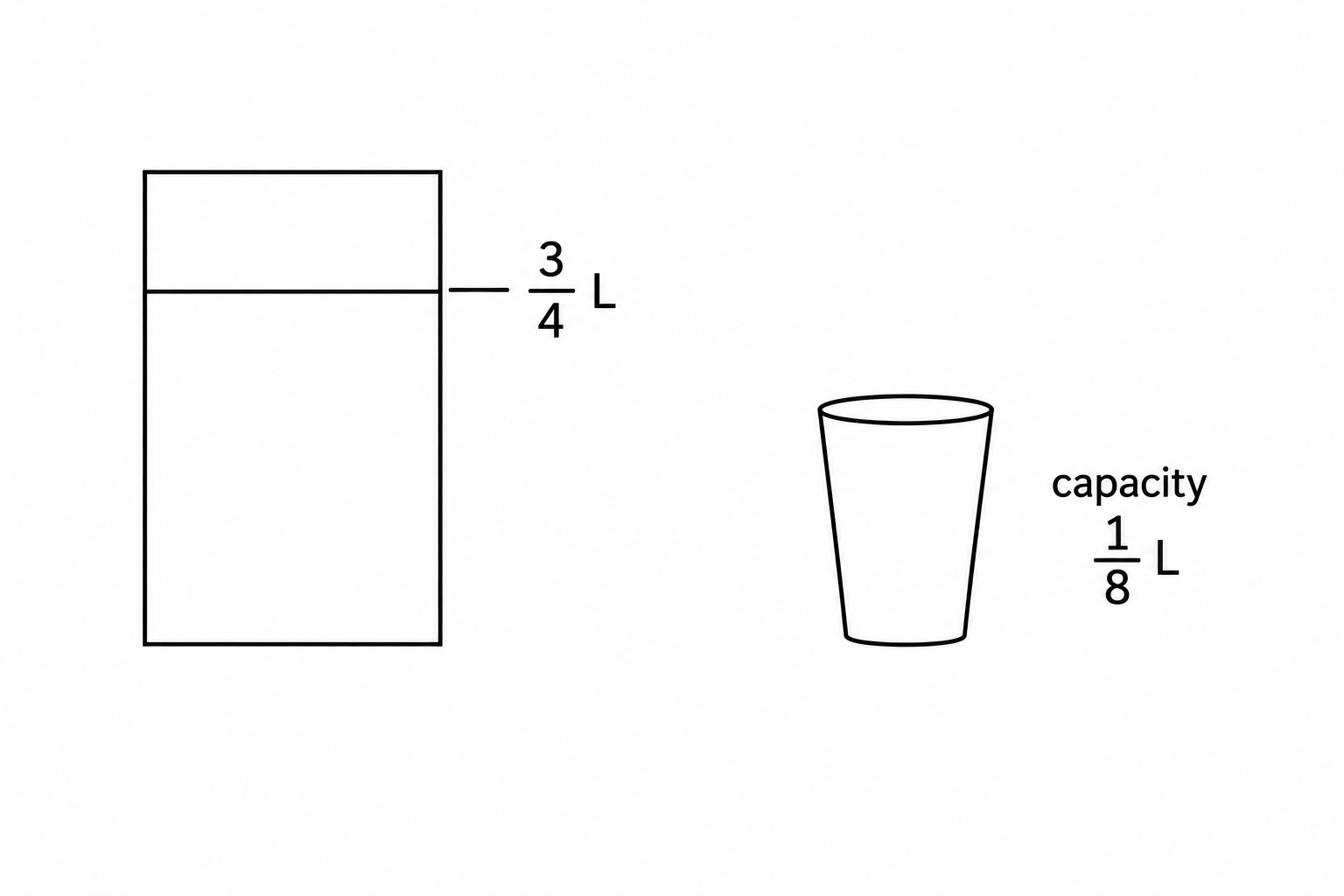
The diagram shows the amount of juice in a container and the capacity of one glass. How many full glasses can be filled?
Q10.
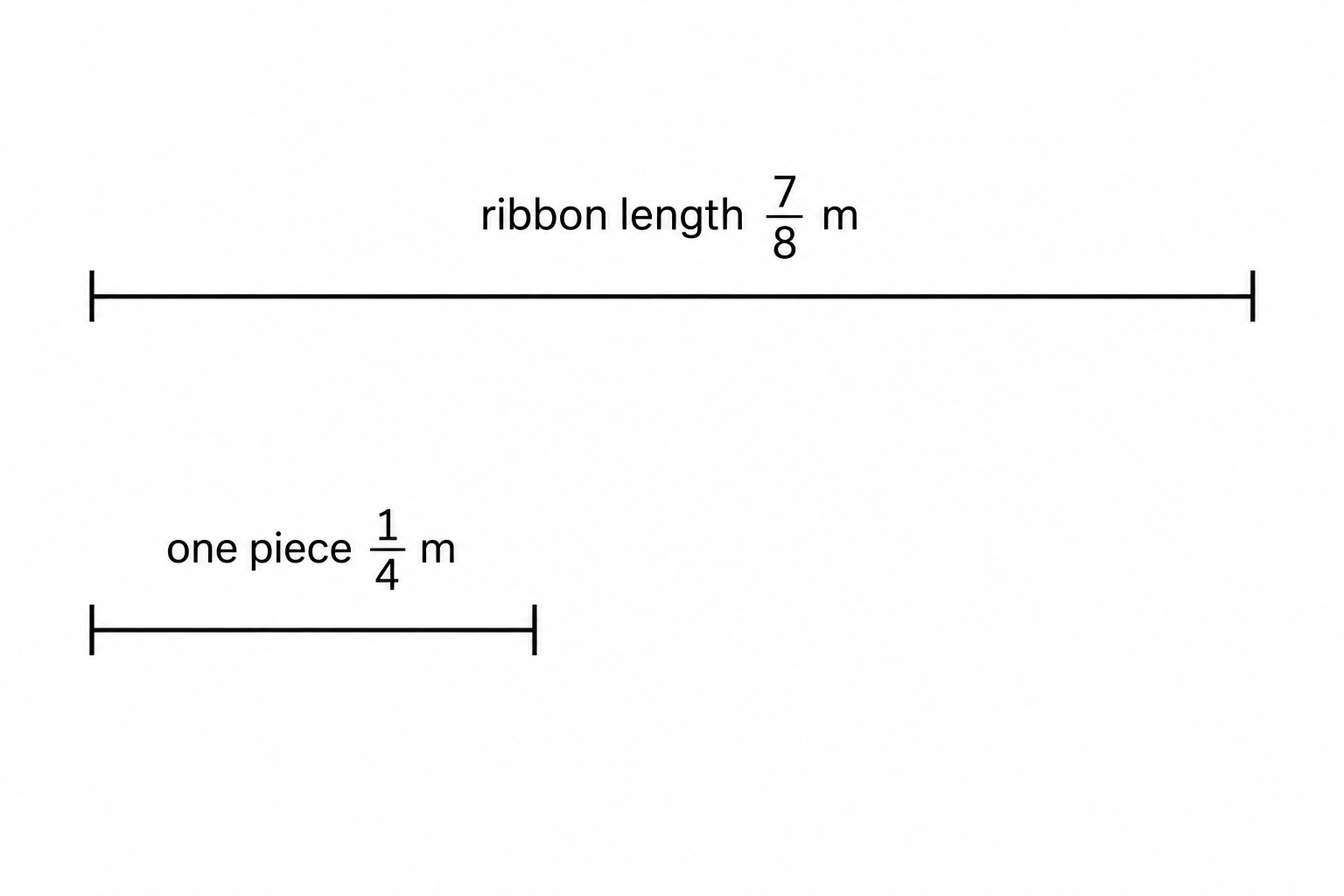
The diagram shows the length of a ribbon and the required length of each piece. How many piece-lengths are contained in the ribbon?
What this assessment covers
Concepts tested
- Dividing fractions
- Equivalent multiplication expressions for division
- Estimating with benchmark fractions
- Interpreting division results in real-world contexts
- Error analysis in fraction division
Question Mix
- Medium questions included
Skills you build
- Perform division of fractions
- Convert division problems to multiplication
- Estimate using benchmark fractions
- Apply fraction division to solve practical problems
- Identify and correct errors in fraction calculations
Related assessments
More practice
Other assessments in this subject
