

MATHEMATICS - FUNCTION TRANSFORMATIONS
Function Transformations Worksheet
- 10 questions
- Difficulty: Hard
- Board: US
- Attempt online on the examination portal
Start the 10-question quiz
Free, no sign-up needed. Your score shows instantly.
Here are the first 3 questions. Click “View all questions” to see the complete assessment.
Q1.
Q2.
Let f(x) = x² and h(x) = − 2x² + 12x − 11. Which expression correctly writes h as a transformation of f?
Q3.
The graph of g is obtained from f(x) = |x| using translations, a reflection across the horizontal axis, and a vertical stretch. Its vertex is ( − 2,6), and it passes through (1, − 3). What is the set of zeros of g?
Q4.
Starting with the graph of an arbitrary function y = f(x), perform these transformations in order: compress horizontally by a factor of frac13, translate right by 2 units, reflect across the vertical axis, and translate down by 4 units. Which equation represents the final graph?
Q5.
A function f is defined for all real numbers and is odd, so f( − x) = − f(x). Which function must be even for every such choice of f?
Q6.
Let f(x) = 2^(x). A transformed function has the form g(x) = f(bx) + k, where b and k are real constants. If g(1) = 7 and g(2) = 19, which expression represents g?
Q7.
Let f(x) = frac1x. A transformed function g(x) = af(x − h) + k has vertical asymptote x = − 2 and horizontal asymptote y = 3. Its graph passes through (1,0). Which expression represents g?
Q8.
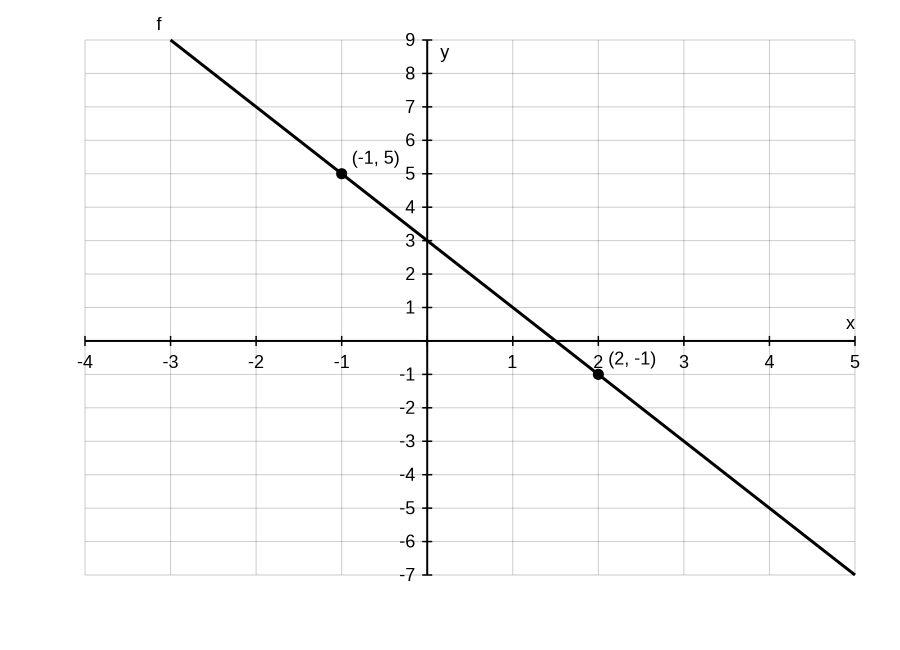
The graph shows the linear function f. Define g(x) = − 3f ((x − 2)/(4) ) + 5. What is the horizontal-axis intercept of the graph of g?
Q9.
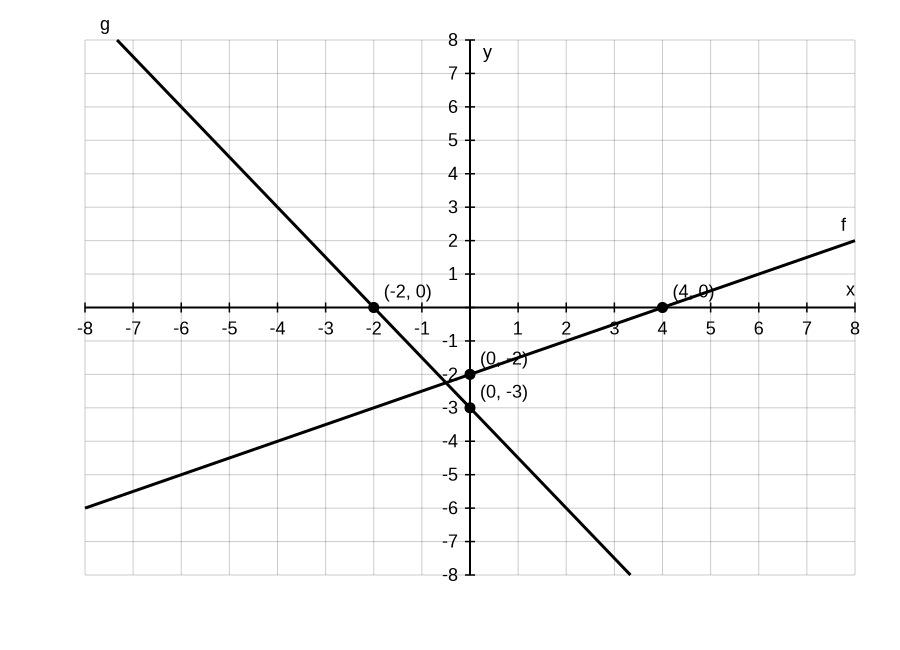
The graph shows linear functions f and g. They are related by g(x) = af(x − h), with no additional vertical translation. What are the values of a and h?
Q10.
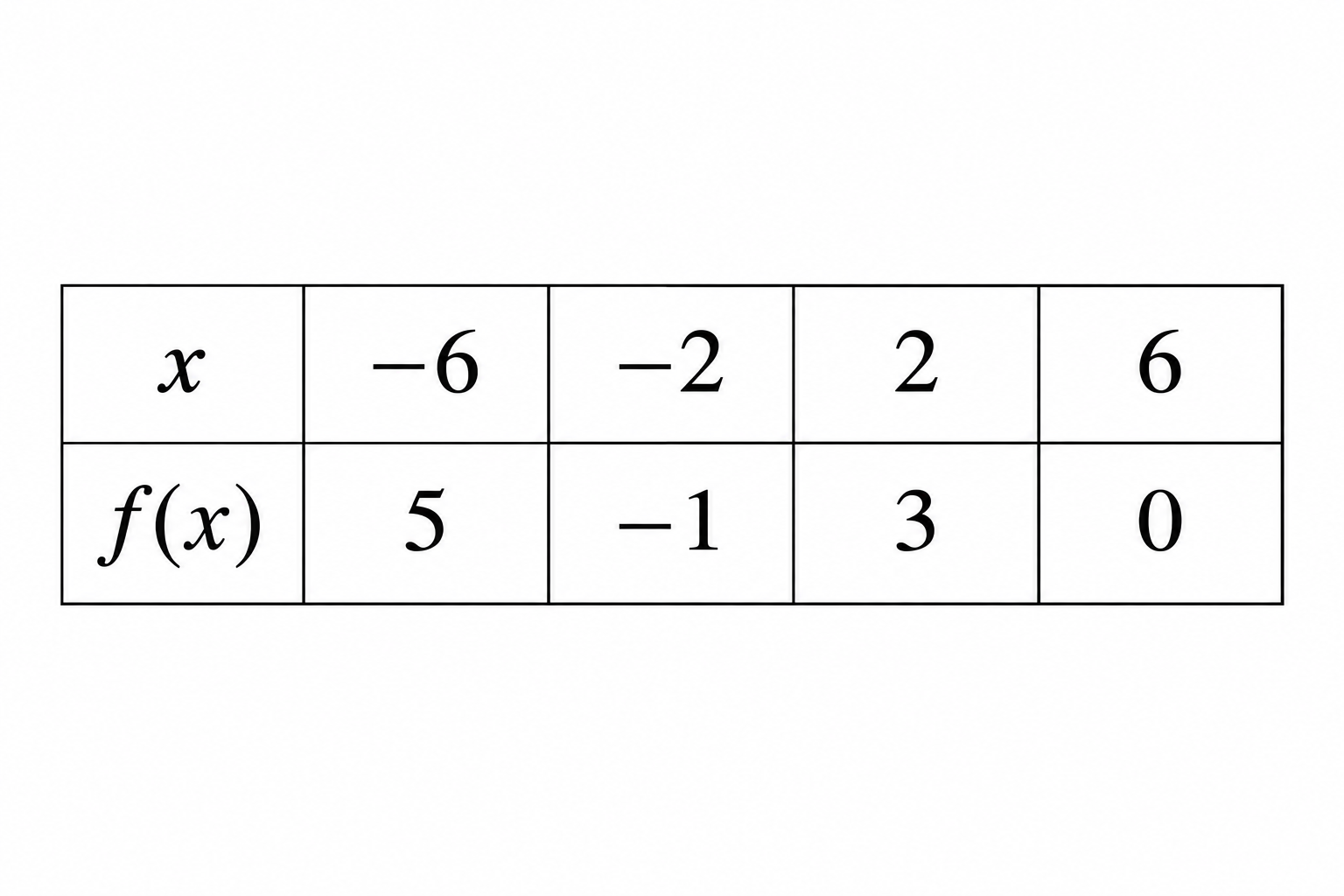
The table gives every input and output of the function f. Define g(x) = − 2f(2 − 4x) + 3, using only nonnegative inputs for which this expression is defined. Which choice gives the domain and range of g?
What this assessment covers
Concepts Tested
- Function Transformations
Question Mix
- Hard questions included
Skills you build
- Apply
Related assessments
More practice
Other assessments in this subject
