

MATHEMATICS - EQUIVALENT FRACTIONS
Equivalent Fractions Worksheet
- Focuses on identifying and creating equivalent fractions
- Includes practical scenarios like dividing a sandwich
- Covers simplifying fractions to their simplest form
- Uses visual aids like number lines and fraction bars
Start the 10-question quiz
Free, no sign-up needed. Your score shows instantly.
Here are the first 3 questions. Click “View all questions” to see the complete assessment.
Q1.
Q2.
What number makes 2/3 = □/6 true?
Q3.
What number makes 3/5 = 6/□ true?
Q4.
Which rule can be used to make an equivalent fraction?
Q5.
Which pair contains equivalent fractions?
Q6.
Which fraction shows 4/8 in simplest form?
Q7.
A point is located halfway between 0 and 1 on a number line. Which two fractions can both name its location?
Q8.
Lena cuts a sandwich into 6 equal pieces and eats 2 pieces. Which fraction is equivalent to the part she eats?
Q9.
Why are 3/4 and 6/8 equivalent?
Q10.
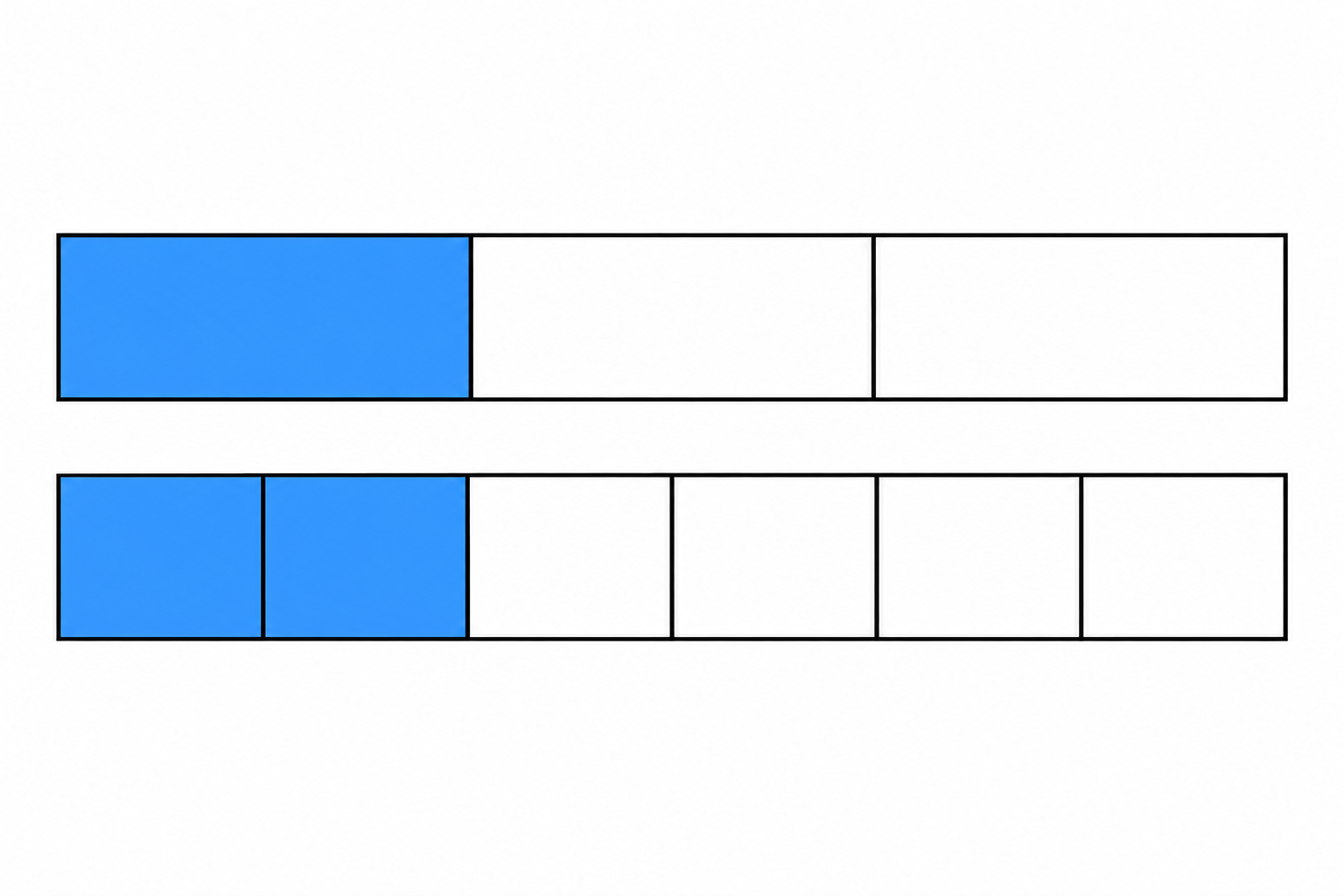
The figure shows two fraction bars of equal size. Which equation describes the shaded parts?
What this assessment covers
Concepts tested
- Equivalent fractions
- Simplifying fractions
- Fraction comparison using number lines
- Fraction representation in real-life scenarios
- Understanding fraction equations
Question Mix
- Easy questions included
Skills you build
- Identify equivalent fractions
- Simplify fractions to simplest form
- Use number lines to compare fractions
- Apply fractions to solve real-world problems
- Interpret and write fraction equations
Related assessments
More practice
Other assessments in this subject
