

MATHEMATICS - DIRECT AND INVERSE PROPORTION
Direct Variation Worksheet
- 10 questions
- Understand the relationship between two quantities when they are in direct or inverse proportion.
- Difficulty: Hard
- Board: CAIE
- Attempt online on the examination portal
Start the 10-question quiz
Free, no sign-up needed. Your score shows instantly.
Here are the first 3 questions. Click “View all questions” to see the complete assessment.
Q1.
Q2.
Two meshing gears turn so that their rotation rates are inversely proportional to their numbers of teeth. The driving gear has 24 teeth and turns at 150 revolutions per minute. The other gear has 40 teeth. How many complete revolutions does the other gear make in 2.5 min?
Q3.
The positive quantities x and y are directly proportional. Increasing x by 6 increases y by 15. For one pair of values, x + y = 42. What is the value of y when x is 8 greater than it was in that pair?
Q4.
A team of 15 workers can complete a job in 18 days. All workers work at the same constant rate. After working together for 6 days, 5 workers leave. How many days in total, from the start, will the job take?
Q5.
The positive quantities p and q are inversely proportional. When p increases by 25%, q decreases by 7. What was the value of q before the change?
Q6.
A spring's extension beyond its natural length is directly proportional to the force applied. Its total length is 22.5 cm with a force of 3 N, and 32.5 cm with a force of 8 N. What force gives a total length of 41.5 cm?
Q7.
A coach travelling at a constant speed of 72 km h⁻¹ takes 2 h 40 min to complete a journey. What constant speed would allow it to complete the same journey in 40 min less?
Q8.
Printer A prints 360 leaflets in 15 min. Printer B prints 25% more leaflets per minute than printer A. Each printer works at a constant rate. How long does printer B take to print 1500 leaflets?
Q9.
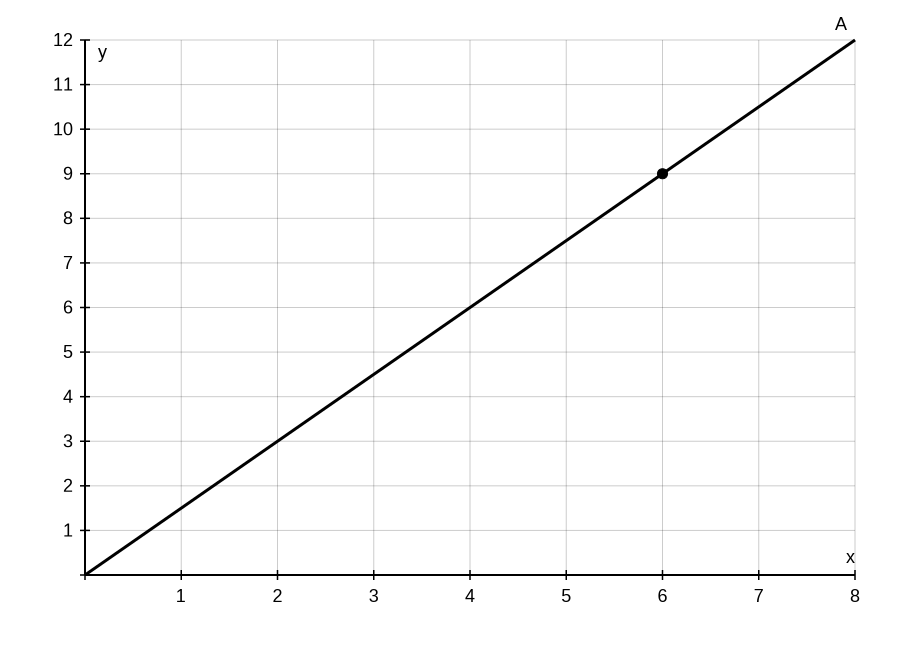
The graph shows a direct proportion between x and y for relationship A. Relationship B is also a direct proportion. For every positive value of x, its value of y is 25% greater in B than in A. In relationship B, what is x when y = 22.5?
Q10.
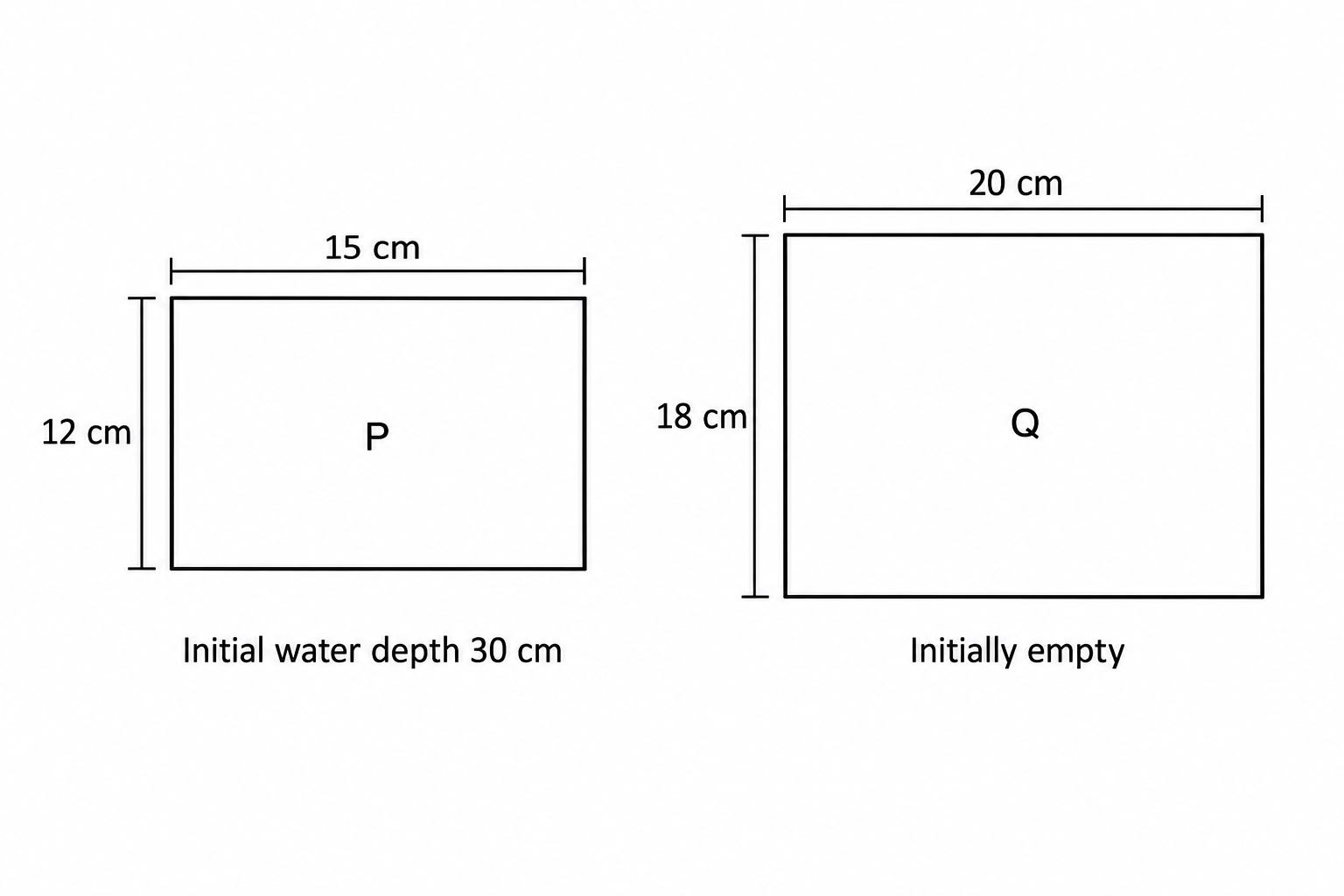
The diagram shows the rectangular bases of two tanks with vertical sides. Tank P contains water to a depth of 30 cm. Tank Q is empty. Four fifths of the water in P is transferred to Q. Water depth is directly proportional to water volume for a fixed base area, and inversely proportional to base area for a fixed volume. What is the depth of water in Q after the transfer?
What this assessment covers
Concepts Tested
- Direct and Inverse Proportion
- Understand the relationship between two quantities when they are in direct or inverse proportion.
Question Mix
- Hard questions included
Skills you build
- Apply
Related assessments
More practice
Other assessments in this subject
