

MATHEMATICS - COMPLEX NUMBERS
Operations with Complex Numbers Worksheet
- 10 questions
- Difficulty: Hard
- Board: CAIE
- Attempt online on the examination portal
Start the 10-question quiz
Free, no sign-up needed. Your score shows instantly.
Here are the first 3 questions. Click “View all questions” to see the complete assessment.
Q1.
Q2.
A complex number z satisfies (2 − i)z + (2 + 3i)overlinez = 12 − 4i, where overlinez denotes its complex conjugate. Find z.
Q3.
The real numbers p and q satisfy (1)/(1 + 2i) = (p)/(2 − i) + (q)/(1 − i). Find p + 2q.
Q4.
Express ((1 + i)⁶)/((1 − i)³(2 + i)) in Cartesian form.
Q5.
For a positive real number t, let z = (t − 2i)/(3 − ti). The real part of z is twice its imaginary part. Find t.
Q6.
A non-zero complex number z satisfies z + 1/z = 2 − i. Without finding z, evaluate (z² + 1)/(z² − z + 1).
Q7.
A sequence of complex numbers is defined by z_n + 1 = (1 + i)z_n + 2 − i for n ≥ 0. Given that z_3 = 9 + 10i, find z_0.
Q8.
The complex number w satisfies (w + i)/(w − 2) = (1 − 2i)/(3 + i). Find w in Cartesian form.
Q9.
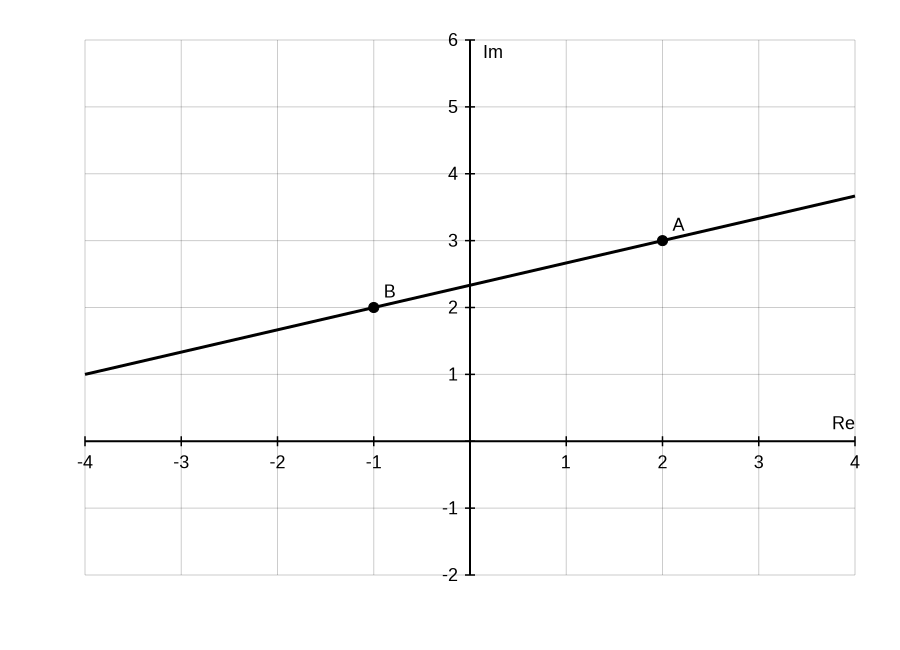
On the Argand diagram, the points A and B represent the complex numbers a and b, respectively. A mapping is defined by T(z) = uz + v, where u and v are complex constants. Given that T(a) = b and T(b) = overlinea, find v.
Q10.
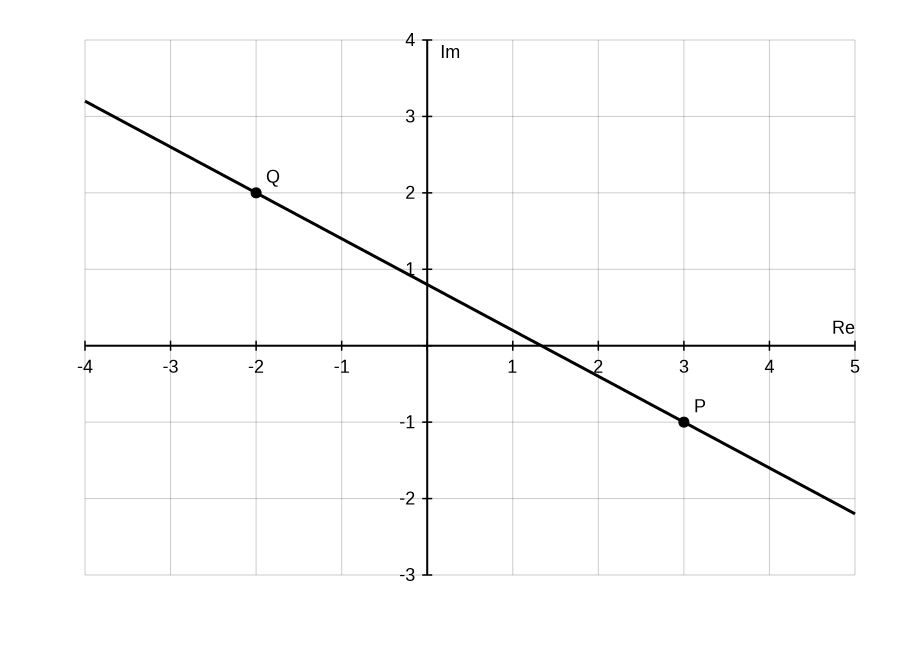
The points P and Q on the Argand diagram represent the complex numbers z and w, respectively. Real numbers a and b satisfy az + boverlinew = zw. Find a + b.
What this assessment covers
Concepts Tested
- Complex Numbers
Question Mix
- Hard questions included
Skills you build
- Apply
Related assessments
More practice
Other assessments in this subject
