

MATHEMATICS - APPLICATIONS OF DIFFERENTIATION
Related Rates Practice Problems
- Focuses on practical applications of related rates in real-world scenarios
- Challenges students with complex, multi-step rate of change problems
- Incorporates geometric shapes such as spheres, cones, and rectangles
- Designed for advanced high school students with a strong grasp of calculus
Start the 10-question quiz
Free, no sign-up needed. Your score shows instantly.
Here are the first 3 questions. Click “View all questions” to see the complete assessment.
Q1.
Q2.
Water is poured into an inverted conical vessel at a rate of 8π\ mathrmcm³ s⁻¹. At every water level, the depth h and the surface radius r satisfy h = 3r. Find the rate of increase of the water depth when h = 6\ cm.
Q3.
A lamp is mounted at the top of a vertical pole of height 6\ m. A person of height 1.8\ m walks directly away from the pole at 1.5\ mathrmm s⁻¹. At what rate is the tip of the person's shadow moving away from the pole?
Q4.
Two ships move along straight routes that meet at right angles. At a particular instant, ship A is 6\ km from the intersection and is moving towards it at 2\ mathrmkm h⁻¹. Ship B is 8\ km from the intersection and is moving away from it at 1\ mathrmkm h⁻¹. Find the rate of change of the distance between the ships at this instant.
Q5.
A ladder of length 10\ m rests with its upper end against a vertical wall and its lower end on horizontal ground. The lower end moves away from the wall at 0.6\ mathrmm s⁻¹. Find the vertical velocity of the upper end when the lower end is 6\ m from the wall.
Q6.
A tracking device is on level ground 200\ m from the point directly below a vertically rising rocket. The rocket is rising at 30\ mathrmm s⁻¹. Find the rate of increase of the angle of elevation θ when the rocket is 200sqrt3\ m above the ground.
Q7.
A rectangle changes shape while its area remains constant at 96\ cm². At an instant when its length is 12\ cm, the length is increasing at 2\ mathrmcm s⁻¹. Find the rate of change of the rectangle's perimeter at this instant.
Q8.
Sand falls onto a conical pile at a rate of 10\ mathrmcm³ s⁻¹. The pile keeps a shape for which its radius is always frac34 of its height. Find the rate of increase of the radius when the pile is 4\ cm high.
Q9.
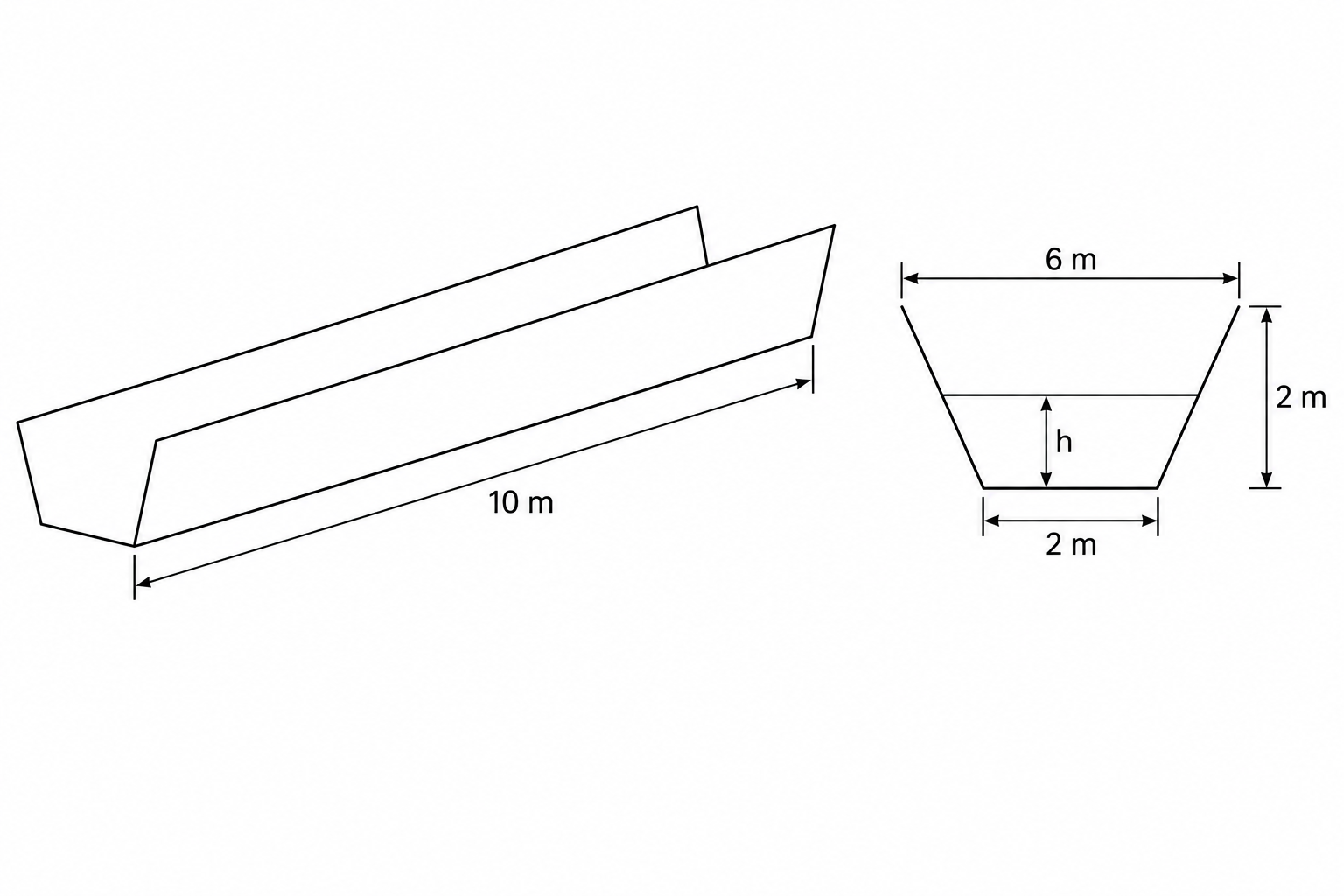
The figure shows a horizontal prismatic trough with a trapezoidal cross-section. Water enters the trough at 0.30\ mathrmm³ s⁻¹. Find the rate at which the water depth is increasing when the depth is 1\ m.
Q10.
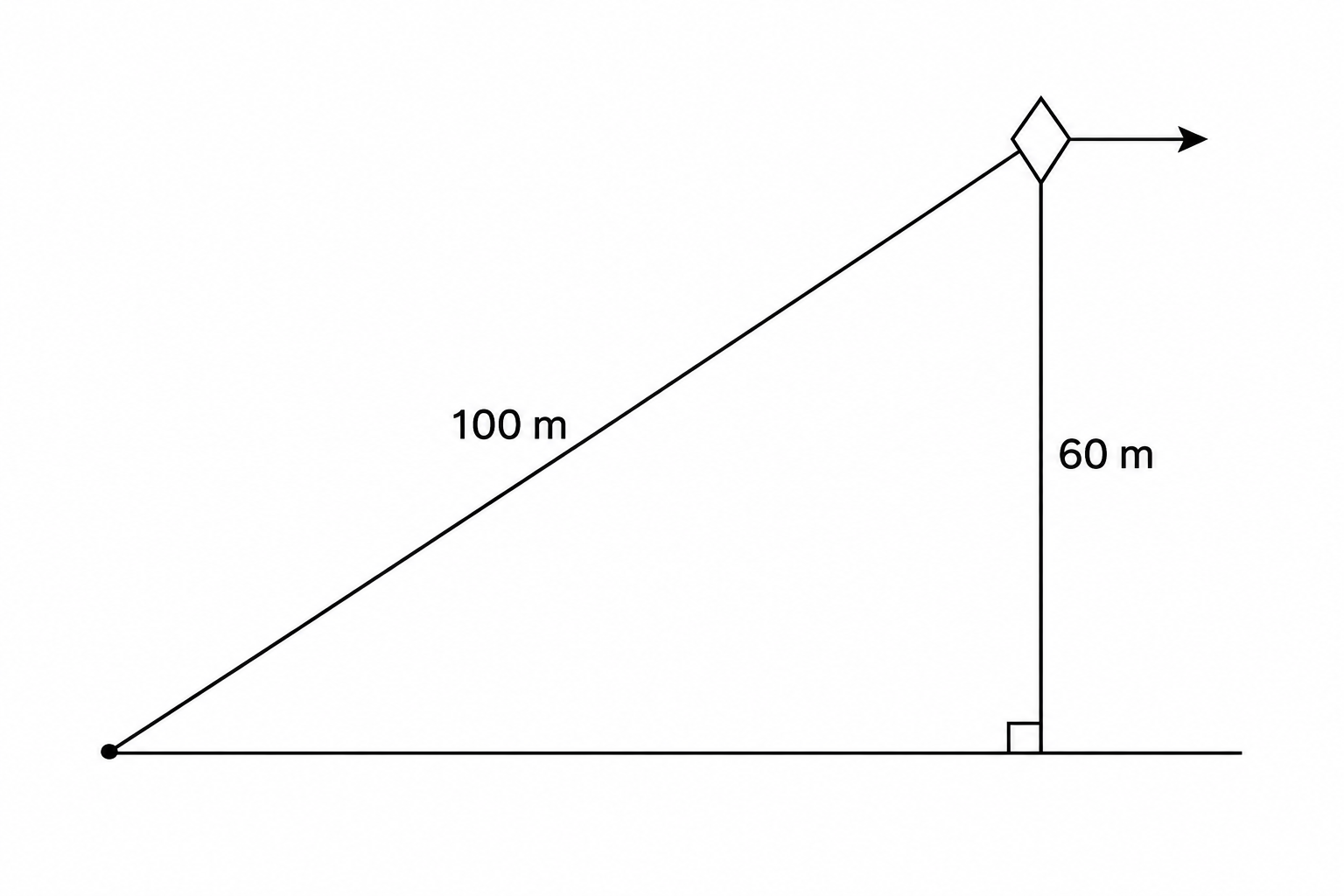
A kite moves horizontally while remaining at a constant height, as shown. Its taut string is being let out at 2\ mathrmm s⁻¹. Find the horizontal speed of the kite at the instant shown.
What this assessment covers
Concepts tested
- Related rates in spherical and conical shapes
- Rate of change in linear motion scenarios
- Geometric relationships in rate problems
- Differentiation with respect to time
- Application of trigonometric functions in rate problems
Question Mix
- Hard questions included
Skills you build
- Apply calculus to solve real-world rate problems
- Interpret and set up equations for dynamic systems
- Differentiate implicitly with respect to time
- Analyze geometric relationships in changing systems
- Solve multi-step problems involving rates of change
Related assessments
More practice
Other assessments in this subject
