

ECONOMICS - 2 THE ALLOCATION OF RESOURCES

Price Elasticity Of Demand Practice Questions

  • Explores the impact of external factors on market equilibrium
  • Analyzes shifts in supply and demand curves
  • Examines the effects of consumer expectations on prices
  • Focuses on complex market scenarios and adjustments

Here are the first 3 questions. Click “View all questions” to see the complete assessment.

Q1.

A frost destroys part of the orange crop at the same time that a health campaign increases consumers’ preference for orange juice. What must happen to the equilibrium price of oranges?

  1. A) It must remain unchanged because the two changes cancel each other.
  2. B) It must fall because both changes reduce the quantity of oranges traded.
  3. C) It must rise because demand increases while supply decreases.
  4. D) It may rise or fall because the change in equilibrium quantity is uncertain.

Q2.

A country’s currency depreciates, making imported timber more expensive for domestic furniture producers. Consumer preferences for furniture do not change. How will the furniture market adjust?

  1. A) Demand will decrease, causing equilibrium price and equilibrium quantity to fall.
  2. B) Supply will decrease, causing equilibrium price to rise and equilibrium quantity to fall.
  3. C) Supply will increase, causing equilibrium price to fall and equilibrium quantity to rise.
  4. D) Demand will increase, causing equilibrium price and equilibrium quantity to rise.

Q3.

Fishing firms introduce technology that increases their productivity. At the same time, the price of chicken, a substitute for fish, falls. Which conclusion about the fish market is correct?

  1. A) The equilibrium price of fish must rise, but the change in equilibrium quantity is uncertain.
  2. B) The equilibrium quantity of fish must rise, but the change in equilibrium price is uncertain.
  3. C) The equilibrium price of fish must fall, but the change in equilibrium quantity is uncertain.
  4. D) Both the equilibrium price and equilibrium quantity of fish must remain unchanged.

Q4.

In a market, the initial demand equation is Qd = 120 − 2P and the supply equation is Qs = 20 + 3P. Advertising changes demand to Qd = 145 − 2P, while supply remains unchanged. How does the equilibrium price change?

  1. A) It rises from $20 to $25.
  2. B) It remains at $20.
  3. C) It falls from $25 to $20.
  4. D) It rises from $20 to $29.

Q5.

Consumers expect the price of cocoa to rise sharply next month, so they purchase more cocoa now. Producers also hold back part of their current stocks to sell next month. What happens to the current equilibrium price of cocoa?

  1. A) It falls because expected future prices reduce current demand.
  2. B) Its direction cannot be determined because both current demand and current supply increase.
  3. C) It rises because current demand increases and current supply decreases.
  4. D) It remains unchanged because stocks are only transferred between time periods.

Q6.

Rice is a normal good. During a recession, household incomes fall, while unusually favourable weather produces a much larger rice harvest. Which change in the rice market is certain?

  1. A) The equilibrium quantity rises, while the change in equilibrium price is uncertain.
  2. B) The equilibrium price falls, while the change in equilibrium quantity is uncertain.
  3. C) The equilibrium price rises, while the change in equilibrium quantity is uncertain.
  4. D) The equilibrium quantity falls, while the change in equilibrium price is uncertain.

Q7.

Automation lowers the cost of producing smartphones. No determinant of smartphone demand changes. Which statement correctly describes the resulting market adjustment?

  1. A) Demand shifts left, price falls, and there is a contraction of supply.
  2. B) Supply shifts left, price rises, and there is a contraction of quantity demanded.
  3. C) Demand shifts right, price rises, and there is an extension of supply.
  4. D) Supply shifts right, price falls, and there is an extension of quantity demanded.

Q8.

Coffee and tea are substitutes. The government places a tax on coffee producers, but there is no direct change in the costs of producing tea. Which sequence is most likely?

  1. A) Coffee demand decreases, the price of coffee falls, demand for tea increases, and the price of tea rises.
  2. B) Coffee supply decreases, the price of coffee rises, demand for tea increases, and the price of tea rises.
  3. C) Coffee supply increases, the price of coffee falls, demand for tea decreases, and the price of tea rises.
  4. D) Coffee supply decreases, the price of coffee rises, supply of tea decreases, and the price of tea falls.

Q9.

Study the market diagram. Which combination of changes explains the movement from E0 to E1?
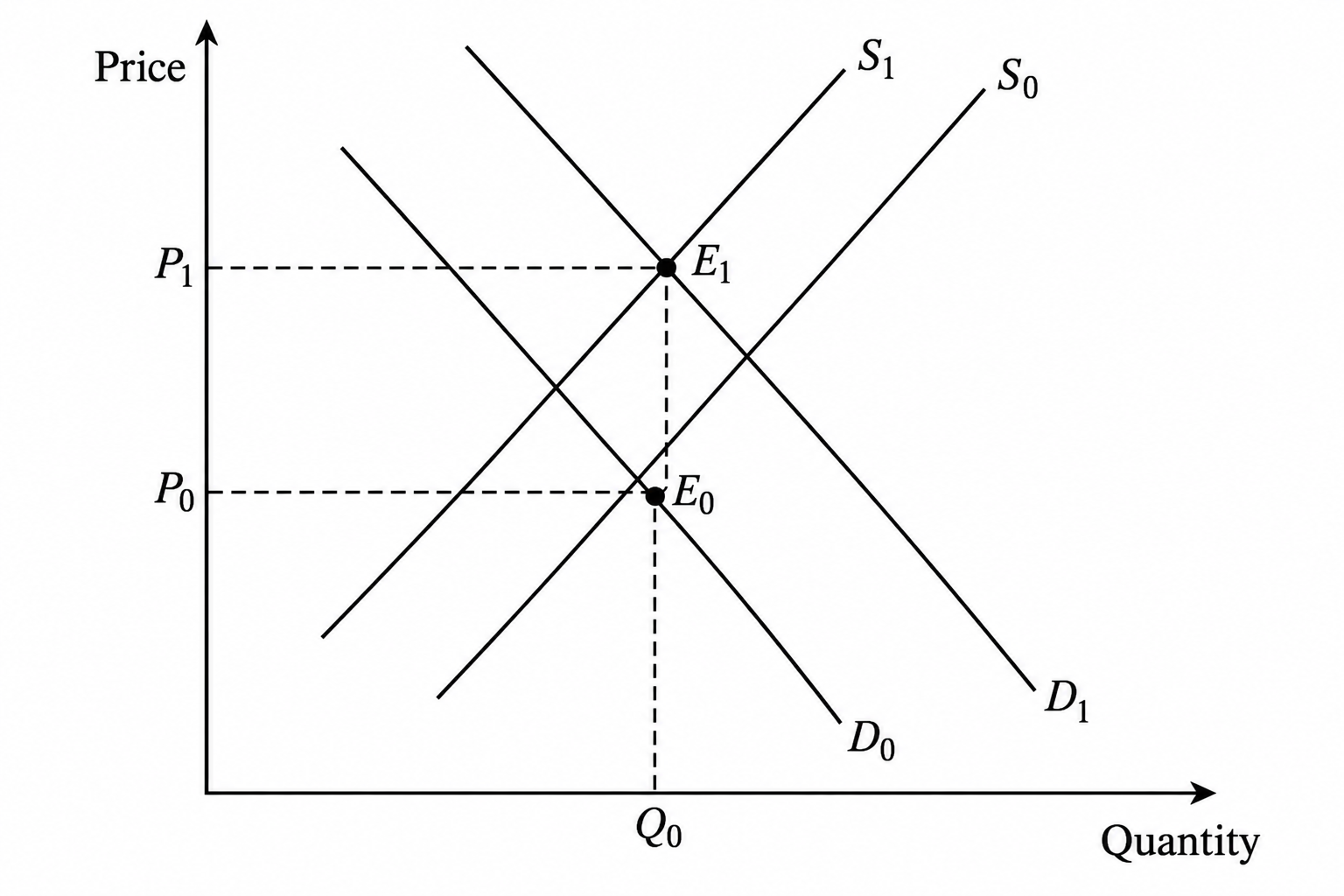
  1. A) An increase in demand combined with a decrease in supply.
  2. B) An increase in both demand and supply.
  3. C) A decrease in both demand and supply.
  4. D) A decrease in demand combined with an increase in supply.

Q10.

The diagram shows a market before and after a change. At the original price P0, what causes the price to move toward P1 after the curve shifts?
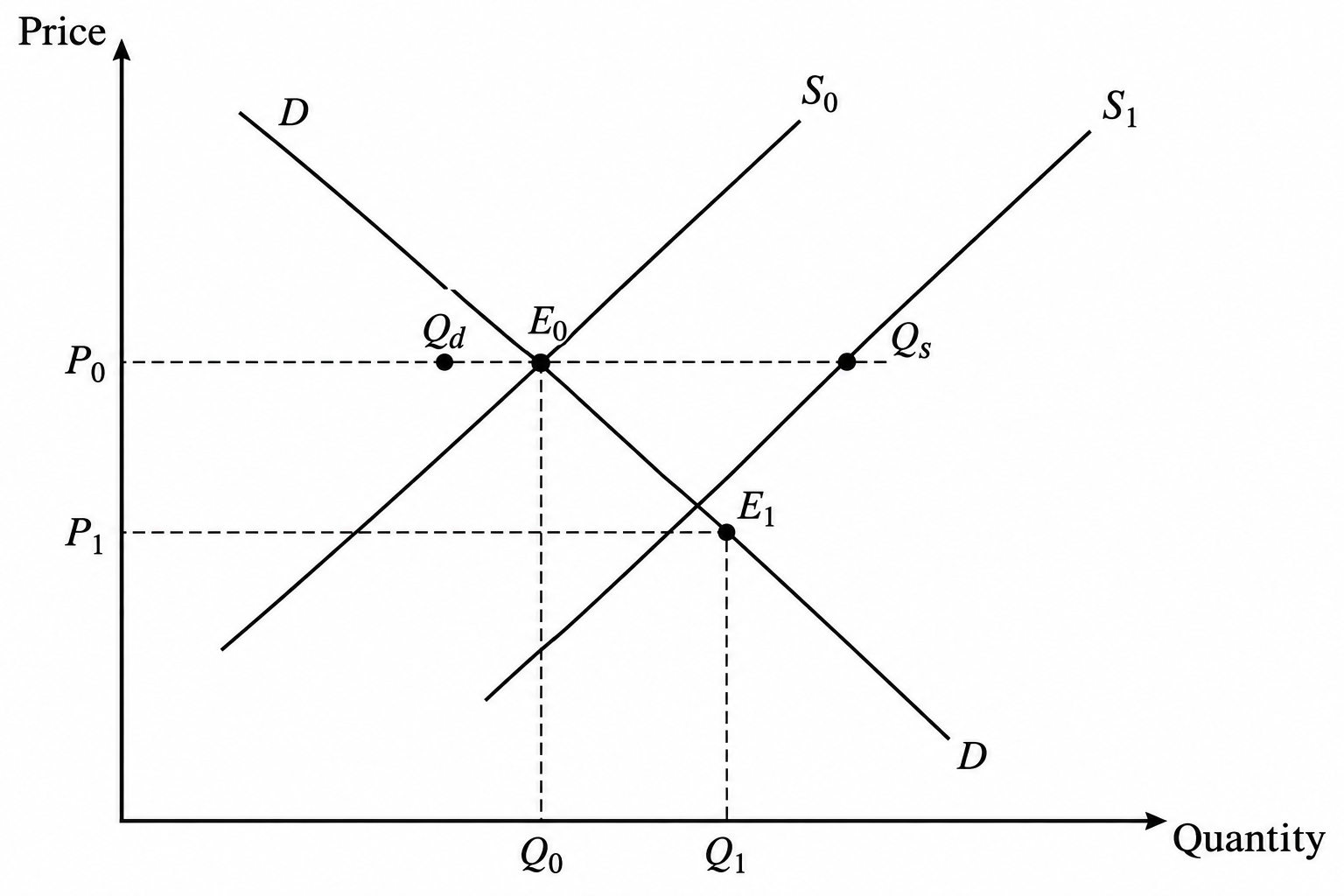
  1. A) A shortage occurs because quantity demanded exceeds quantity supplied.
  2. B) Supply decreases until quantity supplied equals the original quantity demanded.
  3. C) A surplus occurs because quantity supplied exceeds quantity demanded.
  4. D) Demand increases until quantity demanded equals the original quantity supplied.

What this assessment covers

Concepts tested

  • Market equilibrium and price determination
  • Impact of external factors on supply and demand
  • Role of consumer expectations in market changes
  • Substitute goods and their market interactions
  • Effects of technological advancements on productivity

Question Mix

  • Hard questions included

Skills you build

  • Analyze market scenarios and predict outcomes
  • Interpret supply and demand equations
  • Evaluate the effects of external changes on markets
  • Understand consumer and producer behavior in economic contexts
  • Apply economic theories to real-world situations