A city's population is currently 200,000, and its average ecological footprint is 4.0 global hectares (gha) per person. A forecast shows a population of 250,000 and an average footprint of 3.5 gha per person. Which claim is best supported by these data?
Options:
Showing question 1 of 10
Q2 QuestionPoints: 1
Choose the correct answer:
A county is comparing four forecasts for population and consumption per person. Which forecast would reduce the county's total ecological footprint and therefore most likely reduce its demand for land, energy, and natural resources?
Options:
Showing question 2 of 10
Q3 QuestionPoints: 1
Choose the correct answer:
A district of 50,000 people has a food footprint of 1.6 gha per person. High-impact foods make up 40% of this footprint. A program replaces half of those high-impact foods with alternatives that have one-quarter of their footprint. If the population then grows by 10%, which result is expected?
Options:
Showing question 3 of 10
Q4 QuestionPoints: 1
Choose the correct answer:
A town of 80,000 people uses an average of 150 liters of treated water per person each day. Over ten years, its population is expected to grow by 10%, while conservation equipment is expected to reduce use per person by 20%. Which prediction best describes the effect on the freshwater system and the energy used for water treatment?
Options:
Showing question 4 of 10
Q5 QuestionPoints: 1
Choose the correct answer:
Regions A and B begin with equal total ecological footprints. In Region A, population doubles while consumption per person falls by 30%. In Region B, population rises by 20% while consumption per person rises by 10%. Which argument correctly compares their future impacts?
Options:
Showing question 5 of 10
Q6 QuestionPoints: 1
Choose the correct answer:
An island has 120,000 gha of renewable biological capacity. Its 30,000 residents currently use an average of 3.0 gha per person. A development forecast predicts that population will rise by 25% and consumption per person will rise by 20%. What conclusion is supported by the forecast?
Options:
Showing question 6 of 10
Q7 QuestionPoints: 1
Choose the correct answer:
A region has 120,000 people. Each person owns an average of two electronic devices, and each device is replaced every two years. A proposed reuse program is expected to coincide with population growth to 132,000 people, reduce ownership to 1.5 devices per person, and extend replacement time to three years. Which claim about annual device purchases is best supported?
Options:
Showing question 7 of 10
Q8 QuestionPoints: 1
Choose the correct answer:
A school district wants to recommend the project that produces the greatest annual reduction in its community's carbon footprint. A transportation project would help 3,000 commuters reduce emissions by 0.8 metric ton of carbon dioxide equivalent each. A home-energy project would help 8,000 households save 0.25 metric ton each. A food project would help 15,000 residents save 0.12 metric ton each. A tree project would remove 1,900 metric tons in total. Which recommendation is best supported?
Options:
Showing question 8 of 10
Q9 QuestionPoints: 1
Choose the correct answer:
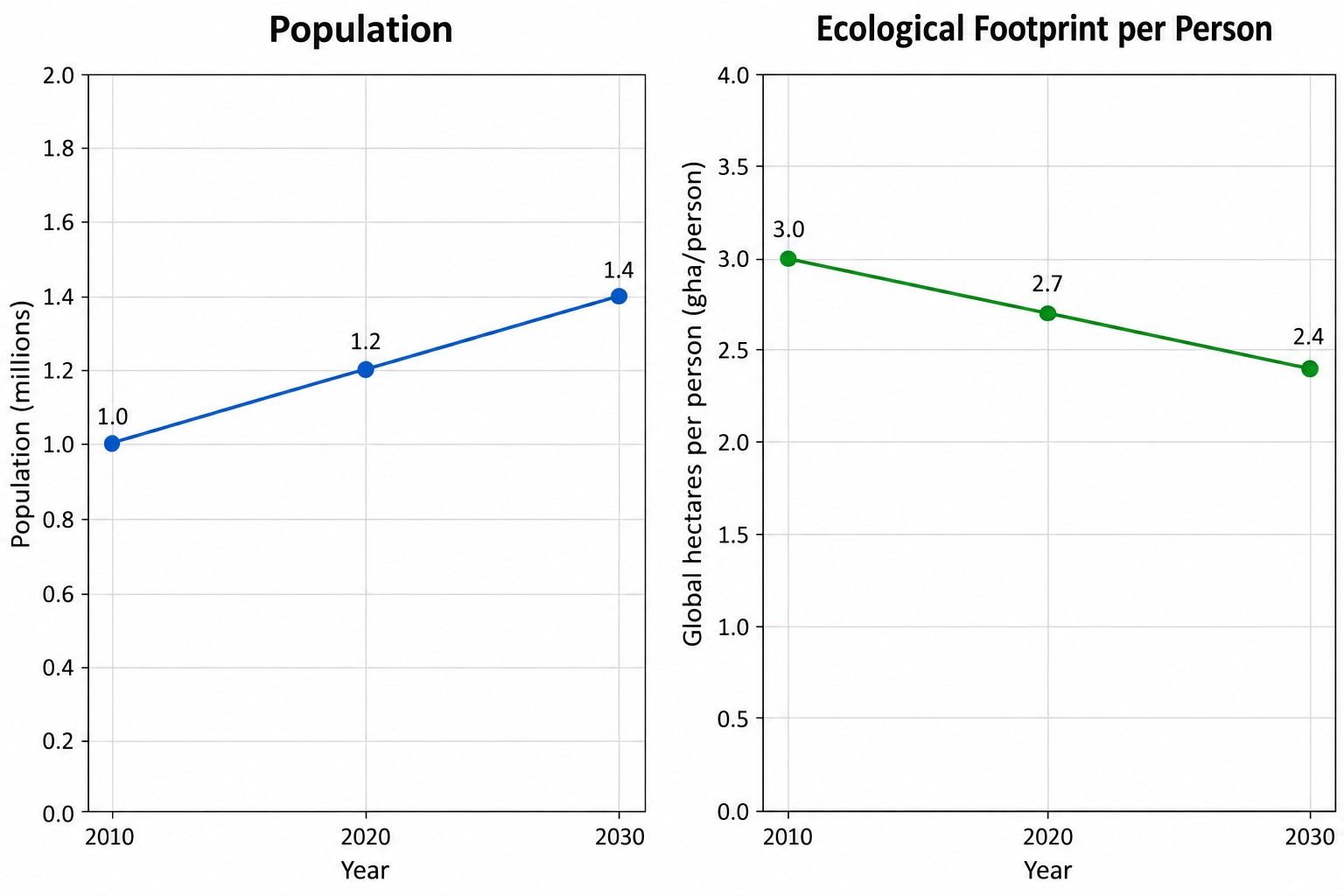
Use the population and ecological-footprint graphs. To prevent the city's total footprint in 2030 from exceeding its 2010 total, what additional change should the city achieve by 2030?
Options:
Showing question 9 of 10
Q10 QuestionPoints: 1
Choose the correct answer:
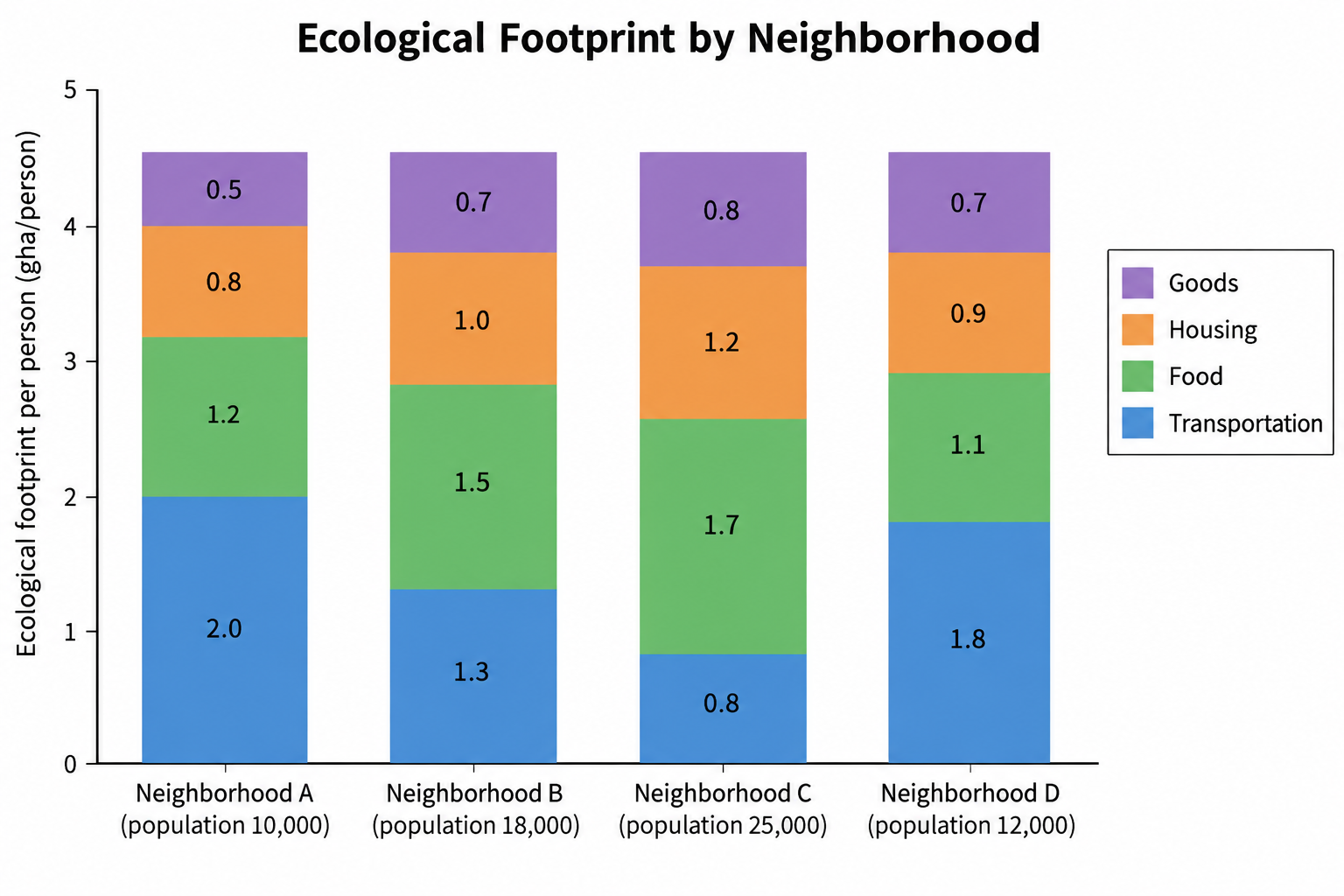
The figure shows population and per-person ecological-footprint components for four neighborhoods. A transportation program can reduce the transportation component by 25% in one neighborhood. In which neighborhood would the program produce the greatest total reduction?