A light beam balances about a pivot. A downward force of 12 N acts on the left and a downward force of 18 N acts on the right. How must their perpendicular distances from the pivot compare?
Options:
Showing question 1 of 10
Q2 QuestionPoints: 1
Choose the correct answer:
A horizontal beam of negligible weight is balanced by one downward force on each side of its pivot. The left force is doubled and its distance from the pivot is halved. The right force and its position are unchanged. What happens when the beam is released?
Options:
Showing question 2 of 10
Q3 QuestionPoints: 1
Choose the correct answer:
A horizontal beam of negligible weight can turn freely about a pivot. A downward force of 8 N acts 0.60 m to the left of the pivot. A downward force of 12 N acts 0.30 m to the right. Which statement describes its initial motion?
Options:
Showing question 3 of 10
Q4 QuestionPoints: 1
Choose the correct answer:
A uniform plank has a weight of 30 N, acting at its centre. Its centre is 0.40 m to the right of a pivot. A downward force applied 0.80 m to the left keeps the plank horizontal. Why can the applied force be smaller than the plank's weight?
Options:
Showing question 4 of 10
Q5 QuestionPoints: 1
Choose the correct answer:
A light horizontal rod is 1.50 m long. Its pivot is 0.60 m from the left end. A downward force of 9 N acts at the left end, and a downward force F acts at the right end. Which equation correctly represents the condition for balance?
Options:
Showing question 5 of 10
Q6 QuestionPoints: 1
Choose the correct answer:
Two equal downward forces act on opposite sides of the pivot of a horizontal beam of negligible weight. One acts closer to the pivot than the other. A student claims that the beam must balance because the forces are equal. Which response correctly evaluates this claim?
Options:
Showing question 6 of 10
Q7 QuestionPoints: 1
Choose the correct answer:
Two different masses hang on opposite sides of the pivot of a light beam. The beam balances on Earth. The complete arrangement is taken to the Moon, where gravitational field strength is smaller. Neither mass nor its position is changed. What happens when the horizontal beam is released on the Moon?
Options:
Showing question 7 of 10
Q8 QuestionPoints: 1
Choose the correct answer:
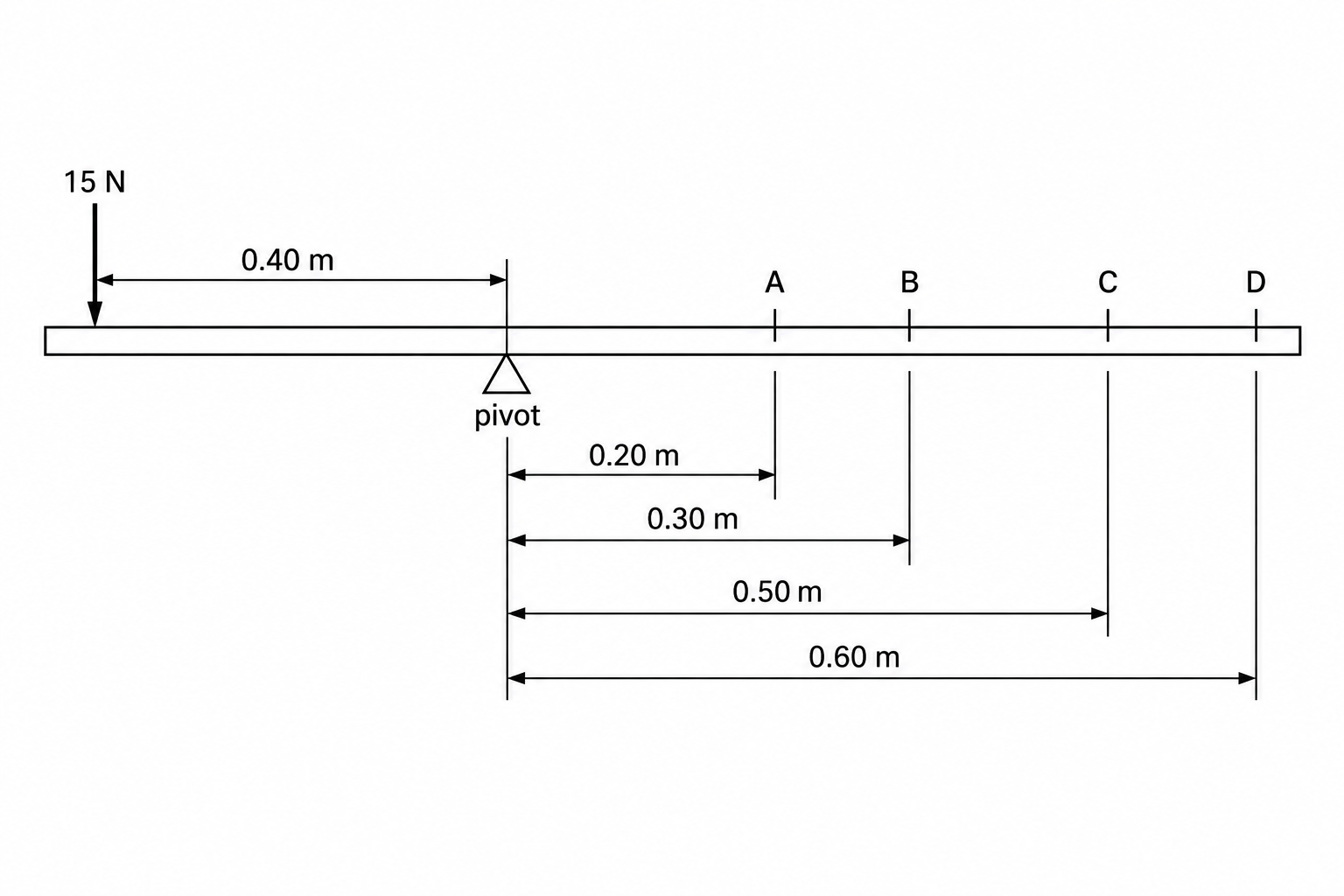
The diagram shows a horizontal beam of negligible weight. A downward force of 15 N acts on the left. At which labelled point should a downward force of 10 N act to balance the beam?
Options:
Showing question 8 of 10
Q9 QuestionPoints: 1
Choose the correct answer:
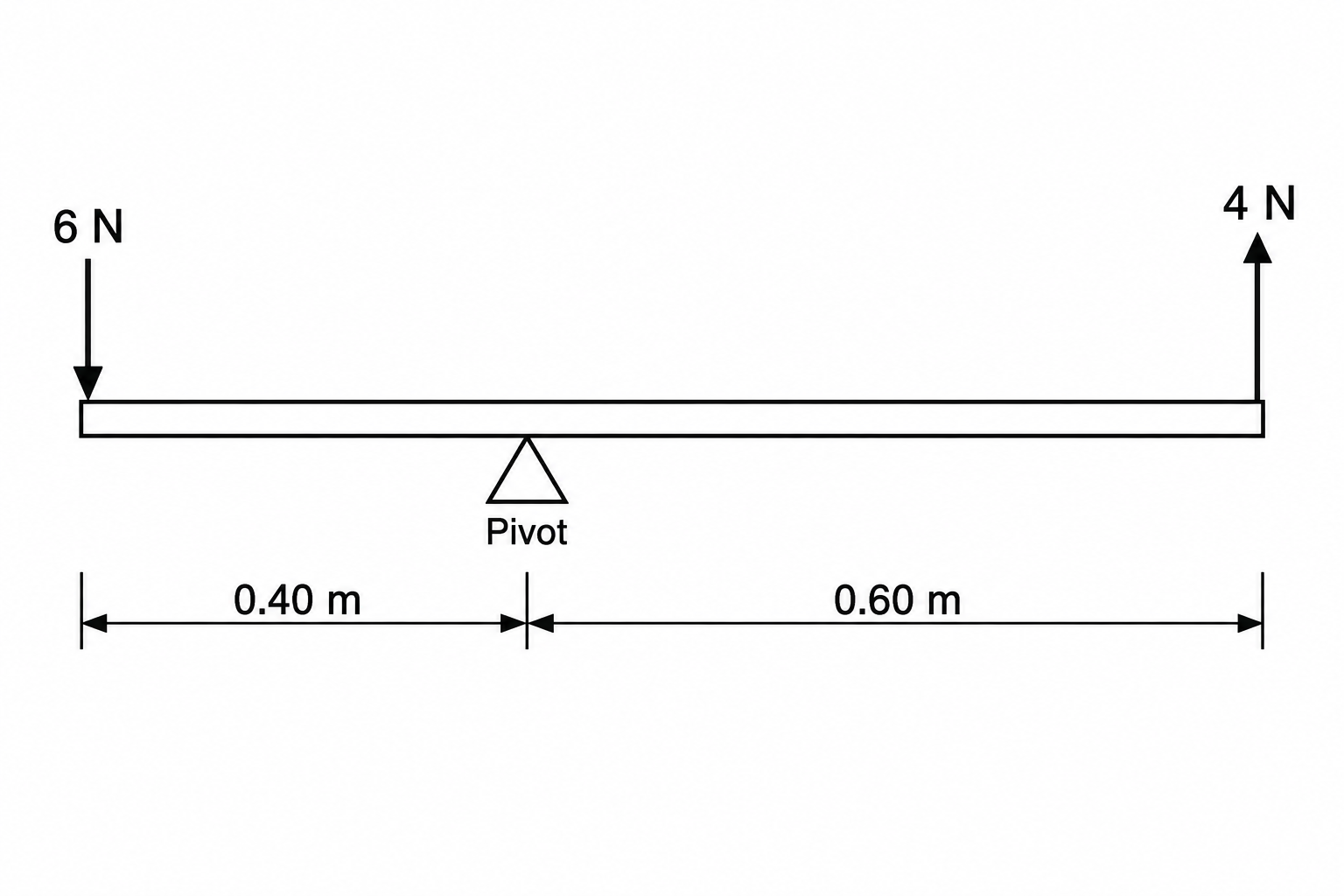
The beam shown has negligible weight and can turn freely about the pivot. Which statement correctly describes the turning effects of the two forces when the beam is released?
Options:
Showing question 9 of 10
Q10 QuestionPoints: 1
Choose the correct answer:
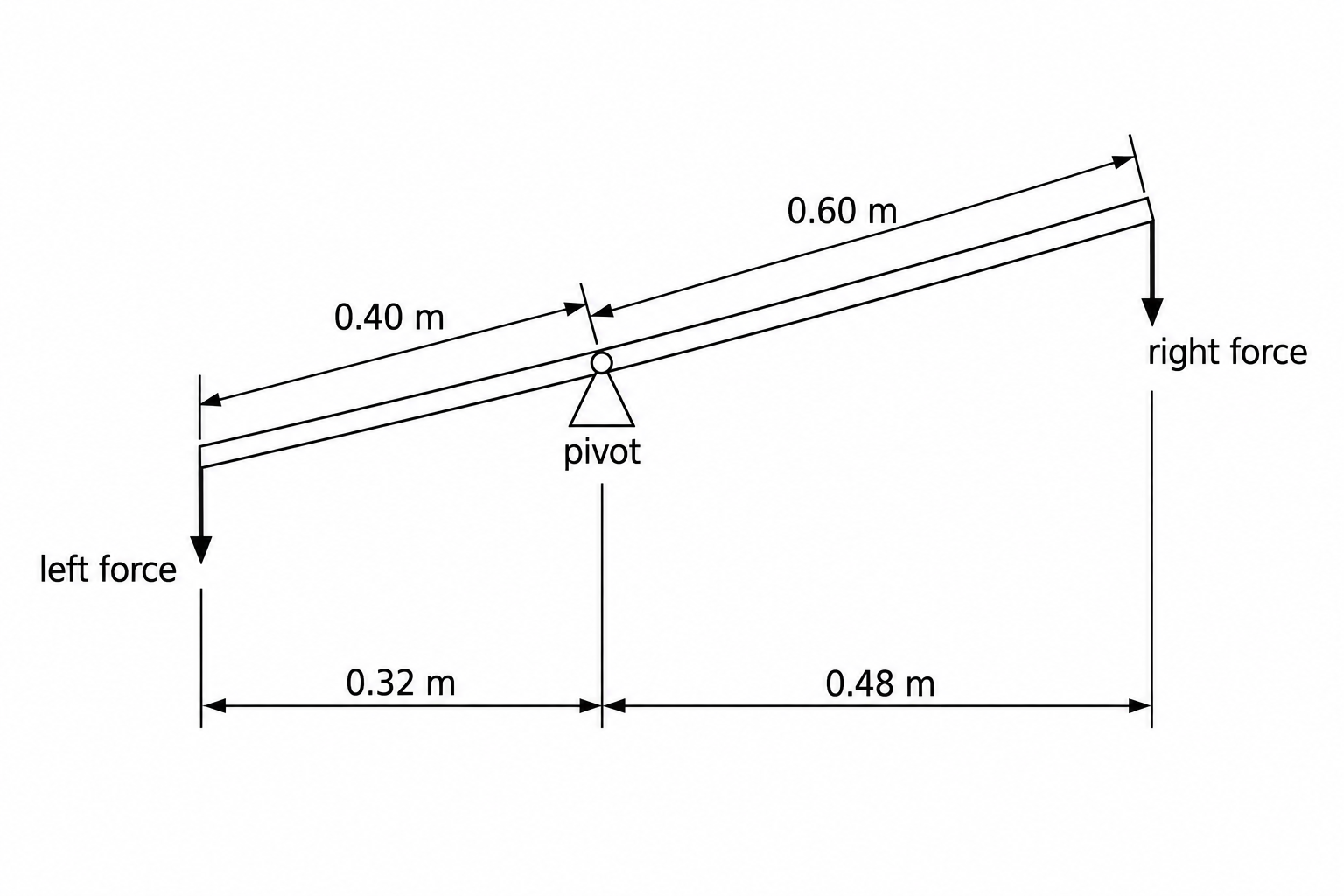
The diagram shows a light inclined beam with one vertical downward force on each side of its pivot. Which pair of distances should be used as the perpendicular distances in the principle of moments, for the left and right forces respectively?