

MATHEMATICS - RATIO

7th Grade Ratio and Proportion Worksheet

  • 10 questions
  • Understand and use the unitary method to solve problems involving ratio and direct proportion in a range of contexts.
  • Difficulty: Medium
  • Board: CAIE
  • Attempt online on the examination portal
Start the 10-question quiz Free, no sign-up needed. Your score shows instantly.

Here are the first 3 questions. Click “View all questions” to see the complete assessment.

Q1.

Six identical notebooks cost £9. The cost is directly proportional to the number bought. Which calculation uses the cost of one notebook to find the cost, in pounds, of ten notebooks?

  1. A) 9 + (10 − 6)
  2. B) 9 × 6 ÷ 10
  3. C) 9 ÷ 6 × 10
  4. D) 9 ÷ 10 × 6

Q2.

A drink contains concentrate and water in the ratio 2:7. Maya uses 1.4 L of water. Which explanation correctly finds how much concentrate she needs?

  1. A) One ratio part is 1.4 ÷ 7 = 0.2 L, so she needs 0.2 × 2 = 0.4 L.
  2. B) One ratio part is 1.4 ÷ 2 = 0.7 L, so she needs 0.7 × 7 = 4.9 L.
  3. C) The concentrate is 7 − 2 = 5 parts less, so she needs 1.4 ÷ 5 = 0.28 L.
  4. D) One ratio part is 1.4 ÷ 9 L, so she needs 1.4/9 × 2 L.

Q3.

A printer working at a constant rate prints 84 pages in 7 min. Leo says it will print 120 pages in 10 min. Which statement correctly checks his claim using the unitary method?

  1. A) He is incorrect because the number of pages should increase by only 10 − 7 = 3.
  2. B) He is correct because both the time and the number of pages increase.
  3. C) He is correct because 84 ÷ 7 = 12 pages per minute and 120 ÷ 10 = 12 pages per minute.
  4. D) He is incorrect because the total time should be 120 ÷ 7 min.

Q4.

On a map, 3 cm represents 12 km. The same scale is used throughout the map. Which calculation gives the map distance, in centimetres, for an actual distance of 18 km?

  1. A) 18 ÷ (12 ÷ 3) = 4.5
  2. B) 3 + (18 − 12) = 9
  3. C) 18 ÷ 3 = 6
  4. D) 18 × (12 ÷ 3) = 72

Q5.

Eight identical towels have a total mass of 2.8 kg. Sam says, “Twelve towels is four more towels, so their mass is 2.8 + 4 = 6.8 kg.” Which response correctly explains his mistake?

  1. A) Each extra towel has a mass of 2.8 kg, so he should add this mass four times.
  2. B) He should subtract four from the original mass because more towels means less mass per towel.
  3. C) He should divide the original total mass by twelve because twelve towels are being weighed.
  4. D) He has treated each extra towel as having a mass of 1 kg; one towel actually has a mass of 2.8 ÷ 8 = 0.35 kg.

Q6.

Red paint and white paint are mixed in the ratio 3:5. The total volume of the mixture is 24 L. Which calculation finds the volume of white paint, in litres, by first finding one ratio part?

  1. A) 24 ÷ (5 − 3) × 5
  2. B) 24 ÷ (3 + 5) × 5
  3. C) 24 ÷ 5 × 3
  4. D) 24 ÷ (3 + 5) × 3

Q7.

A tap delivers 18 L of water in 4 min at a constant rate. Which statement correctly uses the amount delivered in one minute to find the amount delivered in 30 s?

  1. A) It delivers 4.5 L in one minute, so it also delivers 4.5 L in thirty seconds.
  2. B) It delivers 4.5 L in one minute, so it delivers 135 L in thirty seconds.
  3. C) It delivers 4.5 L in one minute, so it delivers 2.25 L in half a minute.
  4. D) It delivers 4.5 L in one minute, so it delivers 9 L in half a minute.

Q8.

Pack A contains four identical pens and costs £2.60. Pack B contains seven of the same pens and costs £4.20. Which statement correctly compares their value using the cost of one pen?

  1. A) Pack A is better value because 2.60 ÷ 4 = 0.65 is greater than 4.20 ÷ 7 = 0.60.
  2. B) Pack B is better value because it contains more pens, regardless of its price.
  3. C) Pack B is better value because one pen costs £0.60, compared with £0.65 in Pack A.
  4. D) Pack A is better value because its total price is lower.

Q9.

The table shows the cost of almonds. Cost is directly proportional to mass. Which explanation correctly finds the missing mass?
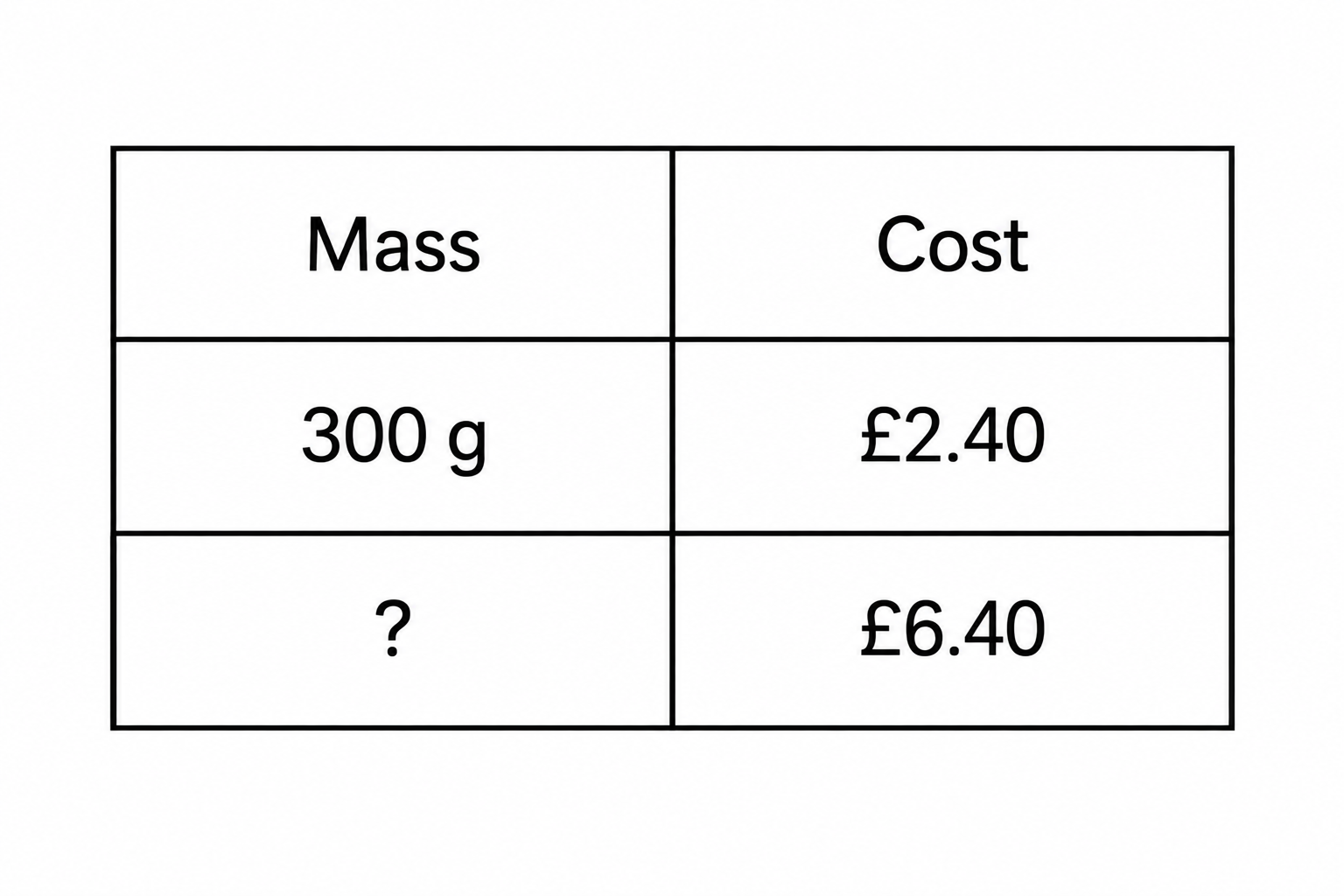
Diagram for question 9: The table shows the cost of almonds. Cost is directly proportional to mass. Which explanation correctly…
  1. A) Each gram costs £0.008, so the missing mass is 6.40 × 0.008 = 0.0512 g.
  2. B) One pound buys 300 ÷ 2.40 = 125 g, so £6.40 buys 125 × 6.40 = 800 g.
  3. C) The cost increases by £4.00, so the mass increases by 4 g to 304 g.
  4. D) One pound buys 125 g, so the missing mass is 125 ÷ 6.40 = 19.53125 g.

Q10.

The diagram shows five identical fence panels placed edge to edge, with no gaps or overlaps. Which statement correctly uses the length of one panel to find the total length of eight such panels?
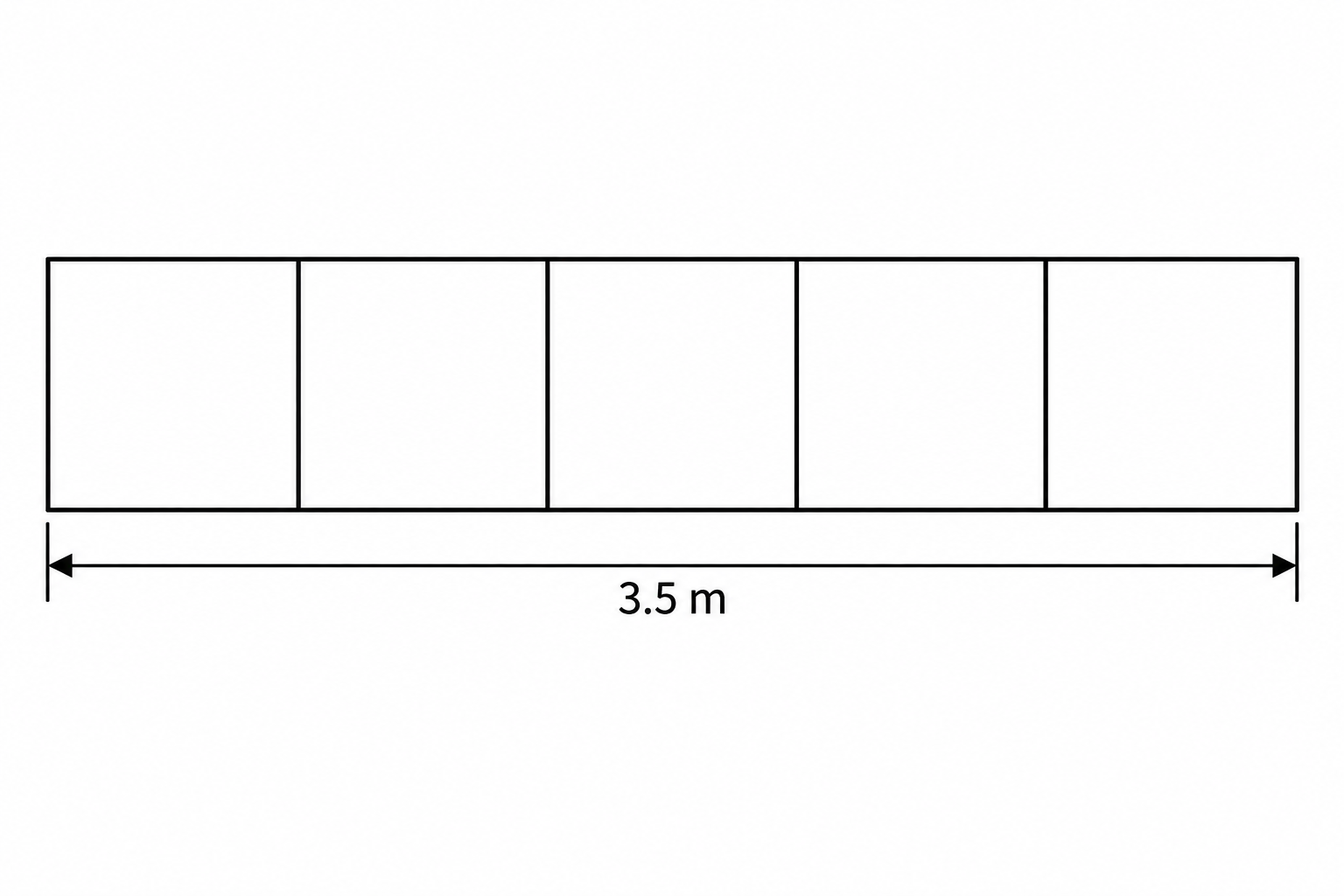
Diagram for question 10: The diagram shows five identical fence panels placed edge to edge, with no gaps or overlaps. Which statement…
  1. A) One panel is 3.5 ÷ 5 = 0.7 m long, so eight panels have a total length of 5.6 m.
  2. B) One panel is 3.5 m long, so eight panels have a total length of 28 m.
  3. C) One panel is 5 ÷ 3.5 = 10/7 m long, so eight panels have a total length of 80/7 m.
  4. D) One panel is 0.7 m long, so eight panels have a total length of 3.5 + 0.7 = 4.2 m.

What this assessment covers

Concepts Tested

  • Ratio
  • Understand and use the unitary method to solve problems involving ratio and direct proportion in a range of contexts.

Question Mix

  • Medium questions included

Skills you build

  • Understand