Choose the correct answer:
A student rationalises frac3√(7) by multiplying the numerator and denominator by √(7). Why does this preserve the value and give a rational denominator?
Choose the correct answer:
A student rationalises frac3√(7) by multiplying the numerator and denominator by √(7). Why does this preserve the value and give a rational denominator?
Choose the correct answer:
Which expression is equivalent to frac5√(11) + √(6) and has a rational denominator?
Choose the correct answer:
A student writes frac43 − √(5) = frac4(3 + √(5))9 + 5. Which statement correctly explains the error?
Choose the correct answer:
Which is the fully simplified form of frac√(18)√(12) with a rational denominator?
Choose the correct answer:
Which expression is obtained by correctly rationalising the denominator of frac√(3)√(3) + 1?
Choose the correct answer:
Before rationalising frac1√(8) − √(2), a student simplifies its denominator. Which equivalent expression should the student obtain?
Choose the correct answer:
A student claims that frac1√(5) − 1 = frac√(5) + 14. Which statement correctly checks this claim?
Choose the correct answer:
Rationalising the denominators allows the surd terms in frac1√(3) − 1 − frac1√(3) + 1 to cancel. What is the simplified value?
Choose the correct answer:
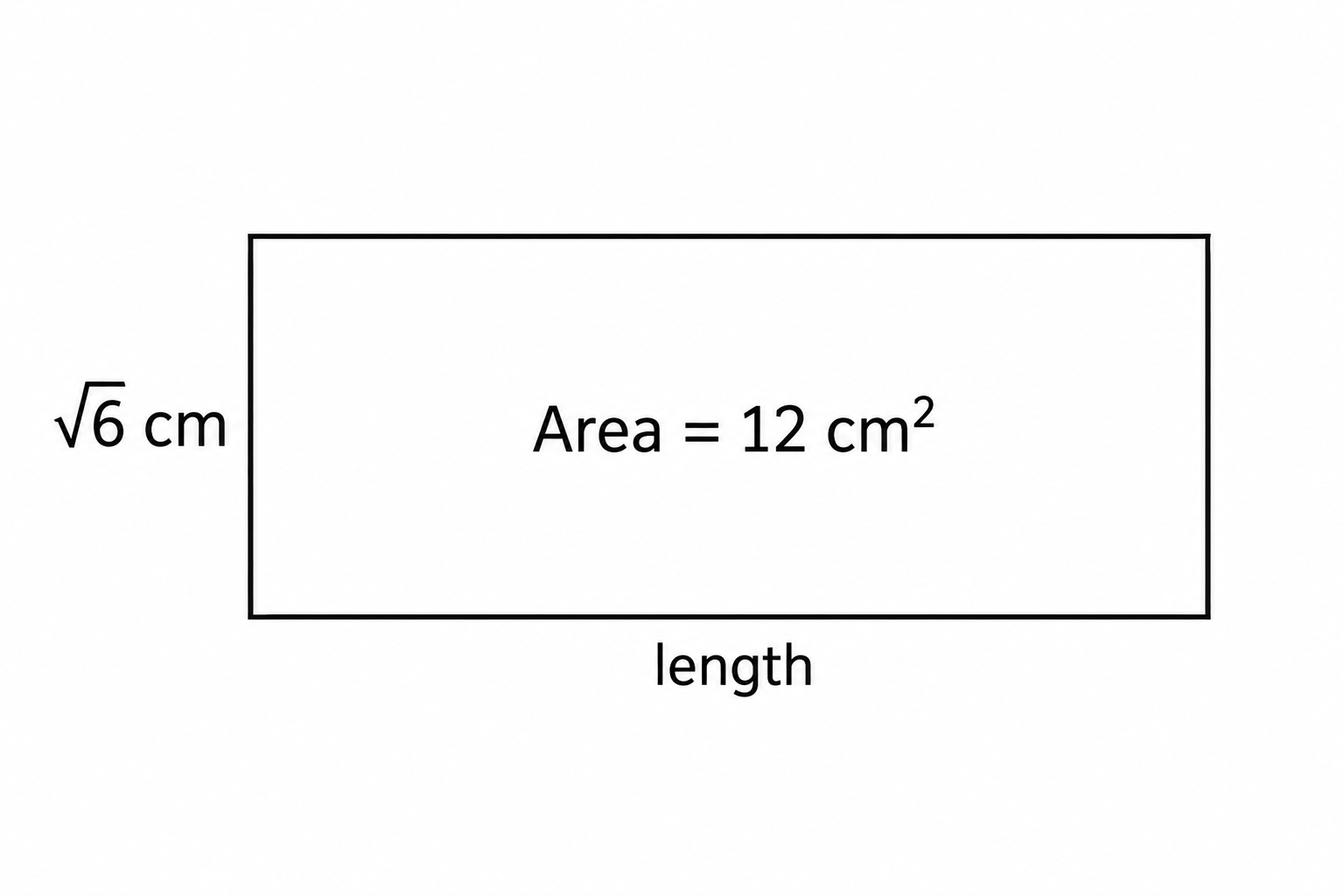
The diagram shows a rectangle with its area and height labelled. Which expression gives its length in simplest surd form?
Choose the correct answer:
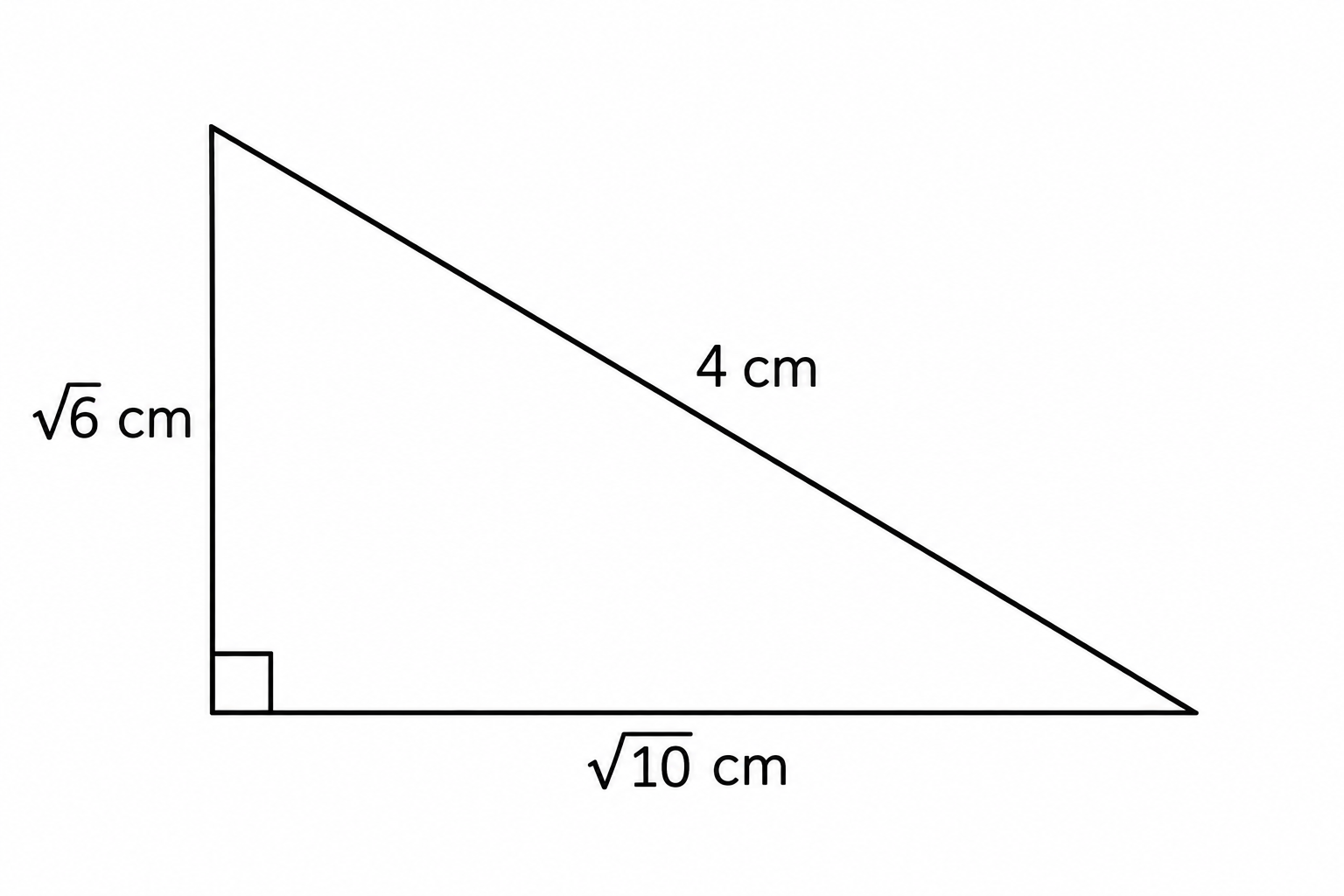
For the triangle shown, which expression gives the length of the shorter perpendicular side divided by the length of the longer perpendicular side, with a rational denominator?