

MATHEMATICS - POLYNOMIAL DIVISION
Synthetic Division Worksheet
- Challenges students with polynomial division using synthetic division.
- Focuses on finding remainders and factors of polynomials.
- Involves solving for unknown coefficients in polynomial expressions.
Start the 10-question quiz
Free, no sign-up needed. Your score shows instantly.
Here are the first 3 questions. Click “View all questions” to see the complete assessment.
Q1.
Q2.
The expression x + 2 is a factor of P(x) = x³ + kx² − 5x + 6. Find k.
Q3.
A polynomial P(x) leaves a remainder of 5 when divided by x − 3 and a remainder of −3 when divided by x + 1. What is the remainder when P(x) is divided by (x − 3)(x + 1)?
Q4.
Which of the following is a factor of P(x) = x⁴ − 5x³ + 2x² + 20x − 24?
Q5.
Find the remainder when 8x³ − 4x² + 6x − 7 is divided by 2x − 3.
Q6.
For P(x) = x³ + kx² + mx + 4, the expression x − 1 is a factor, and the remainder when P(x) is divided by x + 2 is 9. Find the ordered pair (k,m).
Q7.
When a polynomial P(x) is divided by x² − x − 6, the remainder is 4x + 1. Find P(3) + P( − 2).
Q8.
Which listed quadratic expression is a factor of P(x) = x⁴ − 2x³ − 7x² + 8x + 12?
Q9.
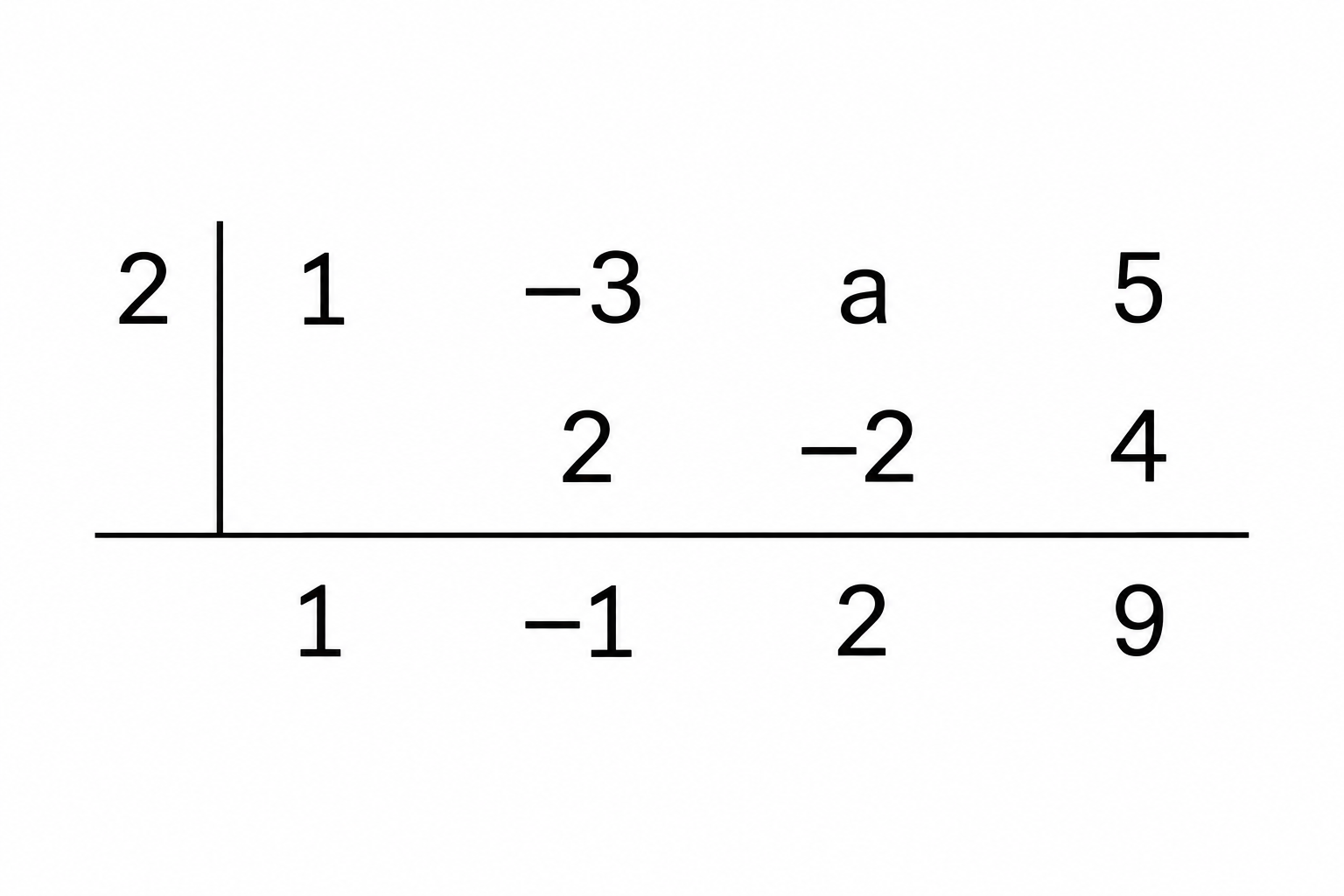
The synthetic-division table shown represents the division of P(x) = x³ − 3x² + ax + 5 by x − 2. Find a.
Q10.
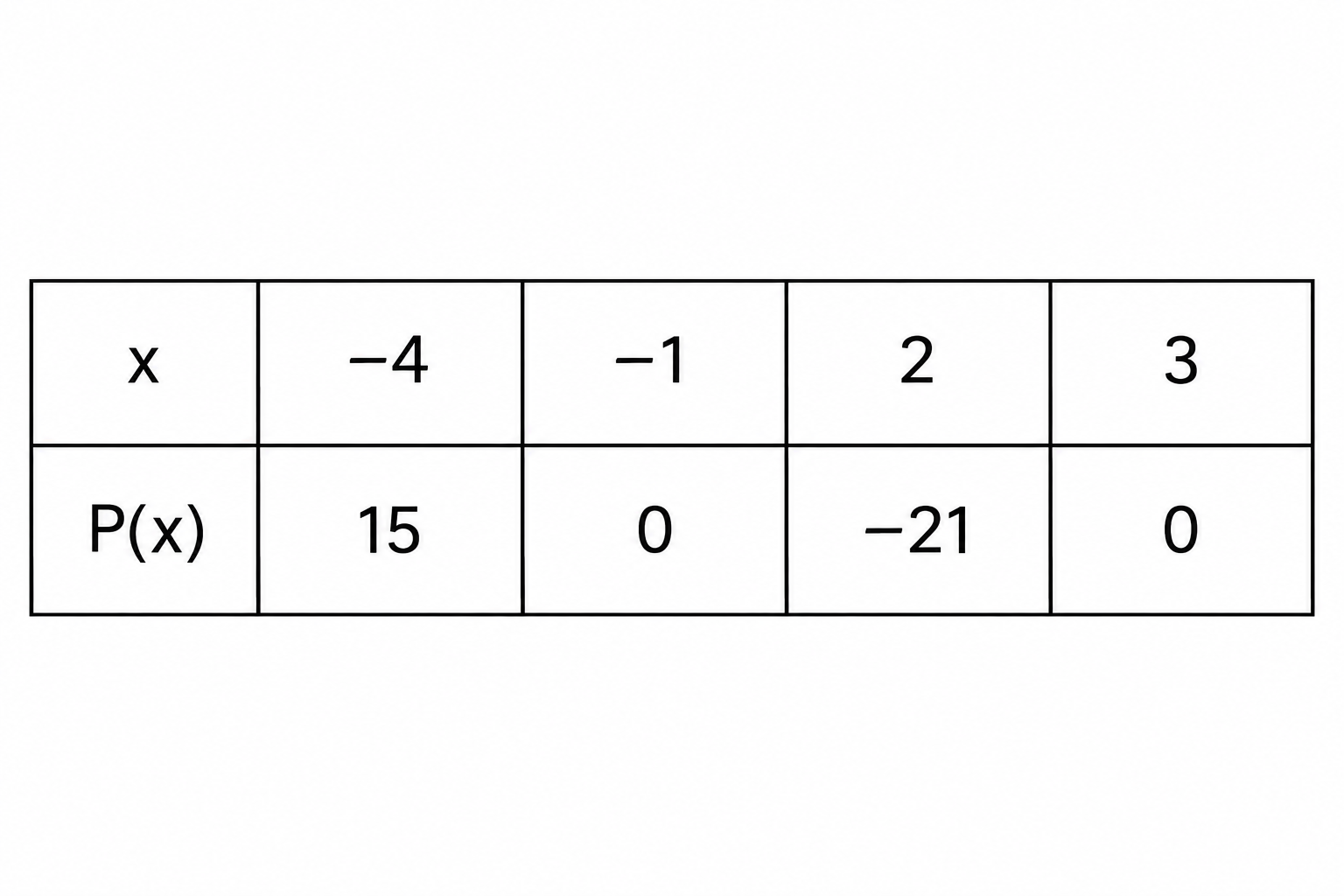
The table shows some values of a polynomial P(x). A new polynomial is defined by Q(x) = P(2x − 1). Which expression is guaranteed to be a factor of Q(x)?
What this assessment covers
Concepts tested
- Synthetic division of polynomials
- Remainder theorem application
- Factor theorem application
- Polynomial factorization
- Solving for unknown coefficients in polynomials
Question Mix
- Hard questions included
Skills you build
- Apply synthetic division to find remainders
- Determine factors of polynomial expressions
- Use remainder and factor theorems effectively
- Solve for unknowns in polynomial equations
- Analyze polynomial behavior under transformations
Related assessments
More practice
Other assessments in this subject
