Q1 Question
Points: 1
Choose the correct answer:
Let P(x) = x³ + ax² + bx + 6. The polynomial has a factor x − 2 and leaves a remainder of 18 when divided by x + 1. What are the values of a and b?
Showing question 1 of 10
Choose the correct answer:
When a polynomial P(x) is divided by x² − 9, the remainder is 3x − 4. Find the remainder when (x − 1)P(2x + 1) + x² is divided by x + 2.
Choose the correct answer:
A polynomial P(x) leaves remainders 4 and 40 when divided by x − 1 and x + 2, respectively. Also, x − 3 is a factor of P(x). What is the remainder when P(x) is divided by (x − 1)(x + 2)(x − 3)?
Choose the correct answer:
The polynomial P(x) = 2x³ + ax² + bx + 9 has factors x − 1 and x + 3. Which of the following is also a factor?
Choose the correct answer:
The polynomial P(x) = x³ − 4x² + ax + 6 has a factor x − 2. When divided by x − k, it leaves a remainder of 6. Given that k>2, find k.
Choose the correct answer:
Both x − 1 and x + 2 are factors of P(x) = x⁴ + ax³ + bx² + ax + 1. Find the remainder when P(x) is divided by x + 1.
Choose the correct answer:
Polynomials satisfy P(x) = (x − 2)Q(x) + 3 and Q(x) = (2x − 1)S(x) − 2. Find the remainder when [P(x)]² + xQ(x) is divided by 2x − 1.
Choose the correct answer:
A cubic polynomial P(x) = x³ + px² + qx + r leaves a remainder of −4 when divided by x − 1 and a remainder of −12 when divided by x + 1. Also, x − 2 is a factor. Find the remainder when P(x) is divided by x − 3.
Choose the correct answer:
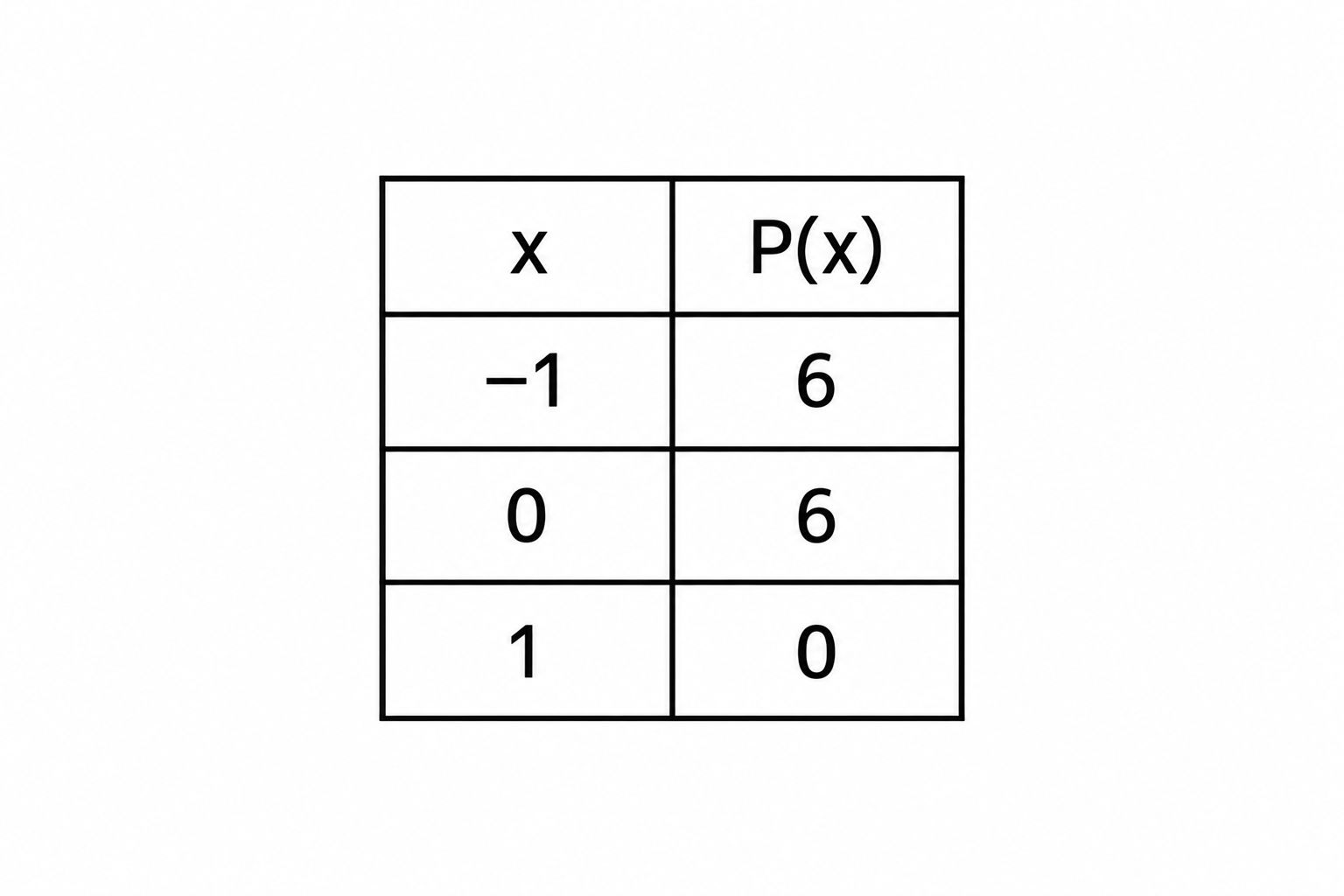
The table gives values of P(x) = 2x³ + ax² + bx + c. Which of the following is a factor of P(x)?
Choose the correct answer:
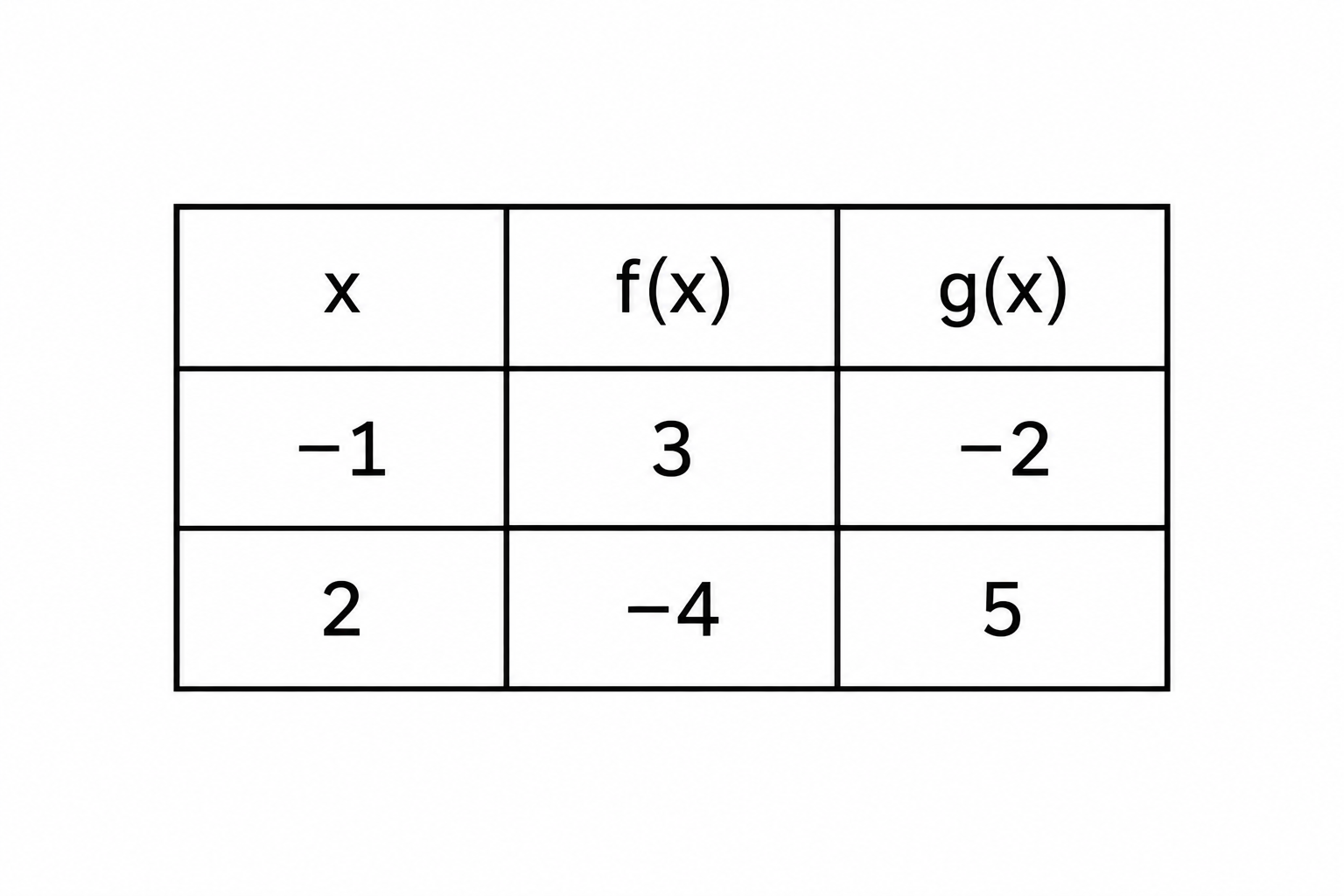
The table gives values of the polynomials f(x) and g(x). Let H(x) = (x + 1)f(x) + (x − 2)g(x). Find the remainder when H(x) is divided by (x + 1)(x − 2).