Q1 Question
Points: 1
Choose the correct answer:
Calculate 51/6 − (23/4 − 5/8 ) + 7/12. Give your answer as a mixed number in its simplest form.
Showing question 1 of 10
Choose the correct answer:
Calculate 51/6 − (23/4 − 5/8 ) + 7/12. Give your answer as a mixed number in its simplest form.
Choose the correct answer:
A container holds some juice. First, 15/6 L is poured out. Then 27/8 L is added. The container now holds 41/12 L. How much juice was in the container initially?
Choose the correct answer:
Estimate 87/12 − (37/8 − 11/10 ) − 25/12 by first rounding each mixed number to the nearest half. Then apply the order of operations. What estimate do you obtain?
Choose the correct answer:
Two red ribbons have lengths 23/8 m and 15/6 m. Two blue ribbons have lengths 7/4 m and 13/6 m. By how much does the total length of the red ribbons exceed the total length of the blue ribbons?
Choose the correct answer:
What number belongs in the box to make this statement true? (41/6 − □phantom0 ) + 7/8 = 211/12
Choose the correct answer:
Which expression has a value greater than 1/2 but less than 3/4?
Choose the correct answer:
A tank has a capacity of 81/3 L and initially contains 37/8 L of water. A further 25/6 L is added, and then 17/12 L is removed. How much more water is needed to fill the tank?
Choose the correct answer:
An estimate for 25/8 + 37/12 − 111/16 is made by rounding each mixed number to the nearest whole number before calculating. By how much does this estimate exceed the exact value?
Choose the correct answer:
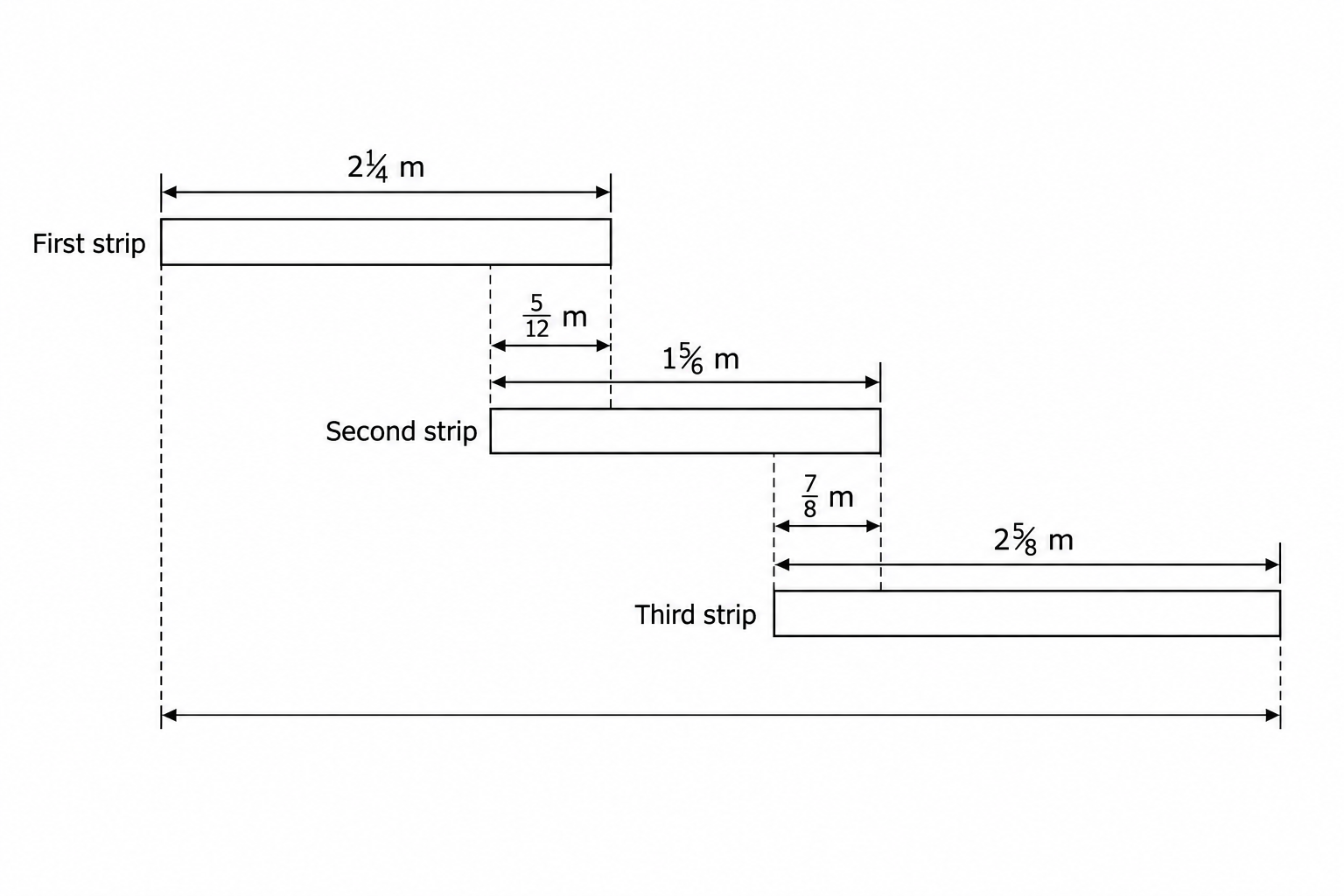
Three strips are placed in a straight line with the overlaps shown in the diagram. There is no overlap between the first and third strips. What is the distance from the left end of the first strip to the right end of the third strip?
Choose the correct answer:
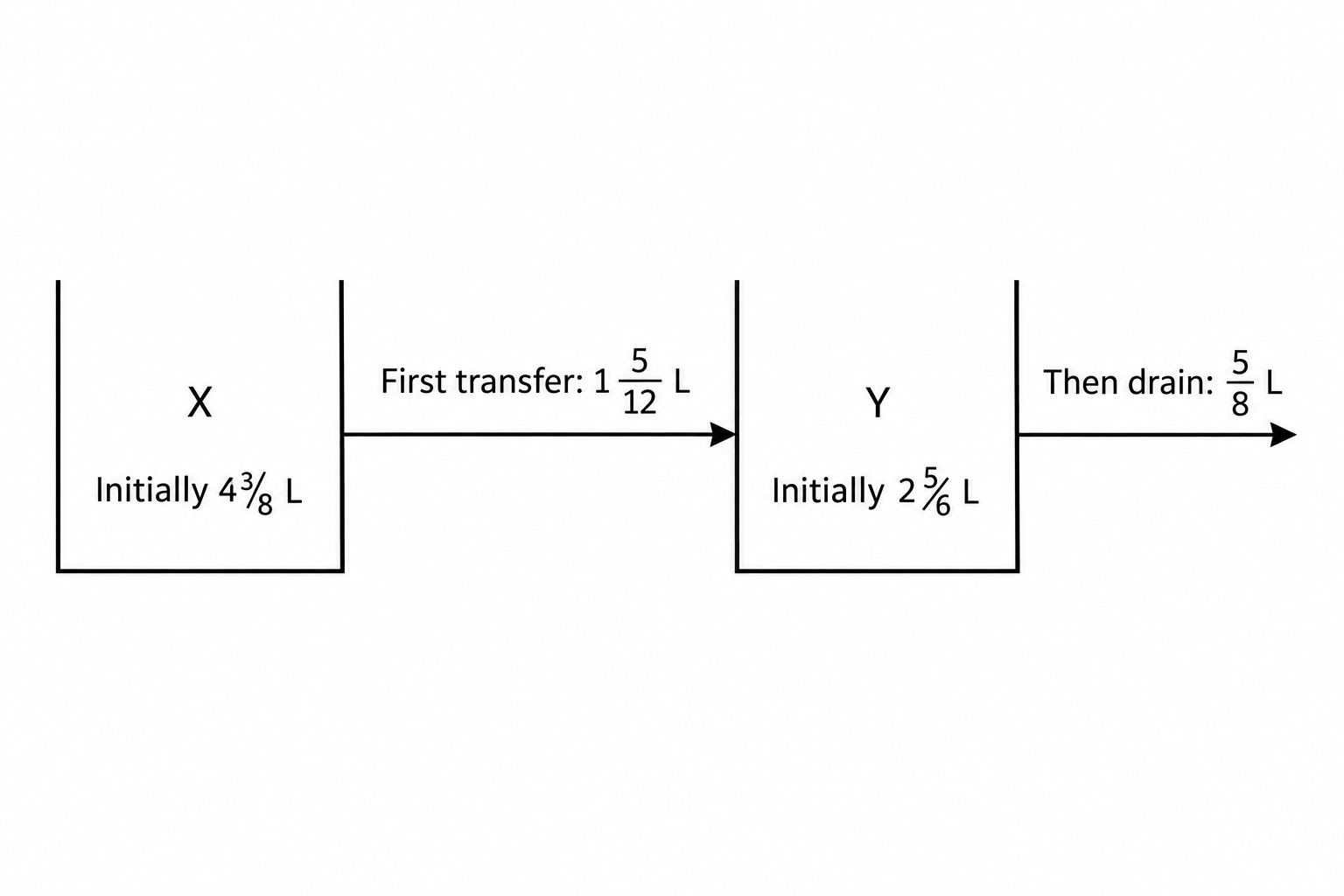
The diagram shows the initial amounts of liquid in two tanks and two transfers. First, liquid is transferred from tank X to tank Y. Then liquid is drained from tank Y. No other liquid is added or removed. After both transfers, how much more liquid does tank Y contain than tank X?