Choose the correct answer:
An aerial consists of a fixed section of length 2.75 m and an adjustable extension of length e m. Its total length must be at least 6.4 m. Which inequality describes all permitted extension lengths?
Choose the correct answer:
An aerial consists of a fixed section of length 2.75 m and an adjustable extension of length e m. Its total length must be at least 6.4 m. Which inequality describes all permitted extension lengths?
Choose the correct answer:
A diver starts at sea level. After t minutes, the diver's height relative to sea level is −0.8t m. The diver must remain strictly above a height of −6 m. Given that time cannot be negative, which range of times is permitted?
Choose the correct answer:
A mass of flour, m kg, is shared equally among 8 containers. Each container may hold no more than 1.65 kg of flour. What is the greatest total mass of flour that can be shared this way?
Choose the correct answer:
A number x is subtracted from −3.6. The result is no greater than −8.1. Which inequality describes all possible values of the number?
Choose the correct answer:
A machine divides an input number x by −3. It accepts an input only when the output is at least 2.4. What is the greatest input the machine accepts?
Choose the correct answer:
A whole-number setting n is reduced by 2/3. The result must be strictly less than −1/6. What is the largest possible setting?
Choose the correct answer:
During a sale, a customer pays 85% of an item's original price, p dollars. The customer can spend at most 51 dollars. Which inequality describes the original prices the customer can afford?
Choose the correct answer:
A cable must be longer than 2350 mm. A supplier records cable lengths as c metres. Which inequality should the supplier use to identify suitable cables?
Choose the correct answer:
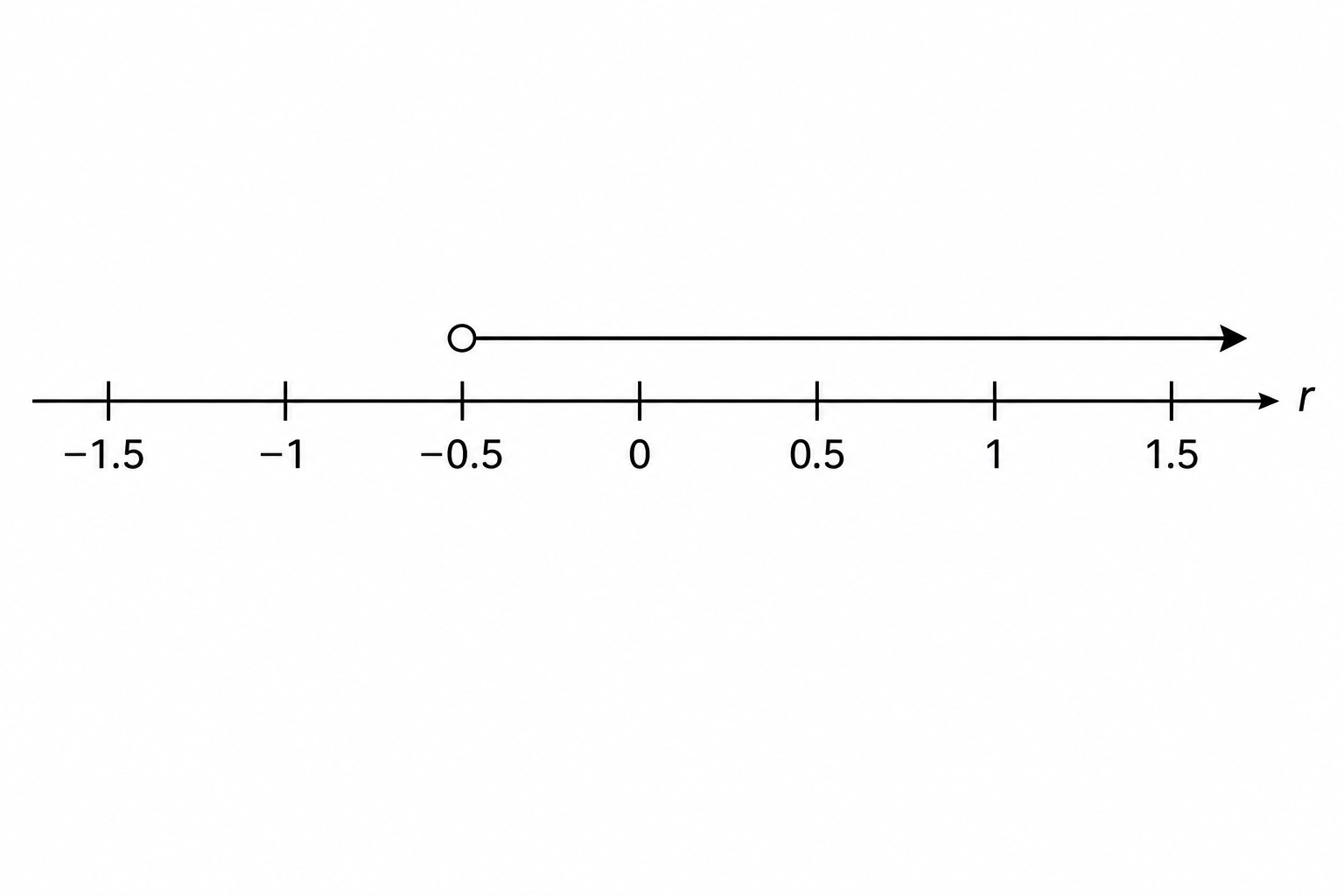
The number line shows all permitted values of a sensor reading r. The sensor calculates its reading using r = x − 1.25, where x is the input. Which inequality describes all permitted inputs?
Choose the correct answer:
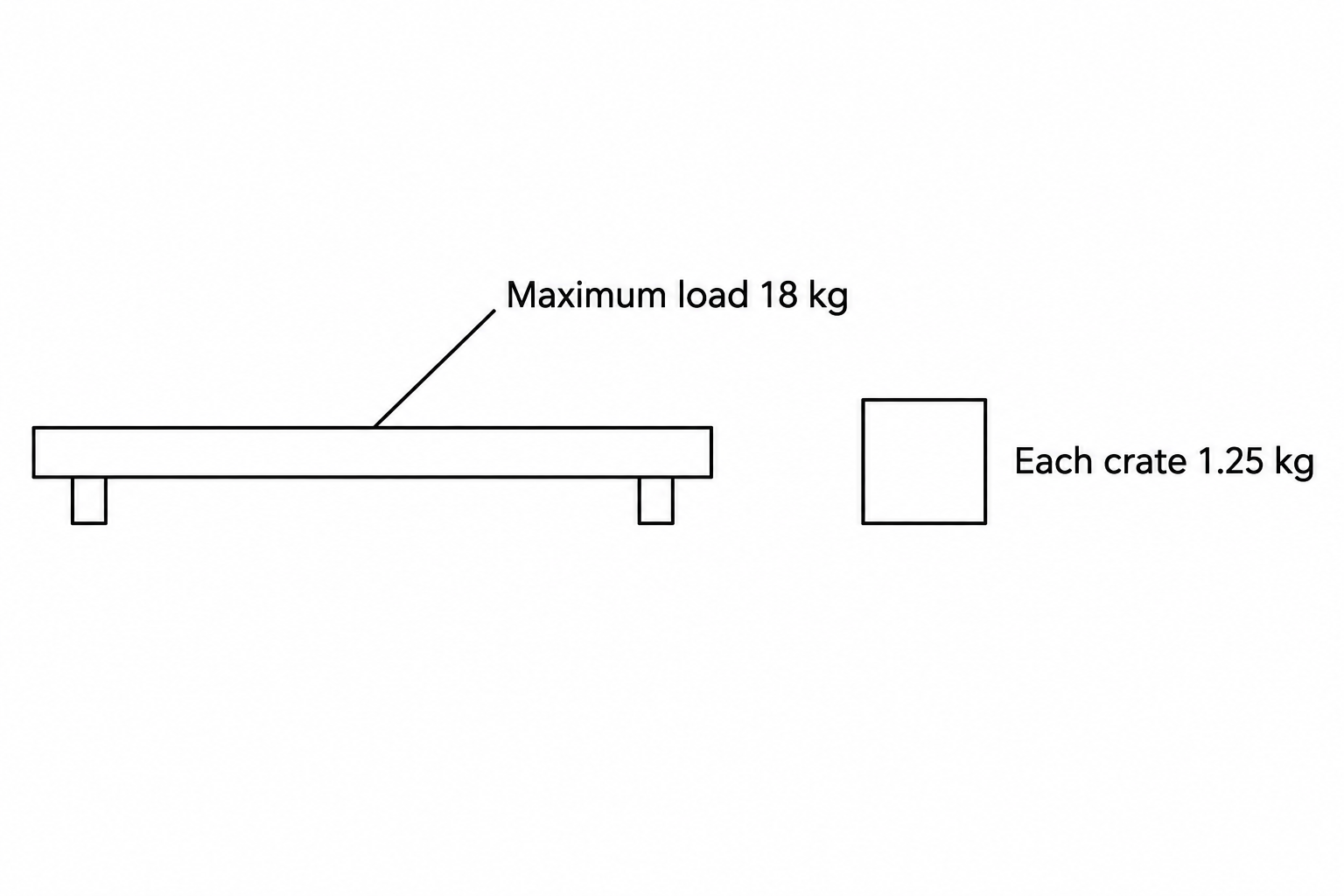
The diagram gives a loading platform's limit and the mass of each identical crate. Only crates are placed on the platform. What is the greatest number of whole crates that can be loaded without exceeding the limit?