

MATHEMATICS - FACTORS AND MULTIPLES
Least Common Multiple Worksheet
- Focuses on finding the least common multiple in various contexts
- Includes complex real-world scenarios involving time and scheduling
- Challenges students with problems involving divisibility and remainders
Start the 10-question quiz
Free, no sign-up needed. Your score shows instantly.
Here are the first 3 questions. Click “View all questions” to see the complete assessment.
Q1.
Q2.
Three warning signals sound every 28 min, 42 min, and 63 min. They sound together at 09:15. At what time will they next sound together?
Q3.
A positive integer n has a highest common factor of 9 with 36. Their lowest common multiple is 252. What is n?
Q4.
Identical rectangular tiles measuring 18 cm × 30 cm are used to cover the smallest possible square without cutting or overlapping any tile. How many tiles are needed?
Q5.
A positive integer greater than 500 leaves a remainder of 5 when divided by each of 12, 18, and 30. What is the least possible integer?
Q6.
Three maintenance checks are carried out every 16, 24, and 40 days. All three are carried out today. During the next 720 days, how many times will all three be carried out on the same day? Do not include today, but include the final day.
Q7.
What is the least four-digit integer that is divisible by both 45 and 56?
Q8.
A warehouse has equal numbers of three products. The products are packed separately into cartons holding 84, 126, and 210 items, respectively. No items are left over. If the equal number of each product is as small as possible, how many cartons are used altogether?
Q9.
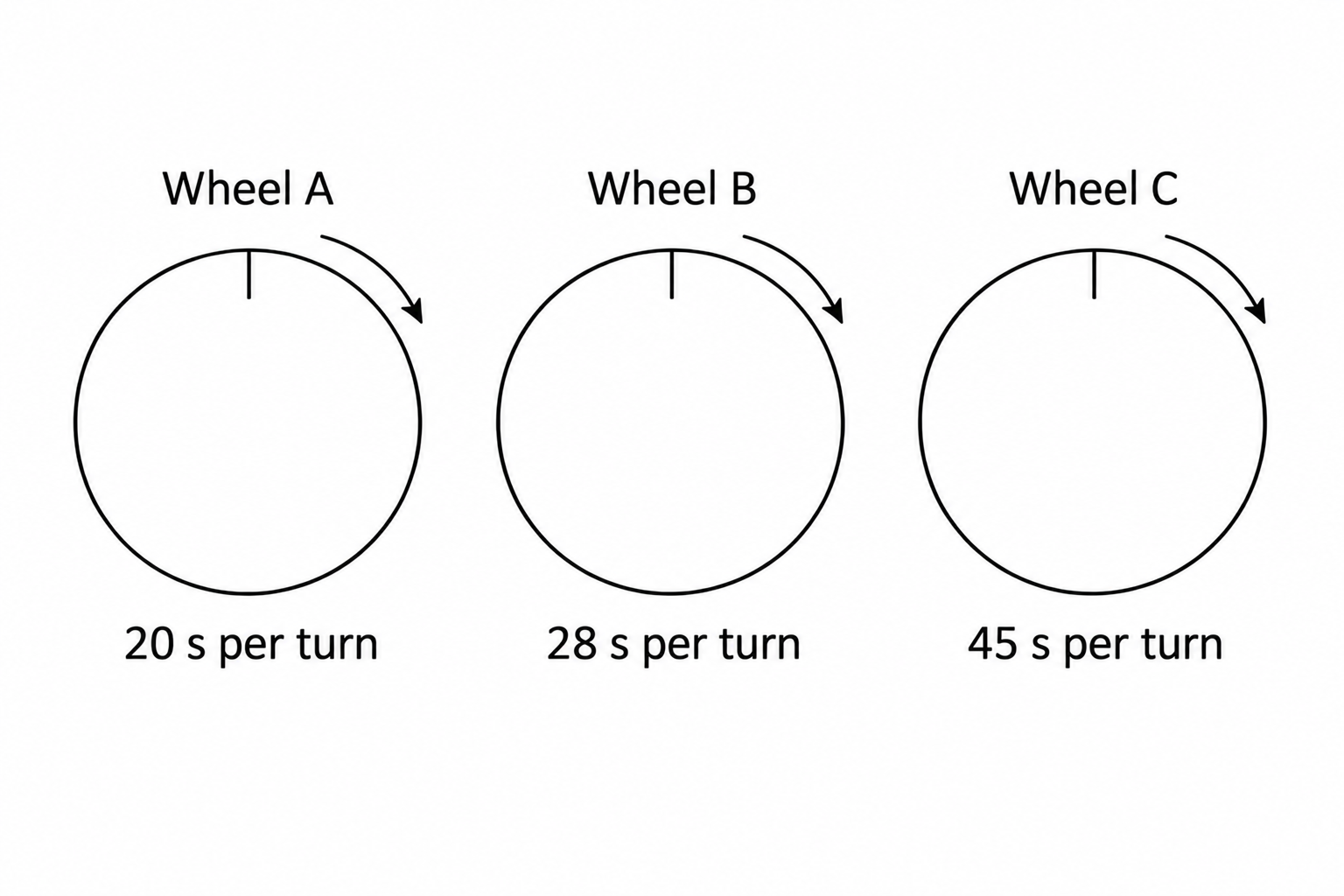
The diagram shows three marked wheels. All three marks start at the top, and each mark returns to the top after one complete turn. After how much time will all three marks first be at the top together again?
Q10.
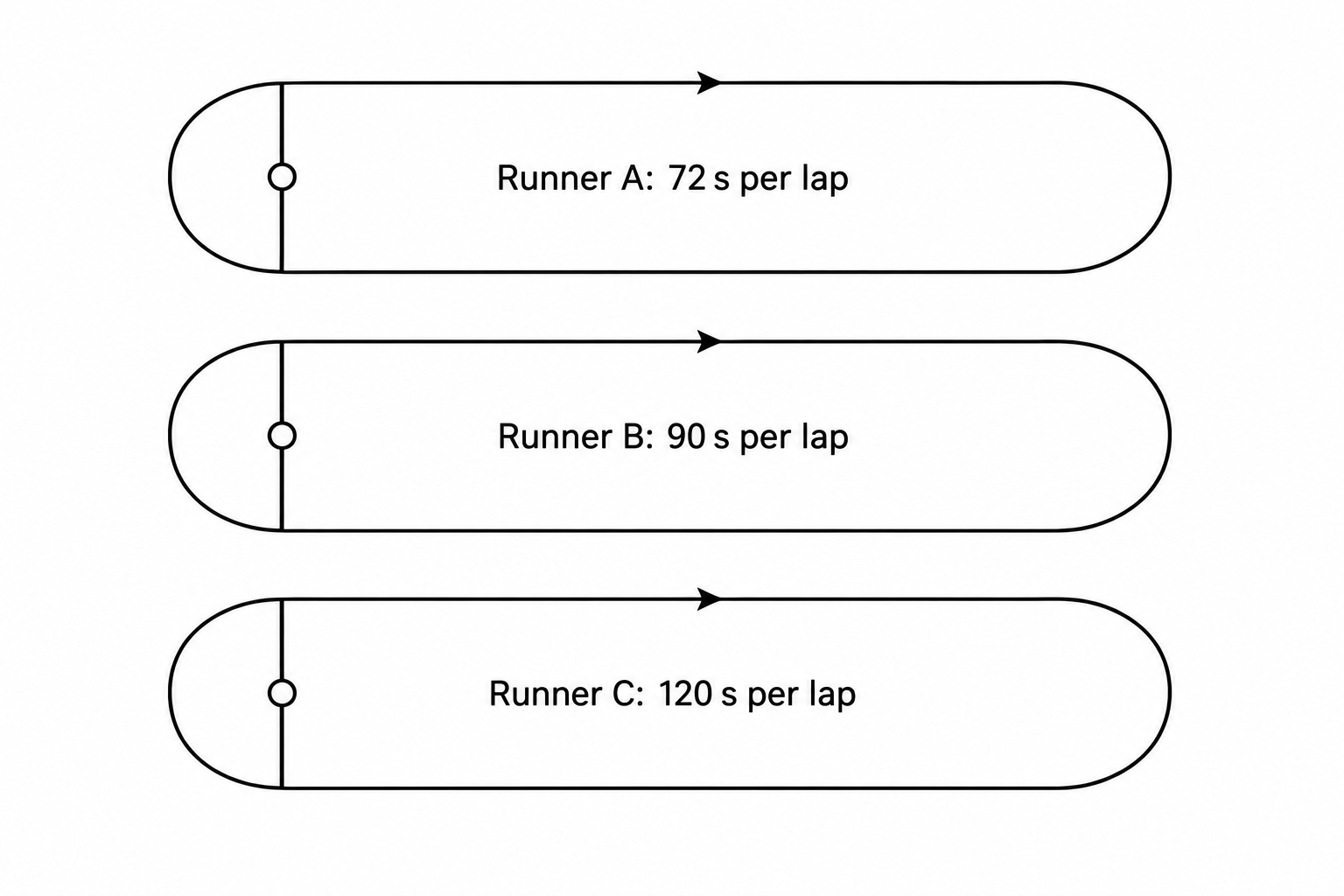
The diagram shows the lap times of three runners who start together at the same starting line. When they first return to the starting line together, how many laps have they completed altogether?
What this assessment covers
Concepts tested
- Least common multiple (LCM) calculations
- Divisibility rules and applications
- Understanding and applying highest common factors
- Problem-solving with time intervals
- Working with remainders in division
Question Mix
- Hard questions included
Skills you build
- Calculating least common multiples for multiple numbers
- Solving real-world problems using mathematical reasoning
- Applying divisibility rules to find solutions
- Analyzing and interpreting complex word problems
- Developing strategies for efficient problem-solving
Related assessments
More practice
Other assessments in this topic
