An observer sees a half-illuminated Moon at its highest point in the sky near sunset. Using a model in which the Moon moves steadily around Earth, what should the observer expect about one week later?
Options:
Showing question 1 of 10
Q2 QuestionPoints: 1
Choose the correct answer:
A science club records a full Moon on day 4 of a project. Its model uses a 29.5-day phase cycle, with approximately equal intervals between the four main phases. The club plans another observation on day 26. Which prediction should it use?
Options:
Showing question 2 of 10
Q3 QuestionPoints: 1
Choose the correct answer:
A student uses a lamp for the Sun, a large ball for Earth, and a small ball for the Moon. Viewed from the Earth ball, the small ball initially shows a waxing crescent. The student moves it halfway around Earth in the Moon's normal orbital direction, keeping it out of Earth's shadow. What should the model now show?
Options:
Showing question 3 of 10
Q4 QuestionPoints: 1
Choose the correct answer:
Two students, one in each hemisphere, photograph the Moon at nearly the same time. Both images show a crescent, but its bright side appears on opposite sides of their upright photographs. Their observations over the previous two evenings show that the illuminated fraction has been increasing. What should a Sun–Earth–Moon model predict for both students about five days later?
Options:
Showing question 4 of 10
Q5 QuestionPoints: 1
Choose the correct answer:
A class observes a solar eclipse and then uses a model with the Moon's orbit tilted relative to Earth's orbit around the Sun. The class advances the model by about 14 to 15 days. Which prediction follows from this model?
Options:
Showing question 5 of 10
Q6 QuestionPoints: 1
Choose the correct answer:
A planetarium model places a waning gibbous Moon at its highest point in the sky at about 3 a.m. The model advances the Moon by one-quarter of its phase cycle, about 7.4 days. Using the model's rule that this advance shifts the Moon's highest point about six hours later, which observation should result?
Options:
Showing question 6 of 10
Q7 QuestionPoints: 1
Choose the correct answer:
An astronaut stands near the center of the Moon's Earth-facing side. When observers on Earth see a full Moon, the Sun is nearly overhead at the astronaut's location. A model keeps the same lunar side facing Earth and advances through one-quarter of the phase cycle. Which pair of observations should the model predict?
Options:
Showing question 7 of 10
Q8 QuestionPoints: 1
Choose the correct answer:
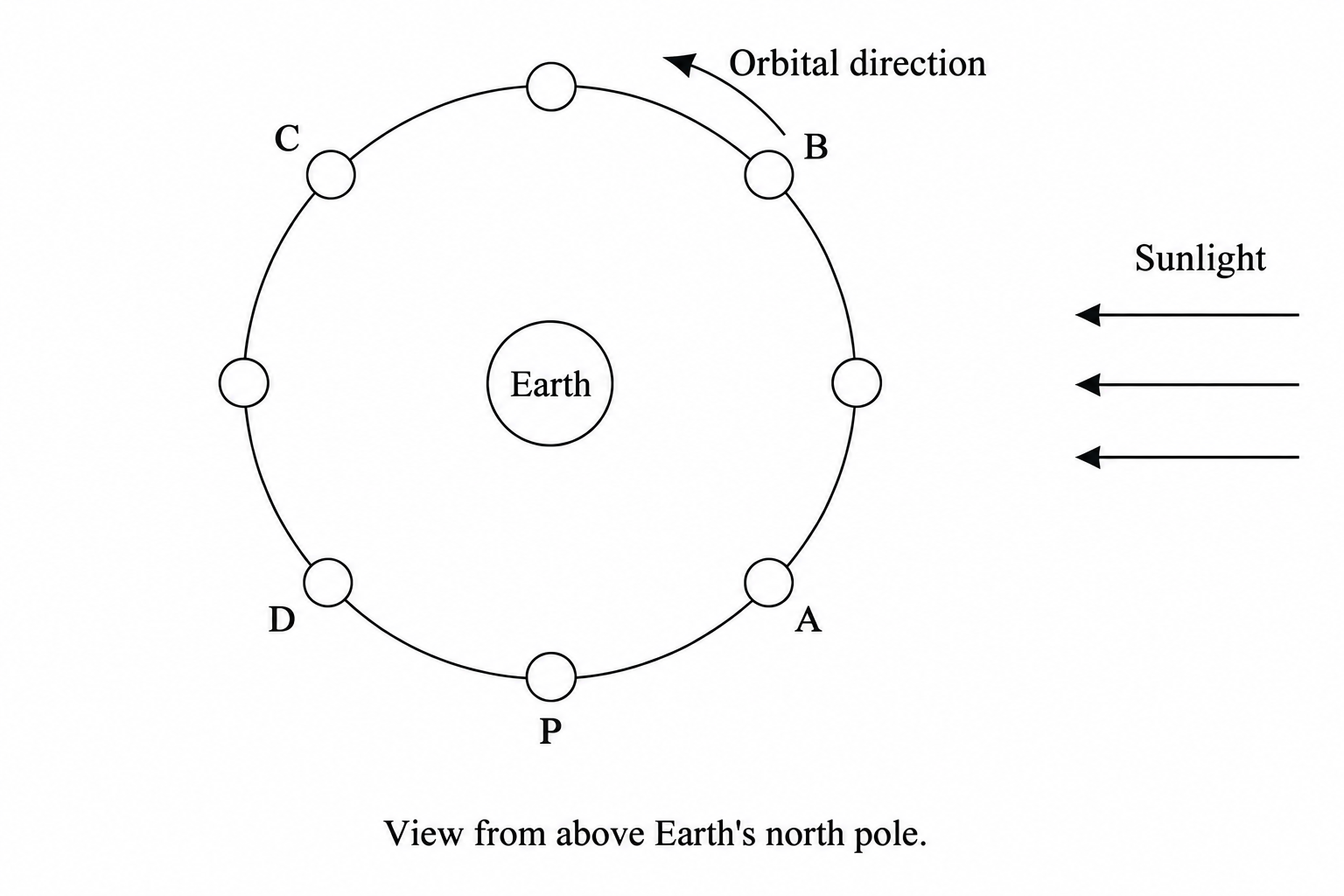
The diagram shows the Moon's orbit viewed from above Earth's north pole. Starting at P, the Moon travels counterclockwise through three-eighths of one orbit. Which labeled position does it reach, and what phase would an observer on Earth see there?
Options:
Showing question 8 of 10
Q9 QuestionPoints: 1
Choose the correct answer:
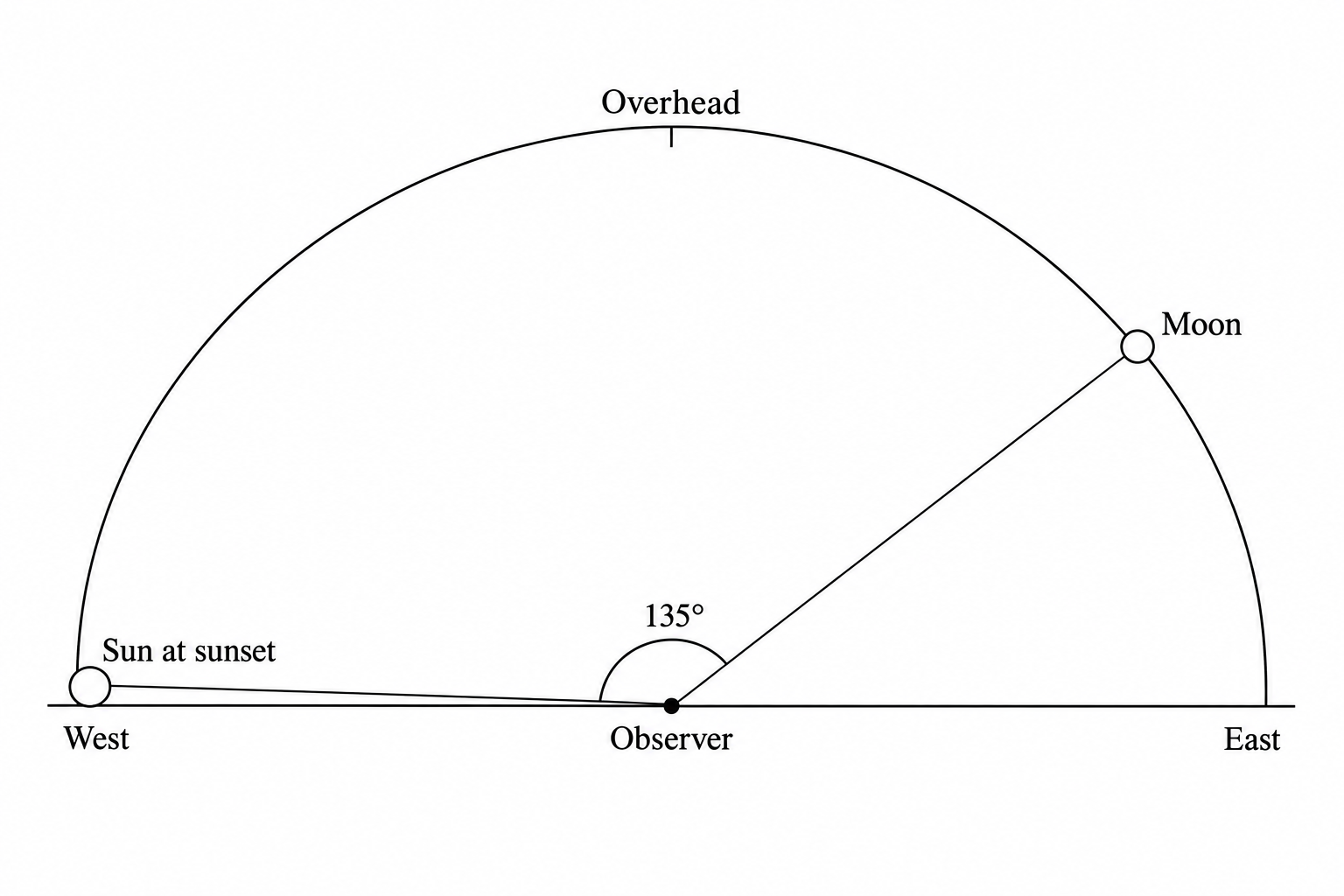
The sky diagram shows the Moon's position relative to the Sun at sunset. Use the 29.5-day phase cycle and the angle shown to predict the Moon's current phase and its approximate rising time about four days later.
Options:
Showing question 9 of 10
Q10 QuestionPoints: 1
Choose the correct answer:
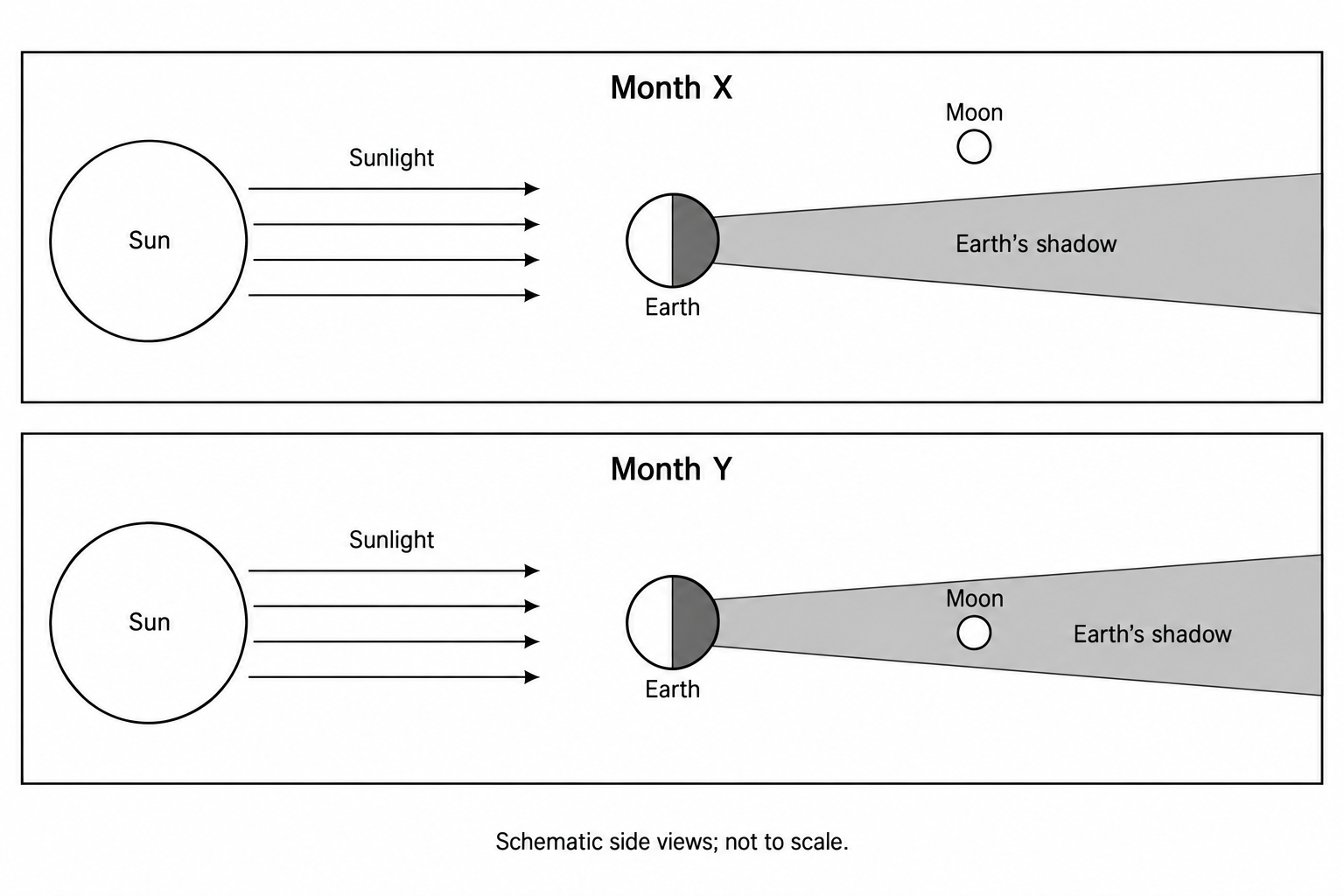
The two panels model the Moon at the same point in its phase cycle during different months. The Moon's tilted orbit places it above Earth's shadow in month X and inside that shadow in month Y. Which observing report agrees with both models?