At atmospheric pressure, a pure substance melts at −12 °C and boils at 54 °C. A sample is heated from −20 °C to 70 °C, then cooled to 20 °C. Which sequence includes all the changes of state that occur, in the correct order?
Options:
Showing question 1 of 10
Q2 QuestionPoints: 1
Choose the correct answer:
A sealed jar containing ice is wiped dry and placed on a balance in a warm room. Later, some ice has become liquid, droplets have appeared on the outside, and the balance reading has increased. No material has leaked through the jar or its lid. Which explanation accounts for both the changes of state and the increased reading?
Options:
Showing question 2 of 10
Q3 QuestionPoints: 1
Choose the correct answer:
A thermometer bulb is covered with wet cotton at room temperature. When dry air is blown over the cotton, the thermometer reading falls while the cotton dries. The water remains well below its boiling point. Which explanation accounts for both observations?
Options:
Showing question 3 of 10
Q4 QuestionPoints: 1
Choose the correct answer:
A pure solid is heated until some, but not all, of it has melted. Its temperature is constant while melting. The heater is then removed, and thermal energy is steadily taken away. Which change occurs first?
Options:
Showing question 4 of 10
Q5 QuestionPoints: 1
Choose the correct answer:
A colourless liquid is boiled, and the gas produced is collected. The gas is then cooled until it becomes liquid again. No chemical reaction occurs. Which statement correctly compares the particles during these two changes?
Options:
Showing question 5 of 10
Q6 QuestionPoints: 1
Choose the correct answer:
A student compares the evaporation of equal masses of water using identical shallow dishes at the same temperature. Which pair of experiments should the student compare to test only the effect of air movement, with faster evaporation expected in the second experiment?
Options:
Showing question 6 of 10
Q7 QuestionPoints: 1
Choose the correct answer:
At atmospheric pressure, pure liquid U boils at 40 °C and pure liquid V boils at 80 °C. Separate open containers of the liquids, initially at 20 °C, are placed in a large water bath maintained at 60 °C. After sufficient heating, but while liquid remains in both containers, which observation is expected?
Options:
Showing question 7 of 10
Q8 QuestionPoints: 1
Choose the correct answer:
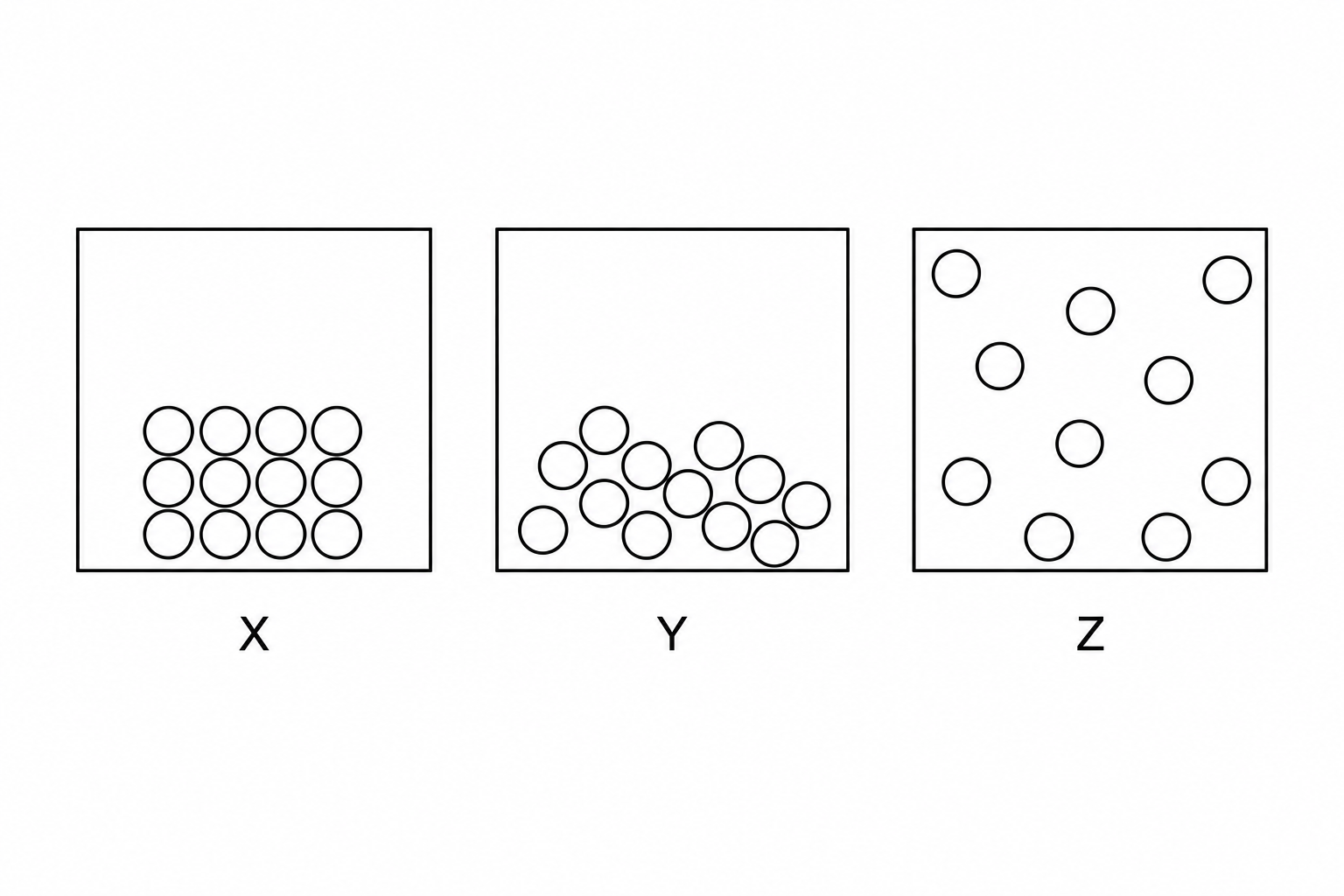
The diagrams represent the same pure substance in three states. A sample starts in state Y. It is cooled until it reaches state X, then heated until it reaches state Z. At constant atmospheric pressure, which sequence of changes does it undergo?
Options:
Showing question 8 of 10
Q9 QuestionPoints: 1
Choose the correct answer:
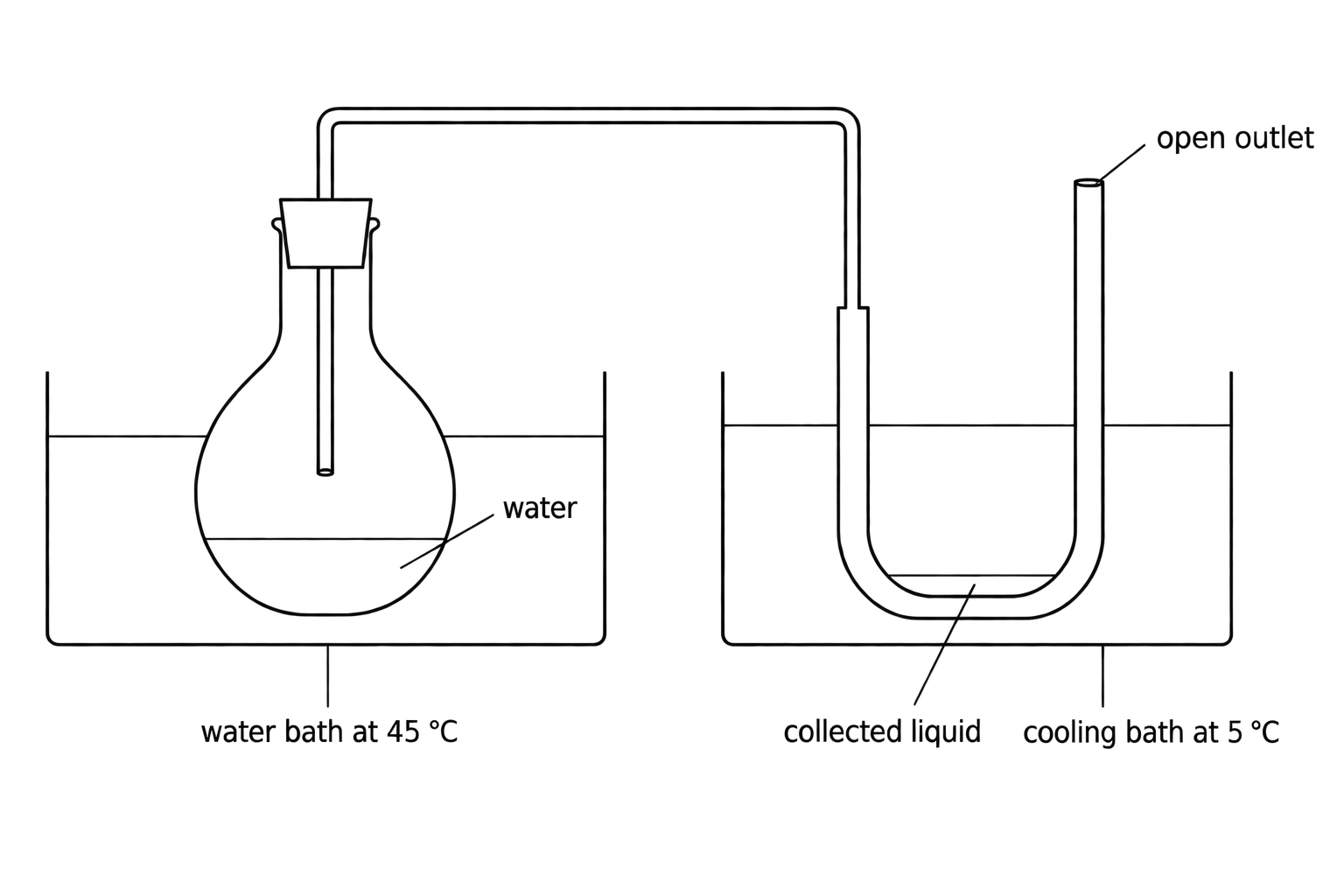
The apparatus is open to the atmosphere through the outlet. Water in the flask is maintained at 45 °C, and colourless liquid collects in the cooled tube. Water boils at 100 °C under these conditions. Which explanation accounts for the collected liquid?
Options:
Showing question 9 of 10
Q10 QuestionPoints: 1
Choose the correct answer:
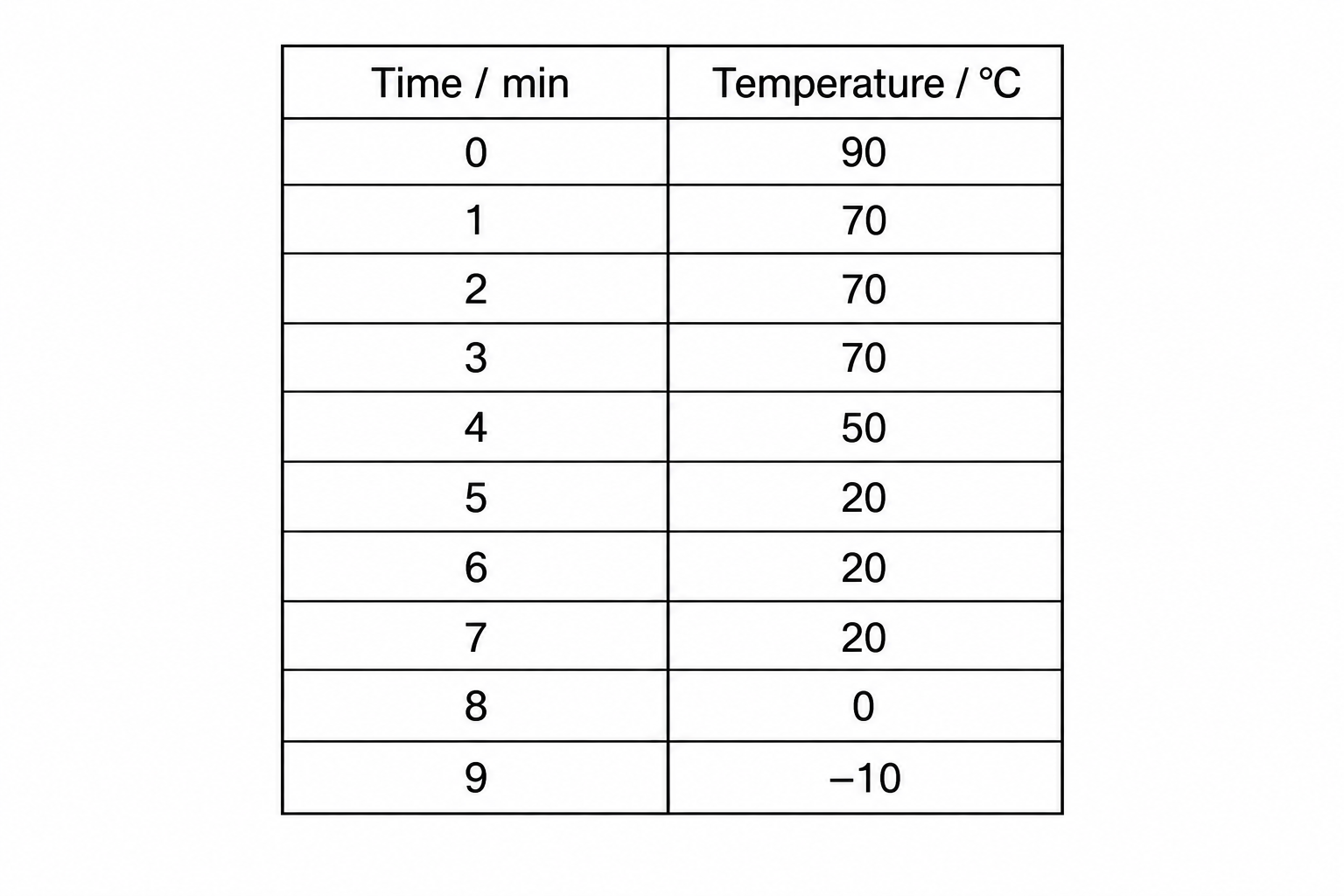
The table shows the temperature of an initially gaseous pure substance as thermal energy is removed steadily at constant pressure. Each constant-temperature interval represents a change of state. Which pair of statements correctly describes the sample at 2 min and at 6 min?