In SOCl₂, sulfur is the central atom and is joined to oxygen by a double bond and to each chlorine atom by a single bond. Sulfur has six outer-shell electrons. Which description correctly applies the electron-pair repulsion model to the sulfur atom?
Options:
Showing question 1 of 10
Q2 QuestionPoints: 1
Choose the correct answer:
The ions NO₂⁺ and NO₂⁻ both contain a central nitrogen atom bonded to two oxygen atoms. Apply electron counting and electron-pair repulsion theory. Which statement correctly describes their shapes and the lone pairs on their central atoms?
Options:
Showing question 2 of 10
Q3 QuestionPoints: 1
Choose the correct answer:
Consider the isolated species NH₄⁺, NH₃ and NH₂⁻. Using the relative repulsions between bonding pairs and lone pairs, which order of H–N–H bond angle is predicted?
Options:
Showing question 3 of 10
Q4 QuestionPoints: 1
Choose the correct answer:
Under suitable conditions, phosphorus pentachloride forms an ionic solid containing PCl₄⁺ and PCl₆⁻. Phosphorus has five outer-shell electrons, and all P–Cl bonds in these ions are single bonds. Which pair of molecular shapes is predicted?
Options:
Showing question 4 of 10
Q5 QuestionPoints: 1
Choose the correct answer:
An isolated SF₆ molecule has six S–F single bonds and no lone pairs on sulfur. Each different pair of fluorine atoms defines one F–S–F angle. Among all fifteen such pairs, how many angles are 90° and how many are 180°?
Options:
Showing question 5 of 10
Q6 QuestionPoints: 1
Choose the correct answer:
In COCl₂, carbon forms a double bond to oxygen and single bonds to two chlorine atoms. Assume that the double-bond region repels the other bonding regions more strongly than either single-bond region does. Which prediction follows?
Options:
Showing question 6 of 10
Q7 QuestionPoints: 1
Choose the correct answer:
Bromine has seven outer-shell electrons. In BrF₃, it forms three single bonds and retains two lone pairs. The five electron-pair regions occupy a trigonal bipyramidal arrangement. An axial position has three neighbouring positions at 90°, whereas an equatorial position has two. Which placement and molecular shape are predicted when strong lone-pair repulsions are minimised?
Options:
Showing question 7 of 10
Q8 QuestionPoints: 1
Choose the correct answer:
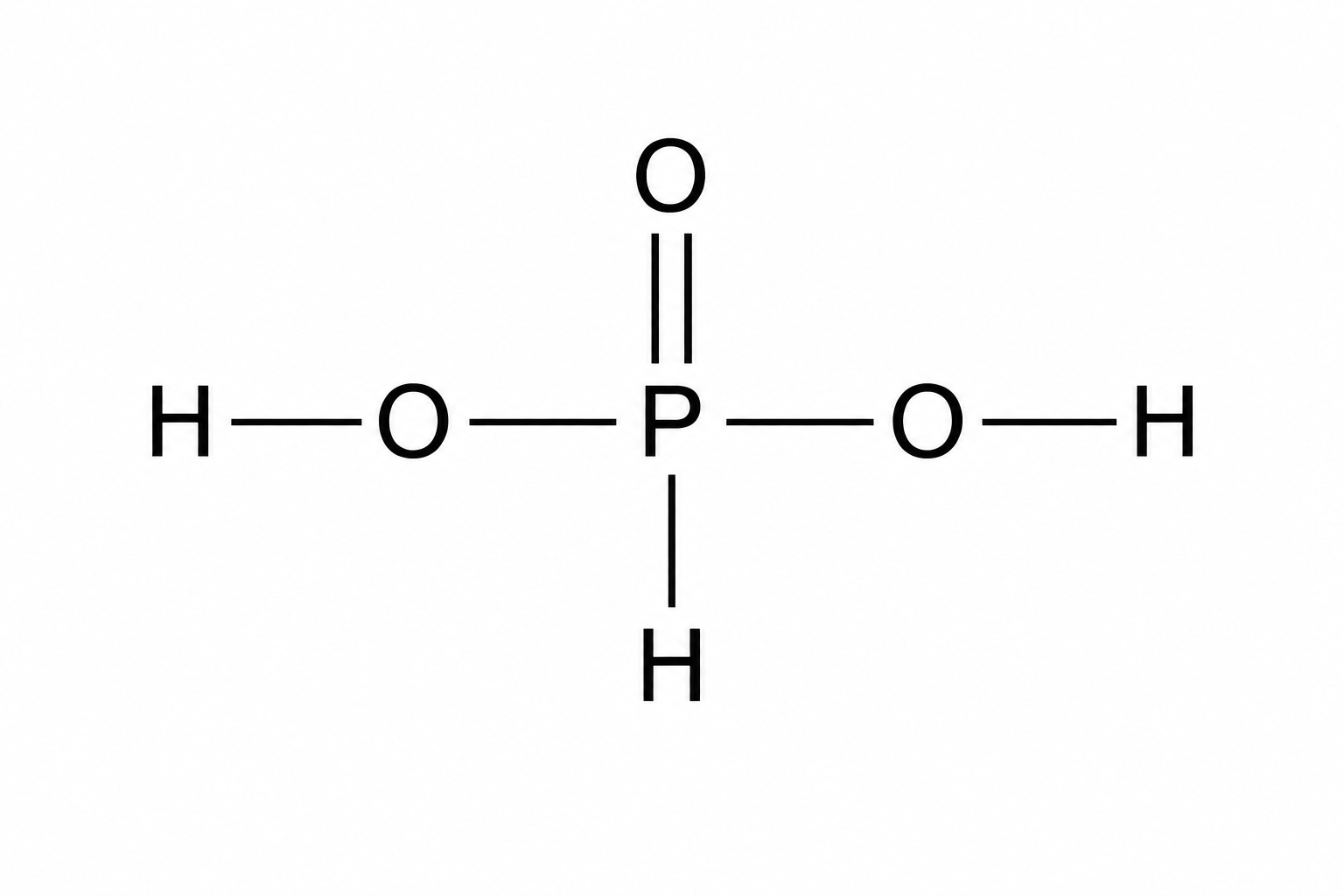
The diagram shows the bonding in a molecule of H₃PO₃. Lone pairs are not drawn. Using this structure, which combination gives the molecular shape about phosphorus and the total number of lone pairs on all the oxygen atoms?
Options:
Showing question 8 of 10
Q9 QuestionPoints: 1
Choose the correct answer:
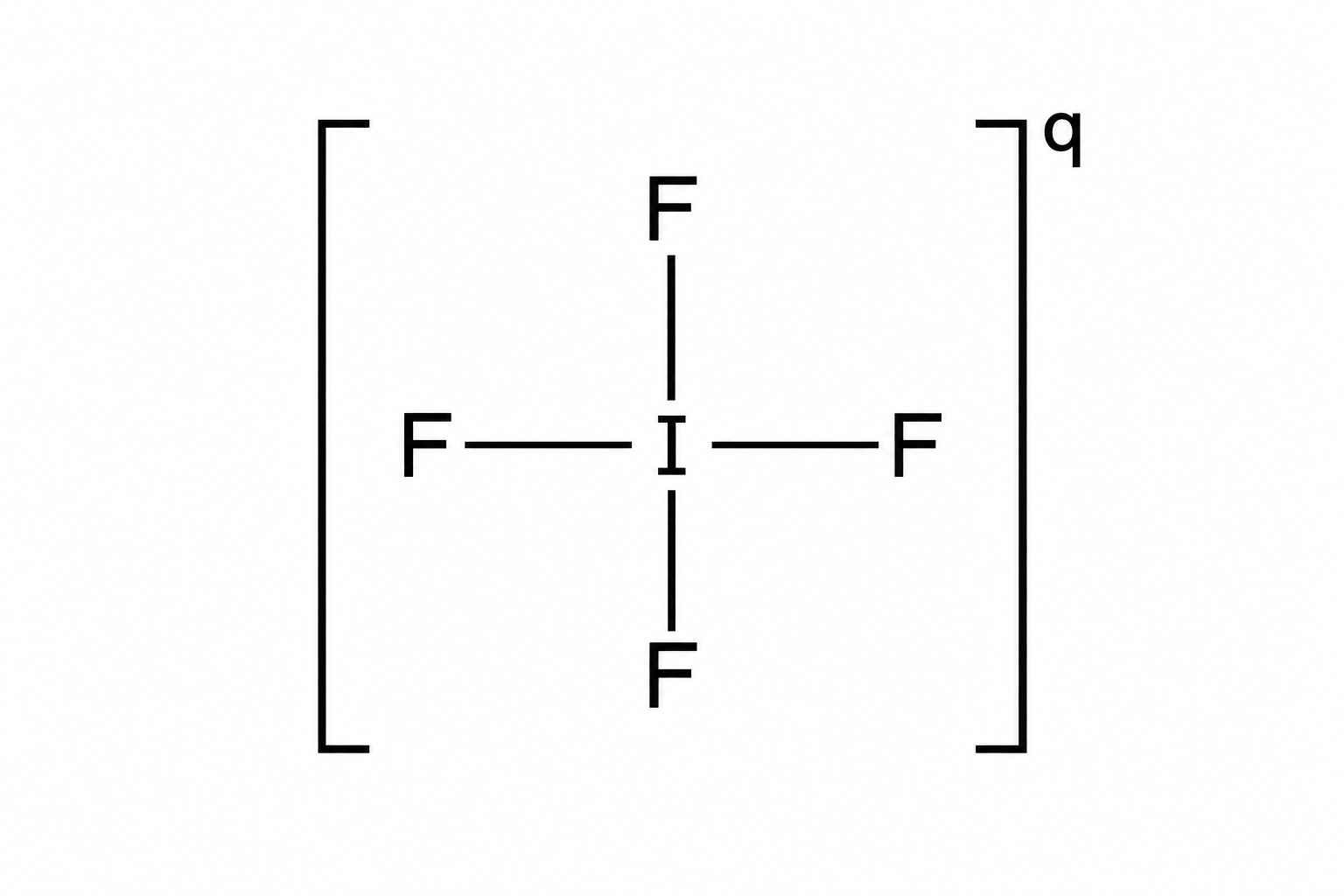
The diagram shows an ion containing iodine and four fluorine atoms. All five nuclei lie in one plane, and adjacent F–I–F angles are 90°. The ion has only I–F single bonds, and every fluorine has three lone pairs. Iodine has seven outer-shell electrons. Using electron-pair repulsion theory, what is the charge q on the ion?
Options:
Showing question 9 of 10
Q10 QuestionPoints: 1
Choose the correct answer:
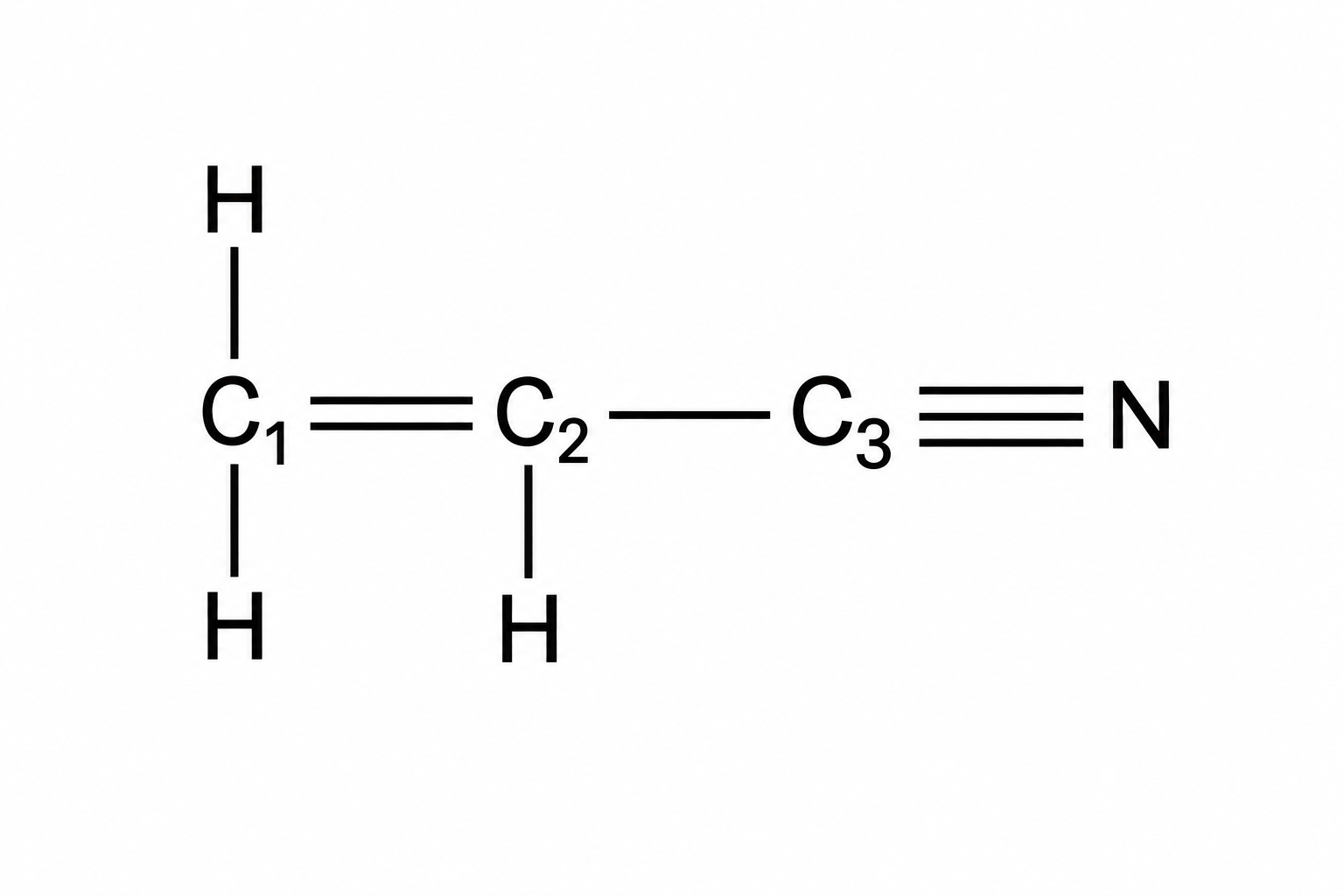
The displayed formula contains carbon atoms labelled C₁, C₂ and C₃. For C₂ and C₃, distinguish the number of shared electron pairs from the number of electron-pair repulsion regions. Which statement correctly gives both these counts and the approximate C₁–C₂–C₃ and C₂–C₃–N bond angles?