Choose the correct answer:
An ion has a charge of 2+ and an electronic configuration of 2,8,8. Which option gives the proton number and electronic configuration of the neutral atom from which this ion formed?
Choose the correct answer:
An ion has a charge of 2+ and an electronic configuration of 2,8,8. Which option gives the proton number and electronic configuration of the neutral atom from which this ion formed?
Choose the correct answer:
An atom has a nucleon number of 27 and contains 14 neutrons. It forms an ion by losing three electrons. Which option gives the electronic configurations of the atom and its ion?
Choose the correct answer:
The ions X⁺ and Y²⁻ both have the electronic configuration 2,8,8. Which option gives the electronic configurations of neutral atoms X and Y?
Choose the correct answer:
An ion has a charge of 2− and contains eight neutrons. The total number of protons, neutrons and electrons in the ion is 26. What is the electronic configuration of the corresponding neutral atom?
Choose the correct answer:
A student records the proton number, charge and electronic configuration of four different species. Which complete record is correct?
Choose the correct answer:
A neutral atom has three occupied electron shells. Its first shell is full, its second shell contains four times as many electrons as its first shell, and its third shell contains half as many electrons as its second shell. Another neutral atom has the same proton number but two additional neutrons. What is the electronic configuration of this second atom?
Choose the correct answer:
Three ions are formed from atoms with proton numbers 4, 13 and 15. Their charges are 2+, 3+ and 3− respectively. Which option lists their electronic configurations in order of increasing number of occupied electron shells?
Choose the correct answer:
Which pair of species has identical electronic configurations but different proton numbers? Each species is described by its proton number, nucleon number and charge; a charge of zero means a neutral atom.
Choose the correct answer:
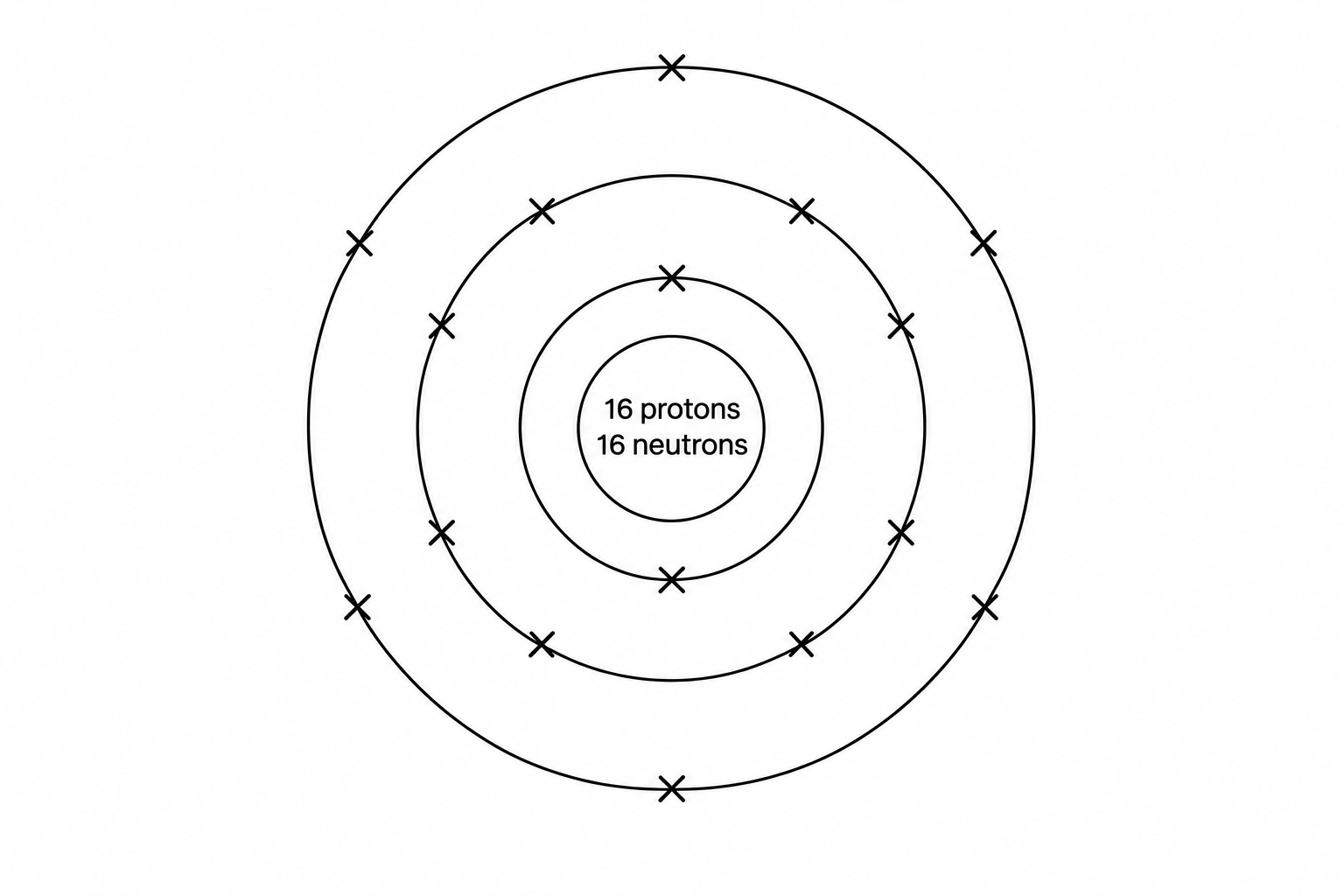
The diagram represents a neutral atom. It gains enough electrons to fill its outer occupied shell without starting another shell. Which option gives the resulting ion's charge and electronic configuration?
Choose the correct answer:
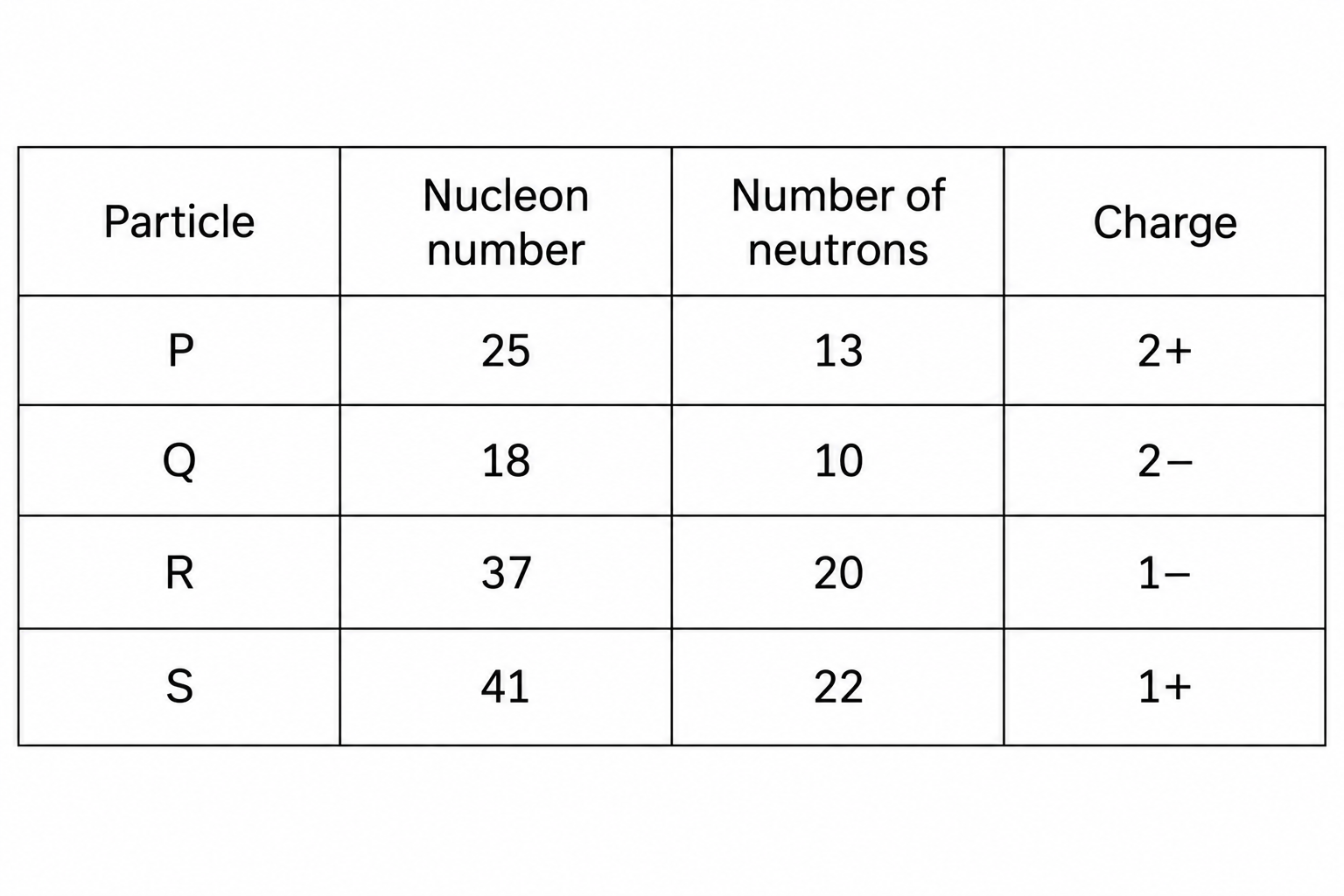
The table describes four particles. Which option gives the electronic configurations of P, Q, R and S in that order?