Designing student assessments shouldn’t feel monotonous, yet many tutors struggle to keep them fresh and impactful. Given that 38% of students say they’re often bored in class, there’s a need to move away from conventional exams and quizzes that test simple memorization or rote learning to make assessments more engaging and participative.
We will explore five practical strategies to transform assessments from routine tasks into meaningful and interactive learning experiences. Whether you want to spark curiosity or close knowledge gaps, these approaches help educators and teachers create assessments that engage students and drive better outcomes. Here’s the cherry on top – these techniques make evaluation less of a chore.
Why Assessment Creation Requires Innovation
Assessments are more than checkpoints; they shape how students learn and how tutors teach. In today’s hybrid and remote classrooms, relying on repetitive quiz formats often fails to capture true understanding. For example, multiple‑choice drills may test recall but rarely gauge whether students can apply concepts or solve problems.
Educators and institutions are turning to innovative approaches that make assessments interactive and adaptive. A good example is adaptive quizzes where software picks the next question based on past success. Playful formats, scenario‑based questions, game-based testing, and problem‑solving tasks help students connect theory to practice, while digital tools speed up grading and provide deeper insights.
Variety is one of the benefits of using Innovation in assessment creation. However, that’s not all. Innovation also creates experiences that build skills and reveal knowledge gaps, while keeping learners motivated. Now let’s look at the 5 ways to make student assessments more engaging:
1. Scenario-Based Assessments
Tutors can work on developing the reasoning capabilities of their students with the help of scenario-based assessments. These assessments encourage students to think critically, reason independently, and apply problem-solving skills to real-life situations. The best examples of scenario-based assessments are problem sums that improve the cognitive agility of learners. Here are some benefits of scenario-based student assessments:
- A safe practice environment
- Higher engagement
- Improved knowledge retention
- Strong decision-making skills
2. Formative Assessments
Formative student assessments are ongoing, low-stakes evaluations teachers use during the learning process, as opposed to the end, to monitor student understanding and identify learning gaps. Formative assessment, like short quizzes, happens during learning to track progress and guide instruction with ongoing feedback. As a tutor, you can monitor each student’s progress and figure out the areas of improvement individually through this assessment type.
Formative assessments offer the following benefits:
- Teachers can identify student mistakes early rather than waiting for a final test.
- They can change future lessons or re-teach topics or ideas based on real data.
- The low-stakes nature of these assessments means students can focus on growth rather than getting perturbed by high-pressure grading
3. Gamified Assessments
Today’s learners are digital natives and have a penchant for interactive games and leaderboards. It’s no surprise they thrive on challenges and rewards. What’s great about gamified assessments is that they bring that same energy into the classroom. An apt way to tap into students’ inherent love for games while considerably boosting learning outcomes Research reveals that gamification can increase knowledge retention by up to 90% and boost test scores by 34%.
If you’re looking to turn evaluation into an engaging experience, gamified assessments are the way to go. When students earn points and receive instant feedback, they are more involved. Research confirms the impact: gamification in e‑learning increases knowledge retention by 90% and raises course completion rates by 62% in STEM subjects. Let’s look at some of the benefits of gamified assessments.
- Students are more likely to participate actively when learning feels like play and there’s a competitive element to it. Leaderboards, badges, and rewards drive healthy competition and sustained interest.
- Game‑like environments lower the stress of traditional exams and can even contribute to a feeling of confidence
- By framing mistakes as part of the game, you can help students learn and build resilience. There’s a mind shift, and they see setbacks as opportunities to try again, rather than failures.
Imagine a math class where problem sums are presented as “levels” in a game. Each correct step earns points, and completing a set unlocks the next challenge. Students not only solve equations but also experience the satisfaction of progression — reinforcing both critical thinking and long‑term retention.
4. Multimedia Assessments
Change has been a constant in the art of teaching. Over the decades, educators and tutors have continuously experimented with teaching, adopting novel tools, methods, approaches, and technologies in order to improve it. All along, tutors have tweaked how information is disseminated. As learning is now increasingly visual and interactive, educators have to appreciate that students absorb information through text as well as videos, images, audio, and simulations.
Multi‑media quizzes make the most of these elements to create richer and more immersive learning experiences that go beyond traditional tests. You can embed short videos, diagrams, or audio clips into assessments to create multi‑sensory learning experiences and improve retention. For instance, a biology quiz may include a labeled diagram of the human heart, asking students to identify functions. Here are some ways multimedia assessments benefit teachers and students alike.
- Videos and images simulate real scenarios, e.g., a safety training quiz with workplace footage, making learning more practical and applicable.
- Multimodal evaluations support visual and auditory learners. You can also use them to make sure no kinesthetic learners are left behind.
- Just recalling facts shouldn’t be the aim of a quiz. Interactive elements in multimedia tests challenge students to analyze and interpret knowledge. Applying knowledge rather than just memorizing and regurgitating facts helps students connect theory to practice.
- Multimedia keeps assessments dynamic. A history quiz in which students watch a 2‑minute clip of a historical speech and then answer questions about its context and impact is more interesting and engaging than, say, static multiple‑choice questions.
5. Summative Assessments
Tutors conduct these assessments at the end of a learning session. A tutor can analyze the performance of all learners with the help of summative assessments. These assessments may become stressful or overburdening for students if designed poorly. Tutors can make summative assessments more engaging by having learners solve puzzles and challenges tied to subject matter. Escape room assessments and infographics are some other ways to spice up boring tests. Here are some reasons summative assessments are so crucial for learner evaluation.
- They provide a snapshot of what students have mastered at the end of a term or course. This helps educators and institutions evaluate whether learning objectives were met.
- High‑stakes assessments are motivating as they encourage learners to consolidate knowledge and put in effort.
- Summative assessments offer measurable evidence for schools and parents to help ensure transparency in student progress and institutional performance.
- Ideal for determining readiness for promotion to the next grade or level, and informing decisions about subject choices or placements.
The Role of Engagement in Deeper Learning
Student engagement not only improves the attention and well-being of students. It also expands a learner’s intellect, which leads to academic success in the future. Do you want your students to participate, interact, and stay motivated at all times? Then it’s time to work on refining the student engagement of your class with the help of engaging student assessments or rewarding class activities where all members can participate.
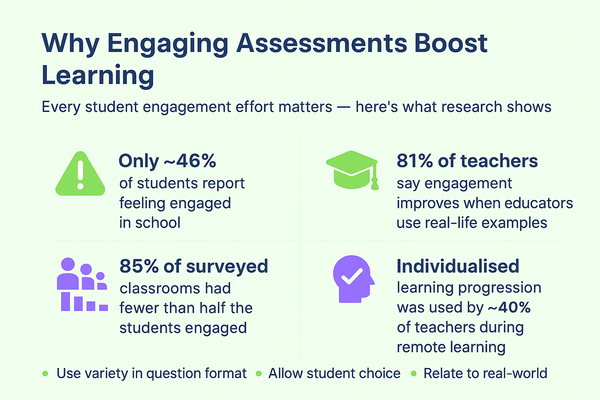
As an instructor, you can also draw inspiration from the aforementioned assessment types and design student assessments of your own that can leave a positive mark on your students.
Final Thoughts
Assessments shape how students learn and how educators teach. Regularly refining them strengthens your curriculum and makes courses more impactful and engaging. As education moves deeper into an era of innovation, it’s essential to rethink how we evaluate learners. Fresh strategies like gamified quizzes and multimedia transform assessments into tools for growth without the added stress.
With smart platforms like Assessified, institutions can design engaging, interactive assessments that build reasoning and critical thinking skills. Adopting these approaches is how educators can ease the burden of testing and also prepare students for the unique challenges of tomorrow.